A domain-neutral D&D 5e (2024) rules & character-sheet computation engine — formulas as data, not code.



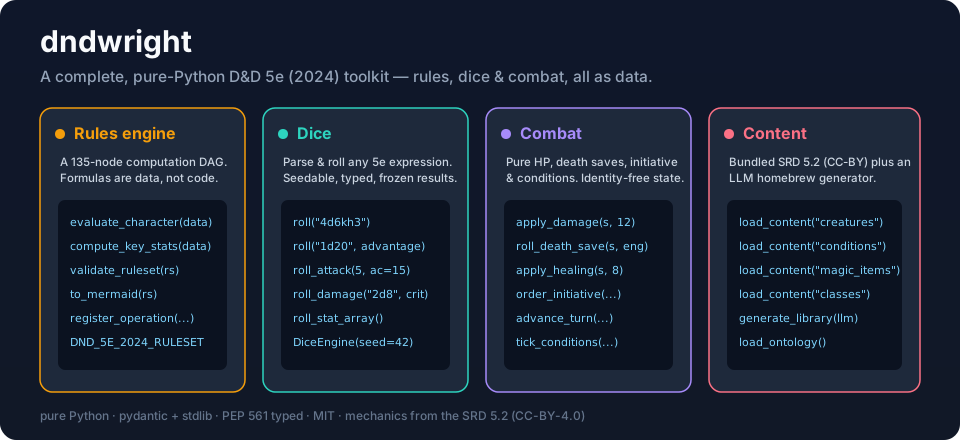
A character sheet is modelled as a directed acyclic computation graph — nodes are values,
edges are dependencies, and formulas are data (a JSON-serialisable DSL), not code. Pure
Python (pydantic + stdlib), no application or framework coupling: map your own character
data in, read computed stats out.
⚠️ Early development (alpha). The API is still moving and may change between minor versions while at0.x. Usable today — pin a version if you depend on it.
pip install git+https://github.com/sligara7/dndwright.git
# or, for local development:
pip install -e ".[dev]"from dndwright import evaluate_character
sheet = evaluate_character({
"ability_scores": {"strength": 8, "dexterity": 14, "constitution": 14,
"intelligence": 18, "wisdom": 12, "charisma": 10},
"class_data": {"class_name": "wizard"},
"species_data": {"name": "Human", "speed": 30},
"level": 5,
})
sheet["proficiency_bonus"] # 3
sheet["ability_modifiers"] # {"intelligence": 4, "dexterity": 2, ...}
sheet["spellcasting_type"] # "full_caster"
# ...plus armor_class, hit_points, hit_dice, initiative, saves, features, ...Lower level — assemble typed inputs and evaluate against the ruleset:
from dndwright import DND_5E_2024_RULESET, assemble_character_inputs, evaluate, apply_modifiers
from dndwright.rules.components import ClassMechanics

inputs   = assemble_character_inputs(class_mechanics=..., ability_scores={...}, level=5)
computed = apply_modifiers(evaluate(DND_5E_2024_RULESET, inputs), inputs)Installing the package also installs a dndwright command (no Python required):
dndwright eval character.json          # character JSON → computed sheet (or '-' for stdin)
dndwright graph --format mermaid        # export the computation DAG (mermaid|dot)
dndwright content magic_items           # dump bundled content (omit category to list)
dndwright validate ruleset.json         # check a ruleset (built-in if omitted)
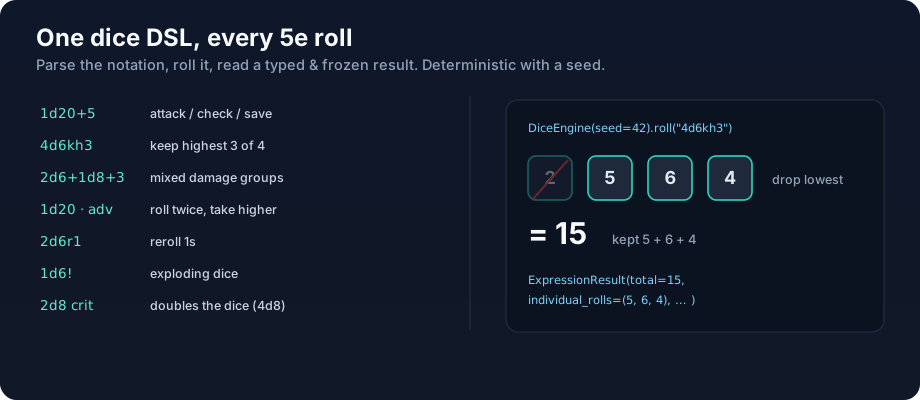
A self-contained, typed dice engine (dndwright.dice) — deterministic by default:
from dndwright.dice import DiceEngine

eng = DiceEngine(seed=42)               # reproducible (stdlib RNG)
eng.roll("4d6kh3").total                # keep highest 3 of 4
eng.roll("1d20", advantage=True)        # -> ExpressionResult
eng.roll_attack(modifier=5, target_ac=15).is_hit
eng.roll_damage("2d8", is_critical=True)  # crit doubles the dice

# unpredictable production rolls (no NumPy dependency):
import secrets
DiceEngine(rng=secrets.SystemRandom())
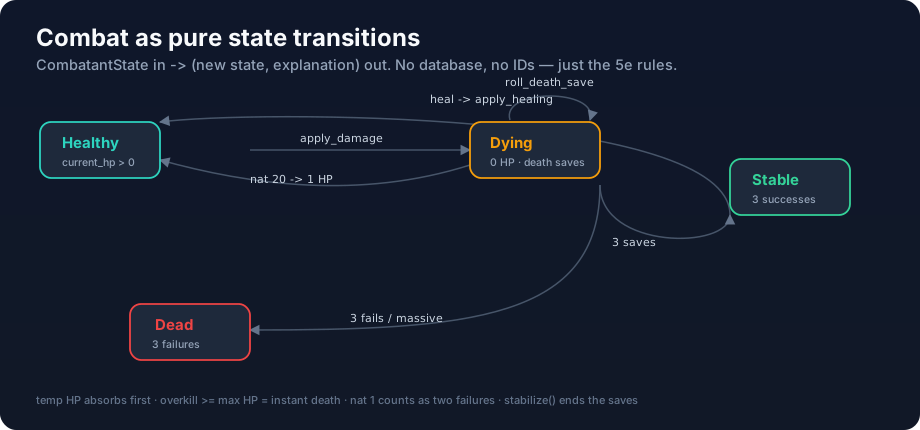
Pure, persistence-free 5e combat (dndwright.combat) — state is a frozen value object,
every op is (state, input) → (new_state, explanation):
from dndwright.combat import CombatantState, apply_damage, roll_death_save
from dndwright.dice import DiceEngine

s = CombatantState(current_hp=8, max_hp=20, temp_hp=3)
s, applied = apply_damage(s, 10)            # temp HP absorbs first, overkill tracked
s, save = roll_death_save(s, DiceEngine(seed=1))   # nat 20 → 1 HP; 3 fails → dead
s.is_stable, s.is_dead, s.hp_percentage
Your app owns persistence: load a row → call these → write the new state back. The rules never see a database.
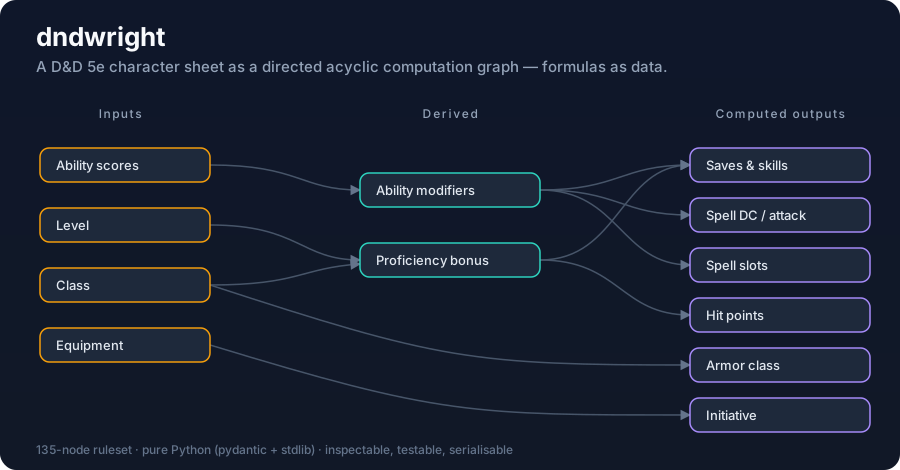
Derived character values form a dependency DAG: ability scores → modifiers → proficiency →
save DCs / spell slots / AC / HP. dndwright represents that DAG explicitly and stores the
formulas as data (FormulaSpec: an op + args), so the rules are inspectable, testable,
and serialisable — not buried in imperative code. DND_5E_2024_RULESET is a 138-node graph (incl. damage-defence channels).
Items, feats and species traits are themselves tiny graphs. compose() merges a
Component's nodes and contributions onto a base ruleset and returns a new, larger
Ruleset — the base is never mutated. Because each contribution keeps its target node's
id, every existing edge downstream re-derives for free: a set/add/union on one
node ripples out to every modifier, save, skill and attack that depends on it.
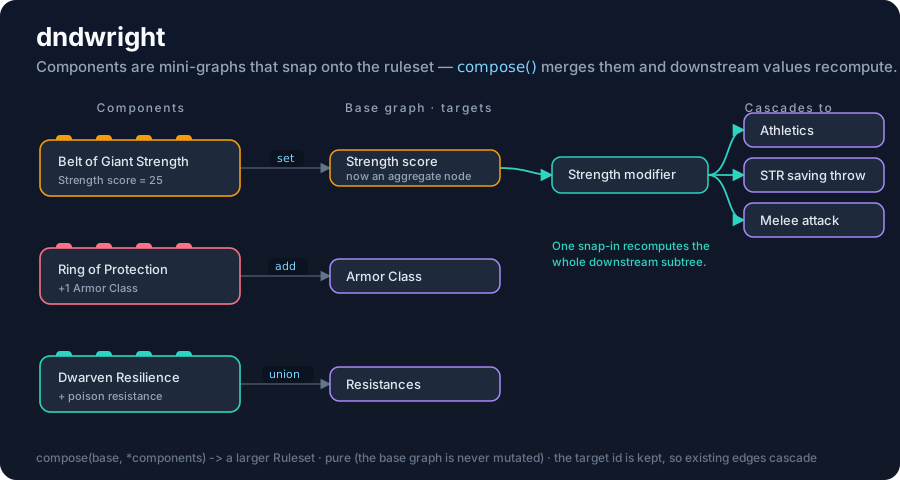
from dndwright import DND_5E_2024_RULESET, compose, modifier
ring = modifier("ring_of_protection", target="armor_class", amount=1)
rs = compose(DND_5E_2024_RULESET, ring) # base untouched; AC now aggregates the +1The same engine runs sci-fi, modern-warfare, steampunk or cosmic-horror. A ThemeScalingLayer
folds three kinds of override onto a ruleset via apply_theme_scaling() (pure, like compose):
input_overrides re-baseline a node's default value, lookup_overrides deep-merge into the
lookup tables (so plate armour can read AC 19 instead of 18), and flavor_renames relabel
terms for display without ever changing a computed value. The graph's shape never changes —
only its numbers and names.
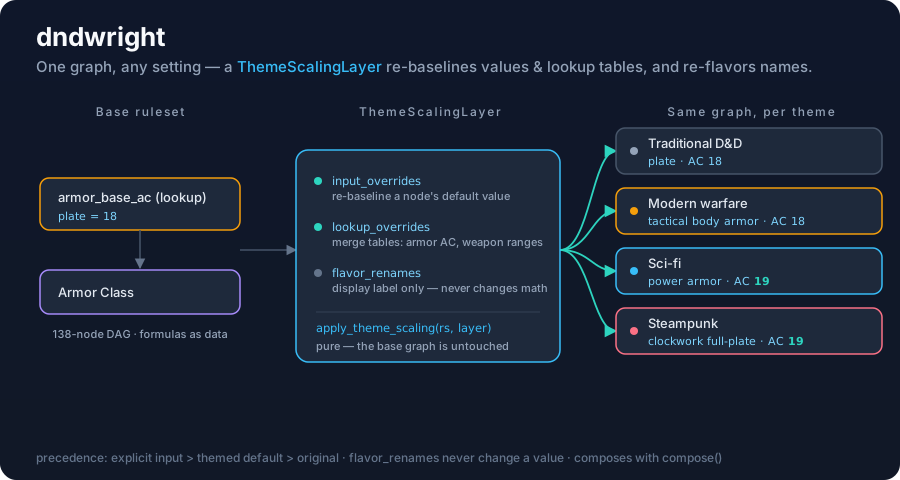
from dndwright import DND_5E_2024_RULESET, apply_theme_scaling, get_theme_scaling
rs = apply_theme_scaling(DND_5E_2024_RULESET, get_theme_scaling("sci_fi"))
rs.lookup_tables["armor_base_ac"]["plate"] # 19 (base is still 18, untouched)| Component | What it does |
|---|---|
evaluate_character |
One call: character data dict → fully computed sheet. |
DND_5E_2024_RULESET |
The 138-node 5e-2024 computation DAG (formulas as data). |
evaluate / assemble_character_inputs / apply_modifiers |
The lower-level engine. |
Ruleset / ComputationNode / FormulaSpec / NodeType |
The DAG schema. |
validate_ruleset / assert_valid_ruleset |
Static integrity check for a ruleset (unknown ops, cycles, dangling refs) — catch authoring errors before evaluation. |
validate_class_homebrew / validate_species_homebrew / validate_subclass_homebrew / validate_background_homebrew / validate_homebrew |
Validate homebrew class/species/subclass/background data against SRD 5.2.1 structural rules (hit die, save profs, archetype, feature levels, skill counts, speed limits). Returns list[str] of violations — empty = legal. |
compose / modifier / Component |
Snap mini-graphs (items/feats/traits) onto a ruleset; downstream values cascade. |
component_from_content |
Build a Component from a bundled item/feat's component field — magic items & feats as data that snap onto a character (constant, dynamic, player-chosen, or conditional effects). |
apply_theme_scaling / ThemeScalingLayer / get_theme_scaling |
Re-skin the ruleset for any setting (sci-fi, modern, steampunk, …): override node defaults & lookup tables and re-flavor names, same graph shape. PREDEFINED_THEME_SCALING ships ready-made themes. |
to_mermaid / to_dot |
Render the computation DAG as Mermaid or Graphviz DOT — see the dependency graph. |
dndwright.dice |
Typed dice engine: parse/roll 5e expressions, attacks, saves, damage, stat arrays. |
dndwright.combat |
Pure combat rules over a frozen CombatantState: damage, temp HP, healing, death saves. |
dndwright.combat.initiative |
Pure initiative: roll, order (DEX tie-break), advance/rewind turns. |
dndwright.combat.conditions |
Pure conditions over the bundled SRD catalog: effects, ticking, saves. |
dndwright.rules.components |
Typed inputs (ClassMechanics, SpeciesMechanics, …). |
dndwright.rules.lookup_tables |
SRD-derived rules tables (hit dice, spell slots, AC, saves). |
load_content("feats") / load_content("magic_items") |
Bundled SRD feats & magic items as data — many carry a composable component. |
The public API is exactly dndwright.__all__, pinned by tests/test_api_contract.py.
Versioning follows SemVer; at 0.x minor versions may break, with
every change recorded in CHANGELOG.md. Maintainers: the release process is documented in
RELEASING.md.
MIT licensed (see LICENSE). The bundled content and rules tables encode game mechanics
derived from the D&D System Reference Document 5.2.1 (English, published May 1, 2025;
© Wizards of the Coast, CC-BY-4.0) — source PDF:
SRD_CC_v5.2.1.pdf.
See NOTICE. Not affiliated with or endorsed by Wizards of the Coast. Contains no PHB/DMG/MM content.