


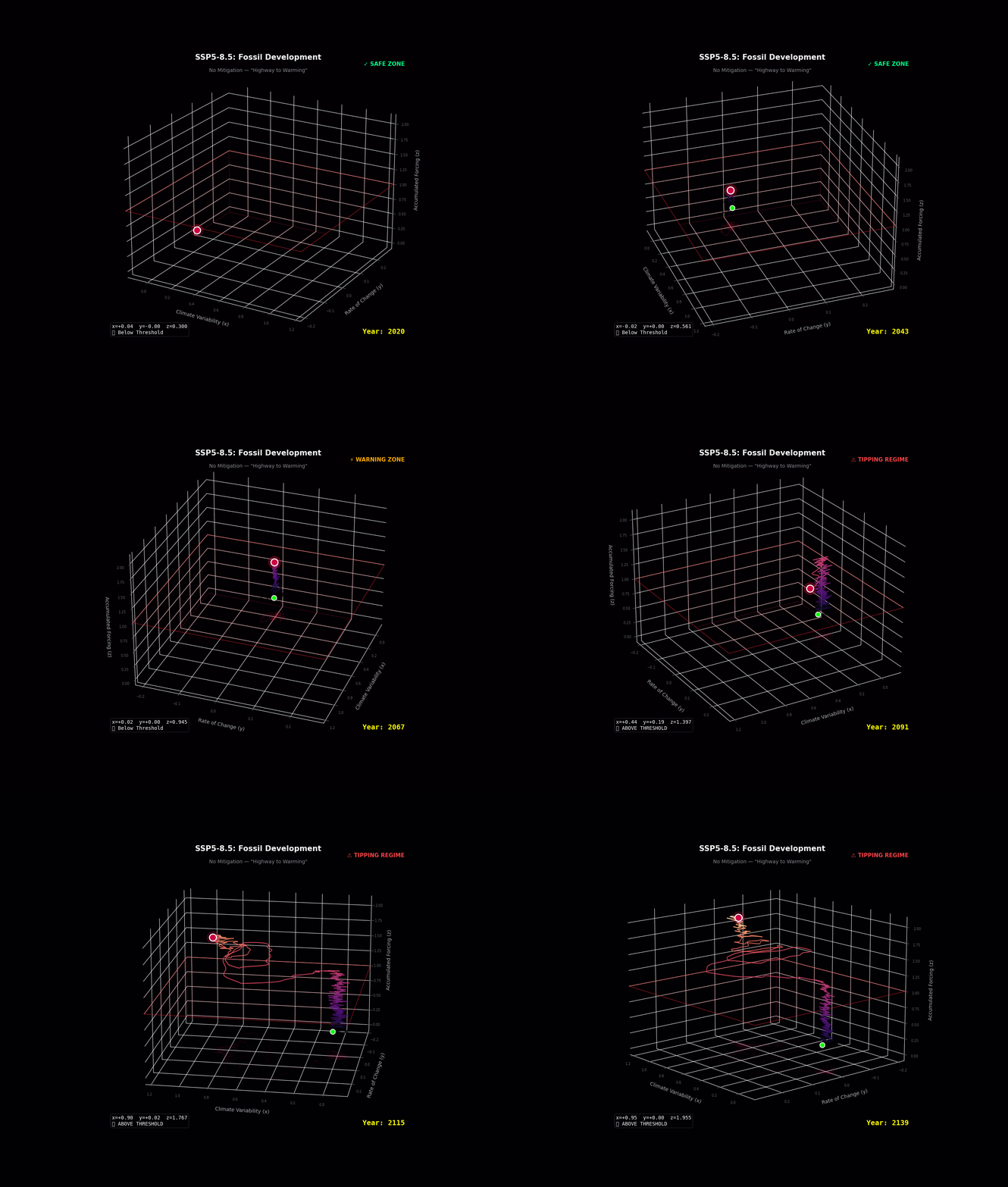
A three-variable dynamical system model exhibiting bifurcation behavior for analyzing climate tipping points under IPCC AR6 SSP scenarios.
The model describes climate system dynamics through a coupled ordinary differential equation system:
dx/dt = y
dy/dt = x(z - z_crit - x²) - cy
dz/dt = ε(A(t)/A_scale - z - βx²)
| Variable | Description | Physical Analog |
|---|---|---|
x |
Fast climate variability | Interannual oscillations (ENSO-like modes) |
y |
Rate of change of x |
Momentum in phase space |
z |
Slow accumulated forcing | Ocean heat content, ice sheet mass proxy |
A(t) |
External forcing | Radiative forcing (W/m²) from SSP scenarios |
The system undergoes a supercritical pitchfork bifurcation when z crosses z_crit:
- z < z_crit: Single stable equilibrium at
x = 0(stable climate) - z > z_crit: Bistable regime with equilibria at
x = ±√(z - z_crit)(tipped state)
The effective potential governing the fast dynamics:
V(x) = -x²(z - z_crit)/2 + x⁴/4
This creates a double-well potential after tipping, representing irreversible regime shifts.
| Symbol | Description | Default | Typical Range |
|---|---|---|---|
c |
Damping coefficient | 0.2 | 0.1 – 0.5 |
ε |
Timescale separation (slow/fast) | 0.02 | 0.01 – 0.05 |
β |
Feedback strength (variability → accumulation) | 0.8 | 0.5 – 1.5 |
z_crit |
Critical tipping threshold | 0.55 | 0.3 – 0.8 |
A_scale |
Global forcing normalization | 13.0 W/m² | — |
All scenarios use a global normalization scale (A_scale = 13.0 W/m²) based on the SSP5-8.5 peak forcing. This ensures consistent comparison across scenarios:
| Scenario | Peak Forcing | Normalized Peak |
|---|---|---|
| SSP1-2.6 | ~3.6 W/m² | 0.28 |
| SSP2-4.5 | ~5.6 W/m² | 0.43 |
| SSP3-7.0 | ~11.6 W/m² | 0.89 |
| SSP5-8.5 | ~13.2 W/m² | 1.02 |
pip install erucakragit clone https://github.com/sandyherho/erucakra.git
cd erucakra
pip install poetry
poetry installRun a single scenario:
erucakra run --scenario ssp245Run all scenarios:
erucakra run --all-scenariosAdjust tipping sensitivity:
# Lower z_crit = more sensitive (tips earlier)
erucakra run --scenario ssp245 --z-crit 0.4

# Higher z_crit = less sensitive (tips later)
erucakra run --scenario ssp370 --z-crit 0.7
Use custom forcing data:
erucakra run --forcing ./my_forcing.csvUse a configuration file:
erucakra run --config ./configs/custom.yamlList available scenarios:
erucakra listRun sensitivity analysis:
erucakra sensitivity --scenario ssp245 --z-crit-min 0.3 --z-crit-max 0.8 --n-samples 10from erucakra import ClimateModel, GLOBAL_A_SCALE, DEFAULT_Z_CRIT_ABSOLUTE
# Initialize model with default parameters
model = ClimateModel(
c=0.2, # damping
epsilon=0.02, # timescale separation
beta=0.8, # feedback strength
z_crit=0.55, # absolute tipping threshold
)
# Run simulation
results = model.run(
scenario="ssp370",
t_end=600.0,
add_noise=True,
)
# Check results
print(f"Scenario: {results.scenario_info['name']}")
print(f"Tipped: {results.tipped}")
print(f"Max z: {results.max_z:.3f}")
print(f"z_crit: {results.z_crit:.3f}")
print(f"First crossing: Year {results.first_crossing_year}")
# Export outputs
results.to_csv("output.csv")
results.to_netcdf("output.nc")
results.to_png("timeseries.png")
results.to_gif("phase_space.gif")from erucakra import ClimateModel, SCENARIOS
model = ClimateModel()
for scenario_key in SCENARIOS:
results = model.run(scenario=scenario_key, add_noise=False)
summary = results.summary()
print(f"{scenario_key}: "
f"max_z={summary['max_z']:.3f}, "
f"tipped={summary['tipped']}, "
f"crossing={summary['first_crossing_year']}")Forcing CSV format:
time,forcing
1750,0.3
1850,0.5
2000,2.5
2100,5.5
2200,4.0
from erucakra import ClimateModel
from erucakra.io import load_forcing_csv
# Load custom forcing
times, values = load_forcing_csv("my_forcing.csv")
# Run with custom forcing
model = ClimateModel(z_crit=0.5)
results = model.run(
forcing=values,
forcing_times=times,
t_end=600.0,
)from erucakra import ClimateModel
model = ClimateModel()
# Vary z_crit to find critical threshold
results_list = model.sensitivity_analysis(
scenario="ssp245",
z_crit_range=(0.3, 0.6),
n_samples=10,
add_noise=False,
)
for z_crit, results in results_list:
if results:
print(f"z_crit={z_crit:.2f}: tipped={results.tipped}, max_z={results.max_z:.3f}")| Scenario | Description | Peak Forcing |
|---|---|---|
ssp126 |
SSP1-2.6 Sustainability | ~3.6 W/m² |
ssp245 |
SSP2-4.5 Middle Road | ~5.6 W/m² |
ssp370 |
SSP3-7.0 Regional Rivalry | ~11.6 W/m² |
ssp585 |
SSP5-8.5 Fossil Development | ~13.2 W/m² |
| Format | Description |
|---|---|
| CSV | Full data table with all variables and diagnostics |
| NetCDF | CF-compliant NetCDF4 with compression and metadata |
| PNG | Time series diagnostic plot with threshold indication |
| GIF | Animated 3D phase space visualization |
| Variable | Units | Description |
|---|---|---|
year |
year | Calendar year (integer) |
year_decimal |
year | Decimal year (fractional) |
x_variability |
— | Fast climate variability |
y_momentum |
1/time | Rate of change |
z_accumulated |
— | Slow accumulated state |
A_forcing_Wm2 |
W/m² | Radiative forcing |
A_normalized |
— | Normalized forcing (A/A_scale) |
warming_proxy_celsius |
°C | Approximate temperature anomaly |
distance_to_threshold |
— | z - z_crit |
regime |
— | "tipped" or "not_tipped" |
Create a custom configuration file:
# my_config.yaml
model:
  damping: 0.2
  epsilon: 0.02
  beta: 0.8
  z_crit: 0.55  # Absolute threshold

simulation:
  t_start: 0.0
  t_end: 600.0
  n_points: 48000
  add_noise: true
  noise_level: 0.03

outputs:
  formats:
    - csv
    - netcdf
    - png
    - gif
  base_dir: ./outputs
Run with configuration:
erucakra run --config my_config.yaml --scenario ssp370The (x, y) subsystem forms a damped Duffing-type oscillator:
d²x/dt² + c(dx/dt) = x(z - z_crit) - x³
The cubic term -x³ provides saturation, preventing unbounded growth.
The z equation is a forced relaxation:
dz/dt = ε(A_normalized - z - βx²)
At quasi-equilibrium: z_eq ≈ A_normalized - βx²
The βx² term creates hysteresis: oscillations reduce effective forcing, so tipping may not reverse when forcing decreases.
For the full system at equilibrium:
Pre-tipping (z < z_crit):
- Single stable fixed point: (x, y, z) = (0, 0, A_normalized)
Post-tipping (z > z_crit):
- Unstable: (0, 0, z_eq)
- Stable: (±√(z - z_crit), 0, z_eq)
where z_eq satisfies the implicit equation from the feedback.
If you use this model in your research, please cite:
@software{erucakra2025,
  author = {Herho, Sandy H. S.},
  title = {\texttt{erucakra}: {A} {P}hysically-{M}otivated {T}oy {M}odel for {C}limate {T}ipping {P}oint {D}ynamics},
  year = {2025},
  url = {https://github.com/sandyherho/erucakra},
  version = {0.0.1}
}MIT License © 2025 Sandy H. S. Herho