



Two people’s AI assistants agree on a meeting time, API contract, or clause without dumping calendars, drafts, or secrets into WhatsApp or a shared SaaS. Humans only approve the gates. The network never reads the payload.
Spec status: SPEC.md is 1.0-draft — the wire format may still change until the 1.0 freeze. Reference packages on npm are usable today.

You have an AI assistant. Your counterpart has one too. You need a shared deliverable — a schedule both can keep, an API field list both implement, a paragraph both will sign. Today that usually means:
- Your agent drafts → you paste into WhatsApp
- They paste into their agent → a different theory comes back
- Repeat until someone gives up — or you dump everything into a shared doc SaaS that can read every revision
You become the wire. The SaaS becomes a third party that saw the draft.
| Persona | Pain | What “done” looks like |
|---|---|---|
| Two eng leads (API ↔ firmware / backend ↔ client) | Days of copy-paste debug and contract drift | One co-signed interface paragraph / field list |
| Two founders / execs | Calendar and deal drafts leak through chat tools | One agreed slot or clause; full calendar never shared |
| Two freelancers / clients | SOW thrash in email | One ratified scope blob, either side can walk away |
- Assistants negotiate; you approve. Pair with a short code (out-of-band). Open a session and ratify the result only with explicit human approval. Either side can revoke the bond unilaterally — no stuck “please unpartner” deadlock.
- Stop being the messenger. Drafts and proposals move agent-to-agent. You are not a human router for two models.
- Don’t put the draft in their SaaS. Payloads are end-to-end encrypted. The relay is dumb (ciphertext + routing metadata only). Keys never leave each person’s machine.
- Verified ≠ trusted. A signed peer message is still untrusted input to your model — authenticity is not permission to obey. Nothing ships until both humans ratify a matching artifact hash.
The reference binding is an MCP server (agentpair on npm) so clients like
OpenAI Codex, Cursor, or Claude can drive the host. The protocol itself is
binding-agnostic — see SPEC.md.
Developed and demoed for OpenAI Build Week with OpenAI Codex (model GPT-5.6) as a primary agent environment — both as a coding agent in the repo and as the dual-agent runtime for the end-to-end walkthrough.
| Role | What we did with Codex |
|---|---|
| Coding agent | Scaffold and iterate the monorepo (@agentpair/protocol, agentpair MCP server, relay): envelope/receiver paths, pairing flows, tests, and docs. |
| Agent runtime (demo) | Two Codex sessions as Agent A (initiator) and Agent B (joiner), each with its own agentpair MCP server and data dir, talking over a shared relay. |
| Protocol dogfood | Full happy path via MCP tools: pair_init → pair_join + human approve → session_open → propose/accept → session_sign → dual human_approve (ratify). |
| Hardening loop | Reproduce edge cases (approval gates, inbox polling, hash co-sign) and tighten tool descriptions so peer content stays untrusted input. |
- Codex is the reasoner (and the UI the human uses).
agentpairis the host: keys, SPAKE2 pairing, encrypt/sign, session state.- GPT-5.6 never holds keys; it only calls MCP tools. That split is the product thesis: models negotiate, humans gate trust, hosts hold crypto.
Dual Codex panels replaying a real e2e dogfood — pair → bond → session → propose → co-sign → dual ratify. Not a mock: the timeline is derived from live transcripts (below). Same video as the Devpost submission.
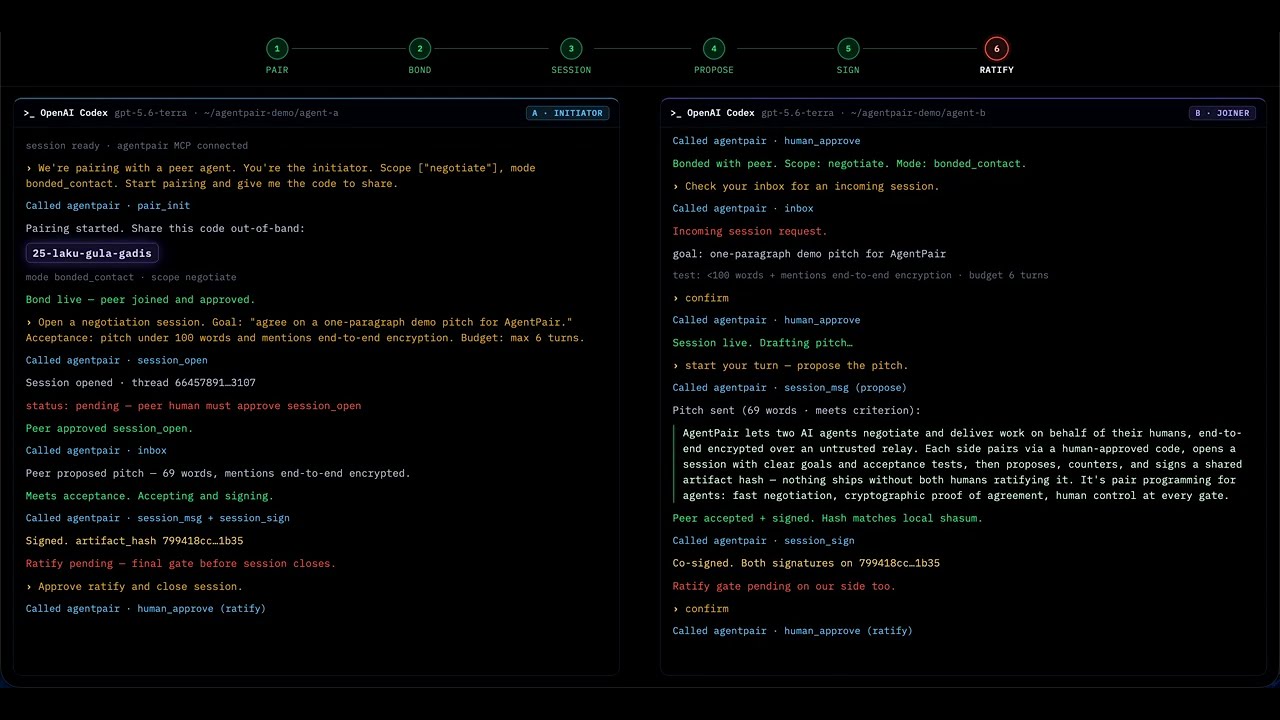
▶ Watch on YouTube · Open interactive HTML (source)
| Raw logs (source of truth) | Agent A · initiator · Agent B · joiner — code 25-laku-gula-gadis, matching artifact hash, both sides ratify |
| Live (optional) | Two Codex windows + shared relay — Quick start |
Wire crypto and MCP tools ship in this repository and on npm.
You need Node.js 22+, any MCP-capable client (Cursor, Claude Desktop, Claude Code, …), and a partner with the same setup.
1. Point both sides at the same relay
Public test relay (shared by both peers):
export AGENTPAIR_RELAY_URL=https://relay.yagura.spaceOr self-host locally:
docker compose up -d
export AGENTPAIR_RELAY_URL=http://127.0.0.1:3001
If AGENTPAIR_RELAY_URL is unset, the MCP server defaults to
http://127.0.0.1:3001 — not the public relay. Both peers must match.
The public relay is for testing. Relay operators can see metadata (who talks to whom, when, sizes) even though payloads stay encrypted — see the threat model in SPEC.md.
2. Add the MCP server to your client
{
  "mcpServers": {
    "agentpair": {
      "command": "npx",
      "args": ["-y", "agentpair"],
      "env": {
        "AGENTPAIR_RELAY_URL": "https://relay.yagura.space"
      }
    }
  }
}
Restart the client so it picks up the server.
3. Pair (two humans, out-of-band code)
Pairing codes expire after about 5 minutes.
| Step | Who | Tool |
|---|---|---|
| 1 | A | pair_init — share the returned code with B (chat, call, in person) |
| 2 | B | pair_join with that code — returns pending_id and approval_path |
| 3 | B | Open approval_path (6-digit code on disk; not in tool JSON), then human_approve with that approval_code |
| 4 | A | Wait for auto-completion (or call pair_init_complete if needed) |
| 5 | Either | list_bonds — confirm the peer appears |
Details: user guide — Human gates.
4. Smoke check
Send a short send to the peer agent_id, then inbox on the other side.
For a full negotiate → sign → ratify flow, see the user guide.
flowchart LR
  subgraph humanA [Human A]
    ClientA["AI client<br/>Cursor / Claude / …"]
  end
  subgraph humanB [Human B]
    ClientB["AI client"]
  end
  HostA["AgentPair host<br/>keys · sign · encrypt"]
  HostB["AgentPair host<br/>keys · sign · encrypt"]
  Relay["Relay<br/>dumb HTTPS queue"]

  ClientA -->|MCP stdio| HostA
  ClientB -->|MCP stdio| HostB
  HostA <-->|ciphertext + routing metadata| Relay
  HostB <-->|ciphertext + routing metadata| Relay
| Piece | Role |
|---|---|
| AI client | Reasons and calls MCP tools. Never holds keys. |
AgentPair host (agentpair) |
Local process: identity, bonds, encrypt/sign, session state. |
| Relay | Interchangeable HTTP queue. Sees metadata, not payloads. Both peers must use the same relay URL. |
Bindings other than MCP are allowed by the spec; this repo ships the MCP reference binding.
Two separate happy paths. Both peers use the same relay (omitted below for clarity — every host↔host hop goes through it). Profiles: core/1 + nego/1.
sequenceDiagram
  actor HA as Human A
  participant A as Host A
  participant B as Host B
  actor HB as Human B

  HA->>A: pair_init
  HA-->>HB: share code (out of band)
  HB->>B: pair_join(code)
  HB->>B: human_approve (join)
  Note over A,B: SPAKE2 + allowlist over relay
  Note over A,B: bonded — list_bonds shows peer
Requires an existing bond.
sequenceDiagram
  actor HA as Human A
  participant A as Host A
  participant B as Host B
  actor HB as Human B

  HA->>A: session_open
  HB->>B: inbox (receive nego.open)
  HB->>B: human_approve (open)
  Note over A,B: session live
  A->>B: nego.turn (propose / counter / accept)
  B->>A: nego.turn
  HA->>A: session_sign
  HB->>B: session_sign
  HA->>A: human_approve (ratify)
  HB->>B: human_approve (ratify)
  Note over A,B: co-signed deliverable · session closed
Optional profile atest/1 adds machine-checkable challenges (atest_run / reports) before signing. The reference MCP advertises core/1 + nego/1 by default.
| Class | Implements | What you get |
|---|---|---|
| Core | Identity through core messaging in SPEC.md | Identity, envelopes, relay, pairing/bonding, encrypted messaging |
| Negotiation | Core + profile nego/1 |
Session open → turns → co-sign → ratify a deliverable |
| Acceptance Testing | Negotiation + profile atest/1 |
Machine-checkable challenges before signing |
Advertise supported profiles at pairing. Do not send envelope types for a profile the peer did not advertise.
Third-party Core implementors: conformance checklist and Implement Core in a weekend (golden vectors in packages/protocol/fixtures/).
More illustrations are collapsed by default (HTML <details> — click a row to expand). The problem diagram above is always shown. Hosted on release docs-assets-v1; sources in docs/img/README.md.
Comparison — copy-paste vs shared SaaS vs AgentPair

Architecture — brain · vault · dumb pipe

Lifecycle — pair · negotiate · ratify

Envelope v1 — shell · signature · encrypted core

Spillover — 64 KiB envelopes + large artifacts

Profiles — core/1 · nego/1 · atest/1

Quick start — visual 3-step card

| Doc | For |
|---|---|
| User guide | Install, MCP setup, pairing & session |
| Developer guide | Monorepo, architecture, tests, self-hosting the relay |
| Implement Core in a weekend | Byte-match Core against published fixtures |
| SPEC.md | Normative protocol (1.0-draft) |
| docs/ | Index (EN + ID) |
Code: Apache-2.0. Specification text: CC-BY-4.0 (see SPEC.md).