Stop hand-copying numbers from 300-page HKEX PDFs.
Get every fact — with its source page — in 5 lines of Python.


English · 中文
Install · Quickstart · Data shape · Cookbook · API · Plans · FAQ
If you've ever tried to extract revenue, segment breakdowns or capex guidance from a 300-page HKEX PDF, you know the failure modes: numbers without page references, OCR drift, units mixed between HKD and RMB, hallucinated year-over-year changes that don't reconcile, segment totals that don't sum to the consolidated figure.
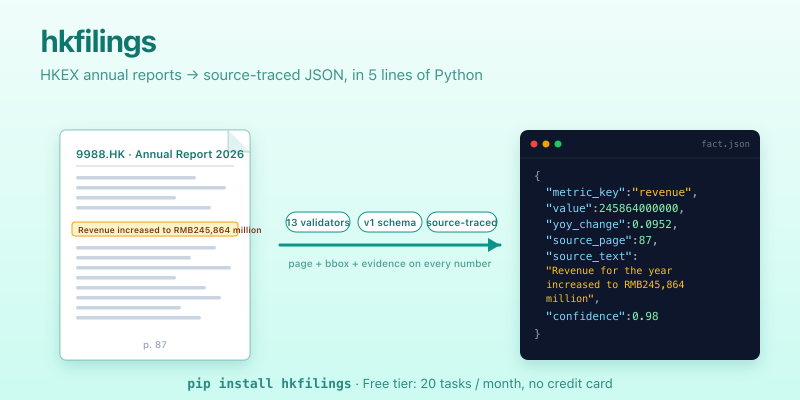
This SDK is a client for an API that returns every fact with:
source_page+source_text— point at the exact location in the PDF (page-level bbox lands inextrawhen the parser can resolve it)- 13 deterministic validators — YoY recalc, accounting equation, segment reconciliation, currency / unit consistency, cashflow sign checks, EPS sign, free-cashflow definition, …
- Frozen v1 schema with forward-compat
extradict — new backend fields land inextra; your existing code never breaks on a release - Layer-2 signals — 11 enumerated signal types (margin driver, upstream cost pressure, downstream demand, inventory & orderbook, capex, …), each bound to evidence with anti-hallucination rules
- Supply-chain graph — suppliers, customers, competitors, regulators, substitutes, partners — with exposure share and direction
| Source-traced | Validated | HK coverage | Schema stability | Free tier | |
|---|---|---|---|---|---|
| Manual analyst | depends | manual | full | n/a | — |
| Wind / Bloomberg / CIQ | ✗ | proprietary | full | shifts each release | ✗ |
| Generic LLM on a PDF | hallucinates | ✗ | any | none | API costs |
| hkfilings | page + text | 13 validators | full HKEX | frozen v1 | ✓ |
pip install hkfilingsRequires Python ≥ 3.10. The only runtime dependency is httpx. Works
great in Jupyter / Colab.
from hkfilings import HKFilingsClient

client = HKFilingsClient(api_key="ak_...")

task   = client.analyze(ticker="9988", year=2026)   # Alibaba 9988.HK
report = client.wait(task.task_id, timeout=600)

for fact in report.facts:
    print(f"{fact.metric_key:32}  {fact.value:>18,.0f}  p.{fact.source_page}")
Free tier: 20 tasks/month, no credit card required. → Get a key
Every fact carries its provenance:
fact.metric_key       # "revenue"
fact.metric_label     # "Revenue"
fact.value            # 245_864_000_000.0
fact.comparable_value # 224_500_000_000.0    (prior period)
fact.yoy_change       # 0.0952
fact.source_page      # 87
fact.source_text      # "Revenue for the year increased to RMB245,864..."
fact.confidence       # 0.98
fact.extra            # forward-compat fields (e.g. bbox, unit) land here
Layer-2 signals come with direction + evidence:
signal.signal_type     # "margin_driver"
signal.direction       # "up" | "down" | "flat"
signal.summary         # "Cloud margin lifted on lower GPU procurement..."
signal.evidence        # [{"page": 42, "text": "..."}, ...]
signal.review_status   # "approved" | "auto_passed" | "pending"
Supply-chain nodes come with role + exposure share:
node.node_label             # "TSMC"
node.node_role              # "supplier" | "customer" | "competitor" | "regulator" | "substitute" | "partner"
node.exposure_share         # 0.18    (18% of revenue / cost tied to this node)
node.direction_to_company   # "inflow" | "outflow"
node.evidence_page # 142Tip: every snippet below runs as-is in a Jupyter notebook once you've exported
HKFILINGS_API_KEYin your shell.
from hkfilings import HKFilingsClient
import pandas as pd

client = HKFilingsClient(api_key="ak_...")
rows = []
for tk in ("9988", "0700"):
    m = client.company_matrix(tk, metrics=["revenue", "gross_profit"])
    rows.extend({"ticker": tk, **cell} for cell in m.cells)

df = pd.DataFrame(rows).pivot_table(
    index="period", columns=["ticker", "metric_key"], values="value"
)
print(df)sigs = client.task_signals(task.task_id, signal_type="margin_driver")
for s in sigs.signals:
print(f"[{(s.direction or '-'):>4}] {s.summary}")
for ev in s.evidence:
text = (ev.get("text") or "")[:80]
print(f" p.{ev.get('page')} — {text}")
# [ up] Cloud Intelligence margin lifted 4.2pp YoY on lower GPU procurement...
# p.42 — During the year, Cloud Intelligence Group recorded segment...import networkx as nx
graph = nx.DiGraph()
sc = client.company_supply_chain("9988")
for node in sc.nodes:
graph.add_edge(
"9988",
node.node_label,
role=node.node_role,
exposure=node.exposure_share,
)
print(graph) # → "DiGraph with N nodes and M edges" (networkx ≥ 3.0)with open("baba_2026_facts.csv", "wb") as fh:
fh.write(client.facts_csv(task.task_id))More runnable examples in examples/.
| Method | What it does |
|---|---|
analyze(ticker, year, …) |
Auto-discover and parse a report by ticker + year |
create_task(pdf_url, …) |
Parse a PDF by URL |
upload(file_path, …) |
Upload a local PDF |
task_status(task_id) |
Poll task progress |
wait(task_id, timeout=600) |
Block until the task reaches a terminal state |
result(task_id) |
Return the Layer-1 financial-facts envelope |
facts_csv(task_id) |
Same data, as CSV bytes |
company_matrix(ticker, metrics=…) |
Cross-period matrix for a ticker |
task_signals(task_id, …) |
Layer-2 signals for one report |
company_signals(ticker, …) |
Cross-period signal feed |
task_supply_chain(task_id) |
Supply-chain nodes for one report |
company_supply_chain(ticker, …) |
Cross-period supply-chain feed |
task_catalysts(task_id) |
Forward-looking catalysts (1–4Q horizon) |
company_catalysts(ticker, …) |
Cross-period catalyst feed |
intelligence_brief(task_id) |
Executive brief (rich nested) |
review_diff(task_id, …) |
Diff between review versions |
patch_fact(fact_id, **fields) |
Update a fact (review action) |
patch_signal(signal_id, **fields) |
Update a signal (review action) |
fact_comment(fact_id, body, …) |
Attach a review comment |
schema(name="financial_fact") |
Fetch a JSON Schema document |
Full docs: https://docs.hkfilings.app/python
The SDK itself is free under MIT. The managed API runs on a usage-based plan with a free tier:
| Plan | Tasks / month | Layer-2 access | Export |
|---|---|---|---|
| Free | 20 | Limited | JSON / CSV (watermark) |
| Pro | 200 | Full | JSON / CSV |
| Team | 1,000 | Full + multi-seat | JSON / CSV / MD |
| Enterprise | Custom | Full + webhooks + SLA | Custom |
→ See current pricing & upgrade on hkfilings.app
You can also self-host the parsing service if you have your own LLM
budget — set base_url="https://your-host" when constructing the
client. Get in touch (sales@hkfilings.app) for on-prem deployments.
The v1 public schema is frozen. JSON Schema documents:
- https://hkfilings.app/v1/schema/financial_fact
- https://hkfilings.app/v1/schema/industry_signal
- https://hkfilings.app/v1/schema/supply_chain_node
- https://hkfilings.app/v1/schema/catalyst
New backend fields land in each dataclass's extra dict — you do not
need to upgrade the SDK to see them. We never remove or rename a
documented field within v1.
| Setting | Constructor arg | Env var |
|---|---|---|
| API base URL | base_url= |
HKFILINGS_BASE_URL |
| API key | api_key= |
HKFILINGS_API_KEY |
| Request timeout (s) | timeout=60.0 |
— |
| User-Agent | user_agent= |
— |
The client honors HTTPS_PROXY / HTTP_PROXY via httpx — useful behind
corporate firewalls.
- v0.2 — Async client (
HKFilingsAsyncClient), retry with exponential backoff,client.facts_to_dataframe()helper. - v0.3 — Streaming task events (SSE wrapper), webhook signature
helpers, CLI (
hkfilings analyze 9988 2026). - v1.0 — Stable surface, deprecation warnings removed, TypeScript SDK companion.
Open issues for what you'd like prioritized.
Q: Can I self-host the parsing engine? A: Yes for Enterprise customers — contact sales@hkfilings.app. The parsing service requires an LLM API key (DeepSeek, OpenAI, or Anthropic) and a Postgres database.
Q: How is this different from Wind / Bloomberg / Capital IQ? A: We focus on Hong Kong listings only and ship the entire evidence chain (source page + text) alongside every number. Our schema is public and frozen; theirs are proprietary and shift between releases. We're priced for individuals and small funds.
Q: A-shares? US listings? A: Not yet. We may add them once the HK coverage is rock-solid.
Q: Is the parsing logic open-source? A: This SDK is open-source under MIT. The parsing engine — LLM prompts, validators, anti-hallucination rules — is closed-source. We publish the JSON Schema contract as a stability commitment.
Q: How do I report a parsing bug for a specific report?
A: Open a GitHub issue with the task_id. We'll triage on the SaaS
side and either fix the engine or update the report.
Q: I got rate-limited. What now?
A: Free tier is 20 tasks/month. Upgrade or wait for the next monthly
reset. HKFilingsError will include status_code=429 and
payload["upgrade_url"].
MIT. See SECURITY.md for vulnerability reporting, CONTRIBUTING.md to help out.
⭐ If this saves you time, star the repo — it's the cheapest way to support the project.
Get a free key → hkfilings.app/signup