


A lightweight, deterministic Monte Carlo simulation framework with robust statistical analytics, parallel execution, and optional GPU acceleration.
- Documentation: https://milanfusco.github.io/mcFramework/
- Source: https://github.com/milanfusco/mcframework
- PyPI: https://pypi.org/project/mcframework/
pip install mcframeworkThe base install depends only on NumPy (>= 1.26) and SciPy (>= 1.10). Optional features are available as extras:
pip install "mcframework[torch]"   # PyTorch backends (CPU, plus MPS/CUDA when available)
pip install "mcframework[cuda]"    # PyTorch and CuPy for the cuRAND backend
pip install "mcframework[viz]"     # Matplotlib for visualization
pip install "mcframework[gui]"     # PySide6 desktop application
For development, install from source with the test and docs extras:
git clone https://github.com/milanfusco/mcframework.git
cd mcframework
pip install -e ".[dev,test,docs]"from mcframework import PiEstimationSimulation
sim = PiEstimationSimulation()
sim.set_seed(42)
result = sim.run(10_000, backend="thread")
print(result)Define a custom simulation by implementing a single method:
from mcframework import MonteCarloSimulation

class DiceSumSimulation(MonteCarloSimulation):
    def __init__(self):
        super().__init__("Dice Sum")

    def single_simulation(self, _rng=None, n_dice: int = 5) -> float:
        rng = self._rng(_rng, self.rng)
        return float(rng.integers(1, 7, size=n_dice).sum())

sim = DiceSumSimulation()
sim.set_seed(42)
result = sim.run(10_000, backend="thread")
print(f"Mean: {result.mean:.2f}")  # ~17.5
Request richer statistics on any run:
result = sim.run(
    50_000,
    percentiles=(1, 5, 50, 95, 99),
    confidence=0.99,
    ci_method="auto",
)
print(result.stats["ci_mean"])  # 99% confidence interval
Register and compare multiple simulations with MonteCarloFramework:
from mcframework import MonteCarloFramework, PiEstimationSimulation

fw = MonteCarloFramework()
fw.register_simulation(PiEstimationSimulation())

result = fw.run_simulation("Pi Estimation", 10_000, n_points=5000, backend="thread")
print(result.result_to_string())Core framework
MonteCarloSimulationbase class: define a simulation by implementingsingle_simulation().- Deterministic parallelism: reproducible results via NumPy
SeedSequencespawning. - Cross-platform execution: threads on POSIX, processes on Windows.
- Structured
SimulationResultwith metadata and formatting.
Statistics engine
- Descriptive statistics: mean, standard deviation, percentiles, skew, kurtosis.
- Parametric confidence intervals: z and t critical values with auto-selection.
- Bootstrap confidence intervals: percentile and BCa (bias-corrected and accelerated).
- Distribution-free bounds: Chebyshev intervals and Markov probability.
Torch backends
- CUDA (NVIDIA): adaptive batch sizing, CUDA streams, dual RNG (
torch.Generatorand cuRAND), native float64, multi-GPU. - MPS (Apple Silicon): Metal Performance Shaders on M1/M2/M3/M4, unified memory, best-effort determinism.
- Torch CPU: vectorized batch execution without GPU hardware.
- Pluggable
ExecutionBackendprotocol for custom backends.
Profiling
- PyTorch profiler integration for CPU and CUDA, with Chrome trace export and optional memory and FLOPs reporting.
Built-in simulations
- Pi estimation (geometric probability on the unit disk).
- Portfolio simulation (geometric Brownian motion wealth dynamics).
- Black-Scholes European and American option pricing with Greeks.
Validation
- Oracle hook (
analytic_reference) so a simulation can declare its known answer. validate_convergence()asserts the Monte Carlo estimate converges to that oracle (CI-gated).
Every built-in simulation with a closed-form answer declares it as an oracle, and
validate_convergence() proves the Monte Carlo estimate converges to it — turning
correctness into a CI-enforced test rather than a vibe:
from mcframework import validate_convergence, BlackScholesSimulation

report = validate_convergence(BlackScholesSimulation(), 50_000, seed=0, option_type="call")
print(report.status, report.estimate, report.oracle)  # "pass" 10.45... 10.4506...
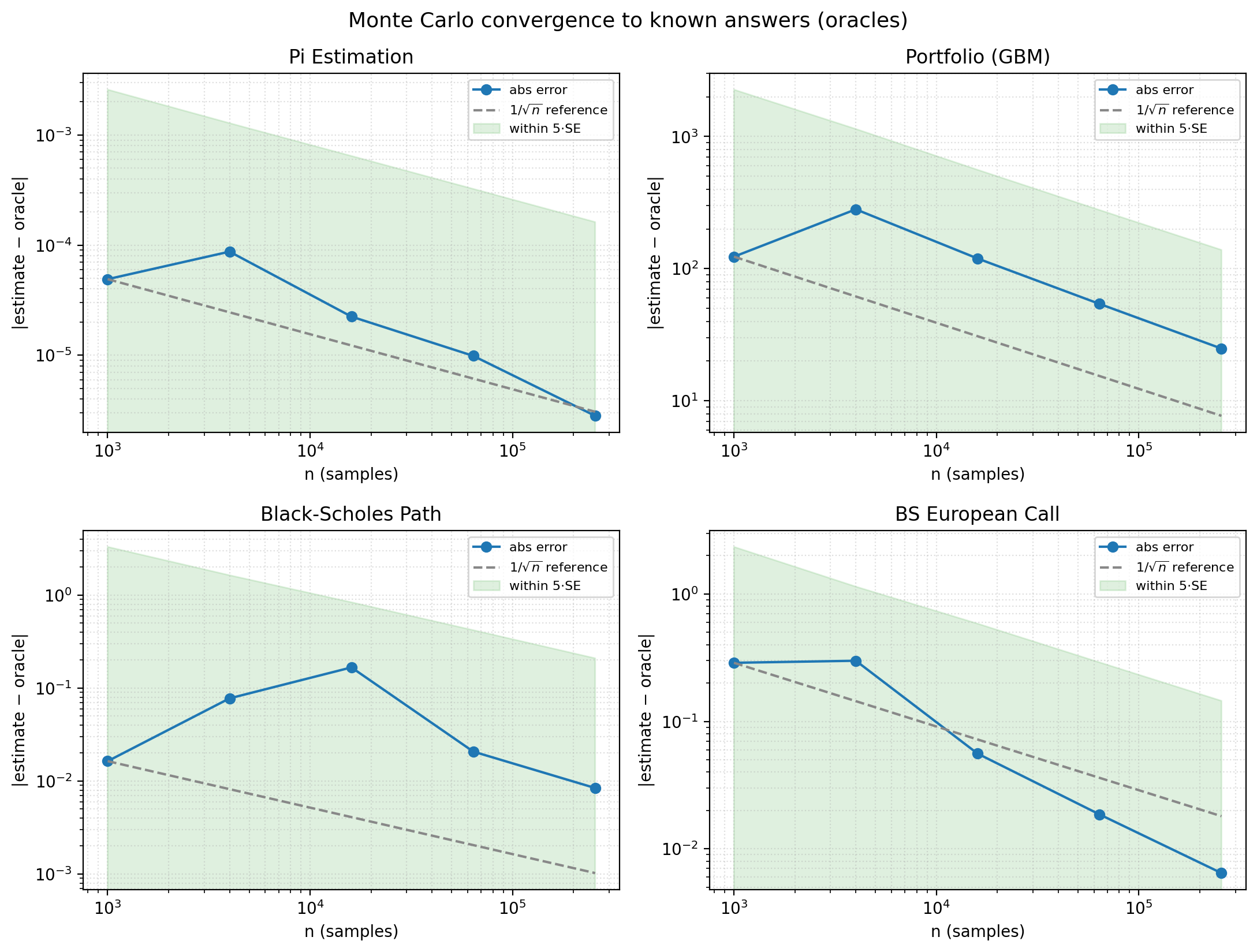
demos/demo_convergence_gallery.py sweeps each oracle-backed simulation over increasing
n; the absolute error tracks the theoretical 1/√n rate and stays inside the 5·SE
pass band:
See the Oracles and Benchmarks guide for details.
MonteCarloSimulation.run() selects an execution strategy via the backend parameter:
| Backend | Selection | Description |
|---|---|---|
"sequential" |
backend="sequential" |
Single-threaded execution |
"thread" |
backend="thread" (POSIX default) |
ThreadPoolExecutor, effective when NumPy releases the GIL |
"process" |
backend="process" (Windows default) |
ProcessPoolExecutor, avoids GIL serialization |
"torch" |
`backend="torch", torch_device="cpu" | "mps" |
Determinism is per-(backend, block-layout), not absolute. The sequential
backend draws all samples from a single spawned stream, while the thread/process
backends spawn one stream per work block (block count depends on n_workers,
n_simulations, and the chunk factor). Since backend="auto" switches from
sequential to parallel once n_simulations crosses 20_000, the same seed
can yield different draws above vs. below that threshold, and sequential and
parallel runs are not bitwise identical. Pin backend and n_workers for
run-to-run reproducible numbers; statistical properties (mean, variance, CI
coverage) hold regardless.
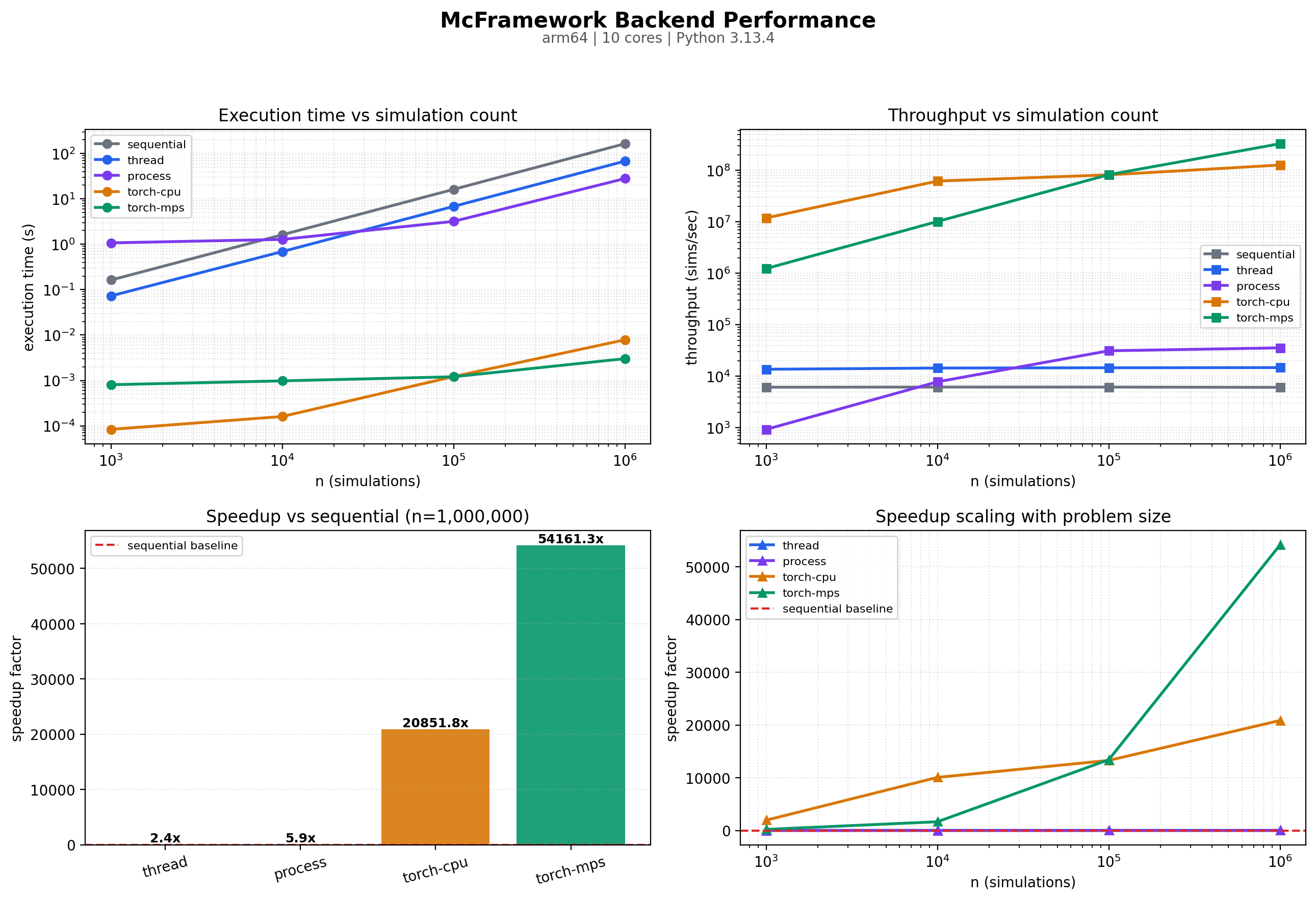
Benchmarking is a first-class subsystem (mcframework.benchmark): run_suite() times the same workload across every available backend and returns a structured, plottable, JSON-serializable report. Speedup is measured against sequential execution; the vectorized Torch and GPU backends benefit most at large simulation counts, where batching amortizes per-call overhead.
from mcframework import PiEstimationSimulation, run_suite, default_backends
from mcframework.benchmark import plot_benchmarks

report = run_suite(PiEstimationSimulation(), [1_000, 10_000, 100_000, 1_000_000], default_backends())
print(report.summary_table())
fig = plot_benchmarks(report)
Or from the command line (installed as the mcframework-benchmark console script):
mcframework-benchmark --quick --save backend_benchmark.png        # reproduce the figure
python demos/demo_backend_benchmark.py --sizes 1000,10000,100000  # same thing, via the demo
See the Backend Benchmarking guide for details.
A simulation runs on PyTorch when it sets supports_batch = True and implements torch_batch(). The same implementation runs on CPU, Apple Silicon MPS, and NVIDIA CUDA.
from mcframework import MonteCarloSimulation
import torch

class MySimulation(MonteCarloSimulation):
    supports_batch = True

    def single_simulation(self, _rng=None, **kwargs):
        rng = self._rng(_rng, self.rng)
        x, y = rng.random(), rng.random()
        return 4.0 if (x * x + y * y) <= 1.0 else 0.0

    def torch_batch(self, n, *, device, generator):
        x = torch.rand(n, device=device, generator=generator)
        y = torch.rand(n, device=device, generator=generator)
        return 4.0 * ((x * x + y * y) <= 1.0).float()

result = sim.run(1_000_000, backend="torch", torch_device="cuda")  # or "mps", "cpu"
See the backend guides for configuration, determinism notes, and troubleshooting:
The gui extra installs a PySide6 desktop application for Black-Scholes Monte Carlo analysis: live market data, path simulations, option pricing with Greeks, what-if analysis, and 3D price surfaces.
pip install "mcframework[gui]"
python demos/gui/quant_black_scholes.pypytest --cov=mcframework -v # tests with coverage
ruff check src/ # lint
pylint src/mcframework/ # lint
sphinx-build -b html docs/source docs/_build/html # build docsThe Architecture guide documents the package layout, design patterns, and UML diagrams.
MIT License. See LICENSE.
Milan Fusco (mdfusco@student.ysu.edu)