

A high-performance HTTP reverse proxy and load balancer written in modern C++. Architected around Linux io_uring to achieve a zero-copy, zero-allocation data plane.
This project is a Layer 7 load balancer designed to minimize userspace overhead by interfacing directly with the Linux Kernel API.
By leveraging io_uring features (multishot accept, fixed file descriptors), pre-allocated kernel pipe pools, and splice()-based data forwarding, this proxy routes HTTP traffic without copying payload data into userspace memory or performing dynamic allocations during active requests.
This proxy is architected to completely eliminate kernel/userspace bottlenecks. The core loop operates with strictly Zero-Copy data routing and Zero-Allocation memory management.
Tested with 50 concurrent connections against local Go backends:
Requests/sec:    34,700.00+
Latency (Avg):   ~2.04ms
CPU Utilization: 32%
Socket errors:   connect 0, read 0, write 0, timeout 0
A live perf record during maximum load proves the zero-copy and zero-allocation claims. The CPU spends the vast majority of its time executing core io_uring system calls and processing the Linux TCP/IP stack, with completely negligible userspace overhead.
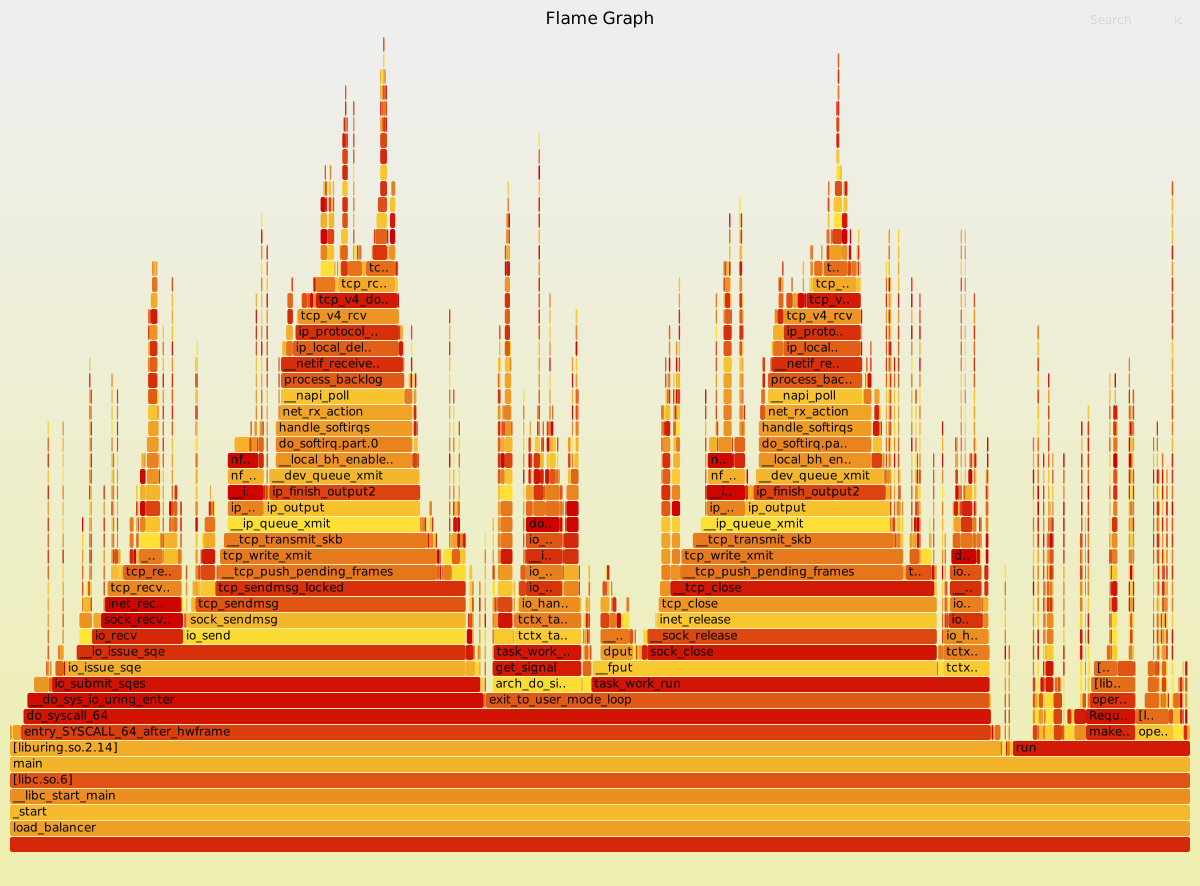
- No sys_pipe2 or sys_close: A custom PipePool entirely eliminates dynamic file descriptor creation under load.
- No Userspace memcpy: Splicing between fixed backend sockets and fixed kernel pipes keeps all payload data strictly inside the kernel.
- No Userspace malloc: Strict std::unique_ptr reuse and pre-allocated arrays ensure the C++ heap remains completely untouched during request processing.
Kernel-Level Traffic Routing (io_uring):
- Completely bypasses standard epoll/recv/send architectures.
- Utilizes
io_uringregistered buffers, multishot accept, and strictly registered/fixed file descriptors for all internal operations.
Zero-Copy Pipeline:
- Large payloads are routed via
SPLICE_F_MOVE, pushing data directly from the client network socket to the backend socket through an internal kernel pipe ring buffer.
Persistent Connection Pooling:
- BackendPool: Maintains persistent, keep-alive TCP connections across multiple backend servers, amortizing the cost of the TCP 3-way handshake to zero for recurring traffic.
- PipePool: Pre-allocates thousands of kernel pipes at startup, checking them out atomically during requests to prevent file-descriptor starvation and syscall overhead.
Multiple Balancing Algorithms:
- Round Robin
- Least Connections (Implemented via RouteStrategy.cpp)
Modern C++ Stack: Built using io_uring, C++20.
Because this project relies on Linux kernel features, you must be running Linux. A kernel version of 5.19+ is highly recommended to support advanced io_uring flags (like Multishot Accept).
- A C++ compiler supporting C++20 (e.g., g++ 11+ or clang++ 14+)
- CMake (version 3.10 or newer)
- liburing (liburing-dev) - Core asynchronous I/O engine
- TOML++ (libtomlplusplus-dev) - Configuration parsing
- EFSW (libefsw-dev) - File watching for hot-reloads
sudo apt-get update
sudo apt-get install build-essential g++ cmake liburing-dev libssl-dev🚀 Building the Project
This project uses CMake for building along with fetchContent.
git clone https://github.com/yourusername/cpp-load-balancer.git
cd cpp-load-balancer

# Create a build directory
cmake -B build

# Compile the project
cmake --build build -j$(nproc)To achieve maximum performance, ensure you raise your OS file descriptor limits before running (e.g., ulimit -n 65535). Run the application:
./build/load_balancerThe application will start, load the config.toml, and begin monitoring it for changes.
[load_balancer]
listen_port = 8080
algorithm = "RoundRobin"
queue_depth = 1024       # io_uring submission queue size
max_connections = 10000

[health_check]
path = "/health"
interval = 10

[[servers]]
name = "Server 1"
url = "http://127.0.0.1:8081"
connections = 200

[[servers]]
name = "Server 2"
url = "http://127.0.0.1:8082"
connections = 200.
.
├── src/
│ ├── main.cpp # Application entry point
│ ├── IoUringEngine.cpp # The core event loop and state machine
│ ├── BackendPool.cpp # Manages persistent Go backend sockets
│ ├── PipePool.cpp # Pre-allocates kernel pipes for splice()
│ ├── RouteStrategy.cpp # Balancing algorithms (RoundRobin/LeastConn)
│ ├── tomlParser.cpp # Config loader
│ ├── healthChecker.cpp # Async backend monitoring
│ └── HotReloader.cpp # Live config file watcher
├── include/
│ └── *.hpp # Header files
├── CMakeLists.txt
└── README.md
This project is licensed under the MIT License - see the LICENSE file for details.