


The primary goal of this project is to explore the changing presence of Airbnb listings in Montreal. Its conception was originally inspired by a 2018 report from the School of Urban Planning at McGill University which analysed Airbnb activity in New York City and sought to answer the following four questions:
- Where is Airbnb activity located in New York, and how is it changing?
- Who makes money from Airbnb in New York?
- How much housing has Airbnb removed from the market in New York?
- Is Airbnb driving gentrification in New York?
Some pertinent findings of the report include the loss of up to 13,500 housing units from NYC's long-term rental market and a 1.4 percent increase in the median rent since 2014. On top of this, Airbnb activity induced highly racialized gentrification: in predominantly Black neighbouhoods, Airbnb hosts were 5 times more likely to be white, earning an estimated $112 million more than their Black counterparts. Similar analyses looking at Airbnb's disruption to the local housing market have been done in Athens and Barcelona.
Despite the popularity of Airbnb, the convenience it offers travelers, and the boosts it grants to local tourism markets, it is not without controversy. Indeed, many municipalities often find themselves at odds with the house-sharing platform. Landlords have found that it is often more profitable to rent out a vacant apartment all year round, which results in shortages of available rental property and an increase in rent for local residents. Other concerns include harrassment, an exacerbation of segregation, a loss of community, and a permanent alteration of an area's cultural atmosphere due to the "over-tourism" that Airbnb facilitates. Cities like Berlin and Tokyo have enacted measures to regulate Airbnb rentals, with other cities following suite. This includes rental caps and licenses. Other cities have banned short-term rentals entirely. Some regulations have already been enacted in Canadian cities such as Vancouver. In Toronto, a new report published by the coalition Fairbnb claimed that 6,500 homes could be added to Toronto's housing market if Airbnb were to comply to the city's new short-term rental rules. Both cities have banned residents from listing secondary properties.
In Montreal, the situation is slightly different. In 2017, the government of Quebec reached an agreement with Airbnb to that required the automatic collection and remission of a lodging tax on behalf of its hosts. The housing situation, however, is just as stark as in other cities. The Plateau and Ville-Marie (downtown), two boroughs with the highest number of available Airbnb listings, also have the lowest housing vacancy rate across the city. A 2017 study by McGill University found that Airbnb has removed 14,000 units from the city. Airbnb has disputed the results, pointing to the fact that 63 percent of listings were listed for fewer than 90 days. However, other problems arise. Illegal online apartment rentals are so widespread that the city is enlisting citizens, municipal workers, and the provincial revenue department to remove key safes left on public property (in 2015, the Quebec government passed a law requiring proper certification for people using a secondary residence for short-term rentals).

The borough of Parc-Extension, a historical landing spot for immigrants and also the city's lowest-income neighbourhood, has seen a drastic increase in rent and housing prices, largely due to development. Parc Ex, as it is known, is ranked the fifth poorest neighbourhood in Canada with 44 percent of the population live below the poverty line. Gentrification in this neighbourhood is currently being driven by the construction of a new campus by the University of Montreal. Many local housing activists have assembled to address this issue, including calling on the government to invest in more social housing.
The question as to how Airbnb drives gentrification in Montreal is not presently well understood. My goal with this project is to understand the dynamics of Airbnb in this borough, as well as others in Montreal, in hopes of understanding how prevalence of Airbnb listings interacts with and drives gentrification in the city. The data was taken from Inside Airbnb, an independent, non-commercial site that regularly scrapes listings data from the Airbnb website. Note that another available data source is Tom Slee, whose scrapes a bit more frequently but is not as up-to-date. Mapping was done using geographic data provided by Statistics Canada.
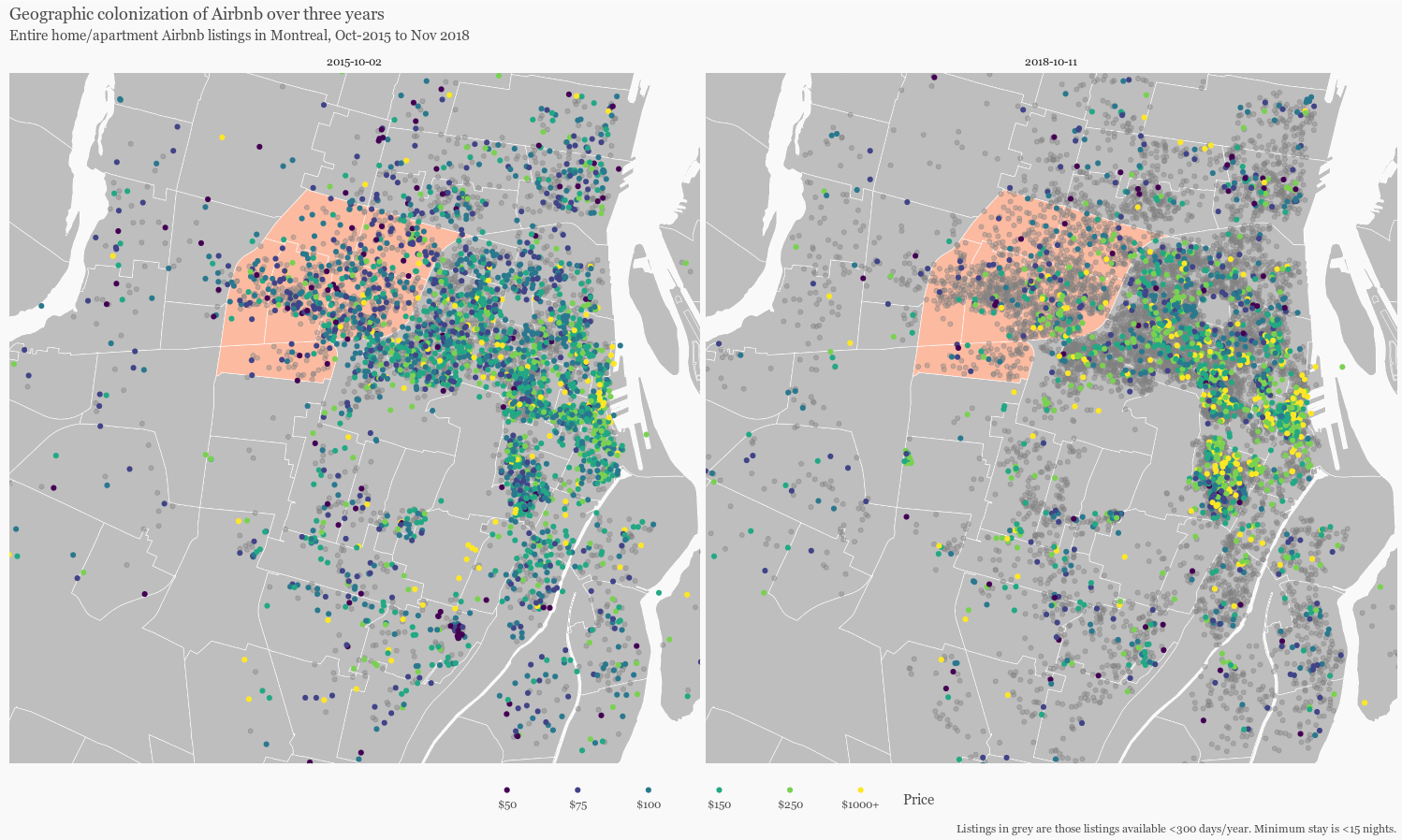 Figure 1 shows the change in the geographic distribution of Airbnb offerings over a period of three years, from October 2015 to 2018. To simplify the plot, only entire-home listings with a 14 or fewer required minimum number of nights are included. Private rooms or shared rooms are omitted. Listings in grey are those available at most 300 days per year. Listings with availability greater than 300 days per year are coloured according to their price bin. Finally, coloured segments of the map show the location of Parc Ex and the neighbouring boroughs of Rosemont, Villeray, and La Petite Patrie. From 2015 to 2018, a much higher density of entire-home, short-term listings is observed in these communities. One interesting change is that there appears to be a higher prevalence of listings available fewer than 300 days a year. Note that having such an availability does not mean that the presence of Airbnb rentals cannot disrupt local economies since the measure of availability provided by Airbnb does not distinguish booked from unavailable properties. In short, the availability of properties could be underestimated. Indeed, a greater number of available Airbnb apartments overall signals a serious departure from the typical long-term housing that dominated these neighbourhoods in previous decades.
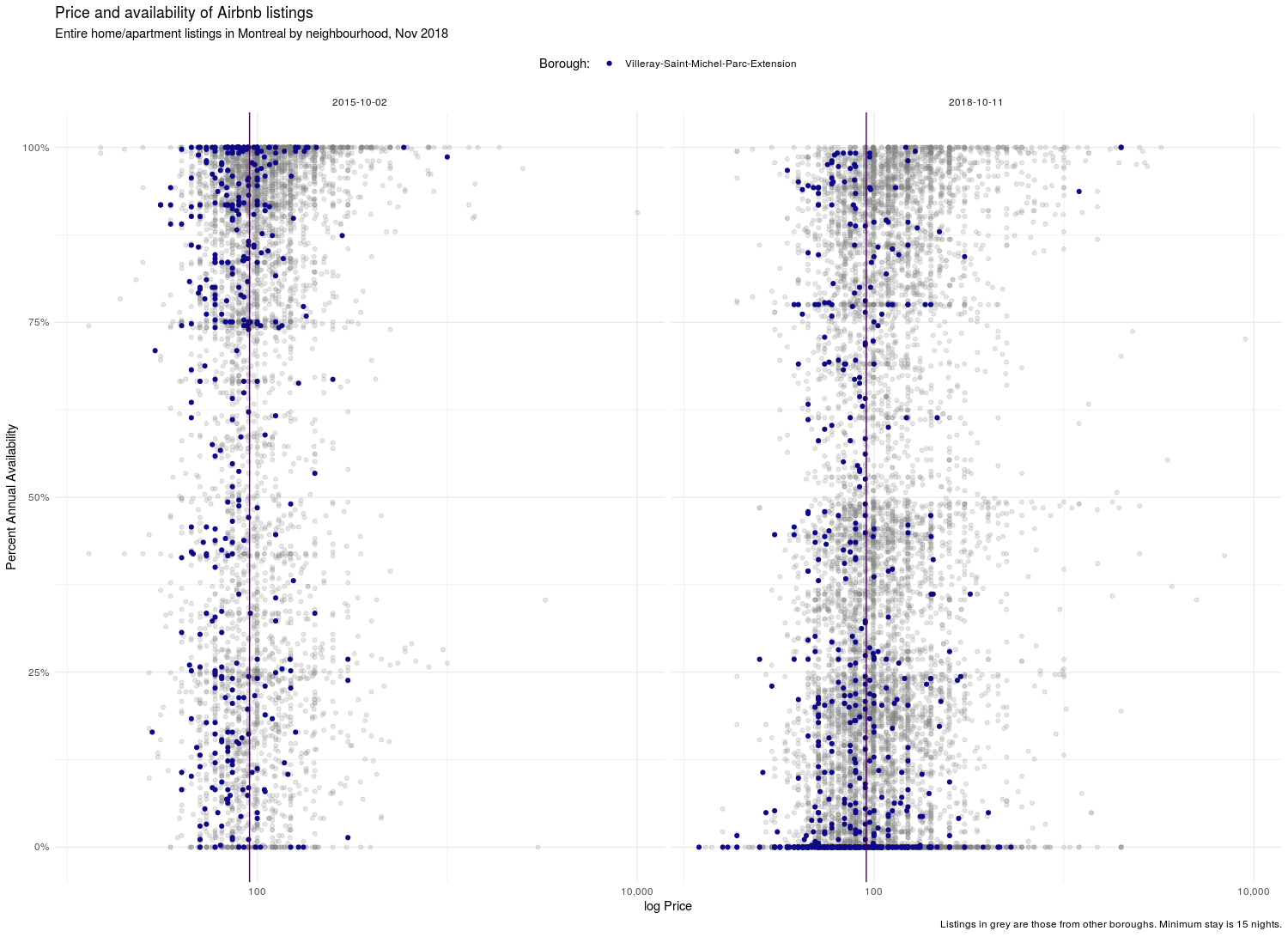 Figure 2 is a scatterplot of entire-home Airbnb listings between October 2015 and 2018 according to their price and their percent annual availability. Coloured points correspond to the borough of Villeray-Saint-Michel-Parc-Extension (VSMPE). The data leads to the same conclusion as Figure 1: that there are indeed fewer listings advertised as available 100 percent of the year. The distribution of price remains remarkably untouched. Although certainly higher with a wider distribution for other neighbourhoods, the mean for VSMPE does not appear to have changed much.
All data was taken from Inside Airbnb, an independent, non-commercial site that regularly scrapes listings data from the Airbnb website. Mapping is done using open-source geographic data from Statistics Canada. One data gap that limits the scope of this project is the lack of eviction data. Eviction rules and tracking differ across provinces, and as of today, there is no centralized database which shows neither prevalence nor cause of eviction. With that said, the large increases in Airbnb listings in VSMPE warrant further investigation as to how the short-term rental platform affects the long-term housing market of this borough and the rest of Montreal.