This project demonstrates an end-to-end Azure Data Engineering pipeline using Azure Data Factory, Databricks, Data Lake Gen2, Delta Live Tables, and Unity Catalog. The pipeline is designed to ingest, process, and transform incremental data using AutoLoader and Delta Live Tables (DLT) while ensuring secure data access between Databricks and Data Lake Gen2 using Access Control.
- Azure Data Factory (ADF) – Data ingestion from GitHub to Azure Data Lake Gen2
- Azure Data Lake Gen2 (ADLS Gen2) – Storage for raw and transformed data
- Azure Databricks & AutoLoader – Incremental data processing
- Delta Live Tables (DLT) – Automated and scalable data transformation
- Parameterized Databricks Notebooks – Dynamic and reusable transformation logic
- Unity Catalog (Databricks) – Storage for structured (Gold Layer) datasets
- Azure Databricks Access Connector – Secure access between Databricks and ADLS Gen2
- Azure Key Vault – Secure credentials management
- Notebook-Based Scheduling – Conditional execution based on the 7th day of the week
- Power BI (Planned Enhancement) – Interactive data visualization and reporting
- Data is extracted from GitHub and ingested into the Bronze Layer of Azure Data Lake Gen2 using Azure Data Factory (ADF).
- The process includes metadata extraction, validation, and file iteration.

- AutoLoader in Azure Databricks is used to load incremental data into the Bronze Layer of Azure Data Lake Gen2.
- AutoLoader enables schema evolution, efficient file discovery, and optimized ingestion.
- The raw data is stored in Delta format to support further transformations.
- Parameterized Databricks Notebooks are used for flexible transformations, allowing dynamic configurations.
- The raw data from the Bronze Layer is cleansed, transformed, and stored in the Silver Layer of Azure Data Lake Gen2.
- Delta Live Tables (DLT) ensure automated, scalable, and fault-tolerant transformations.
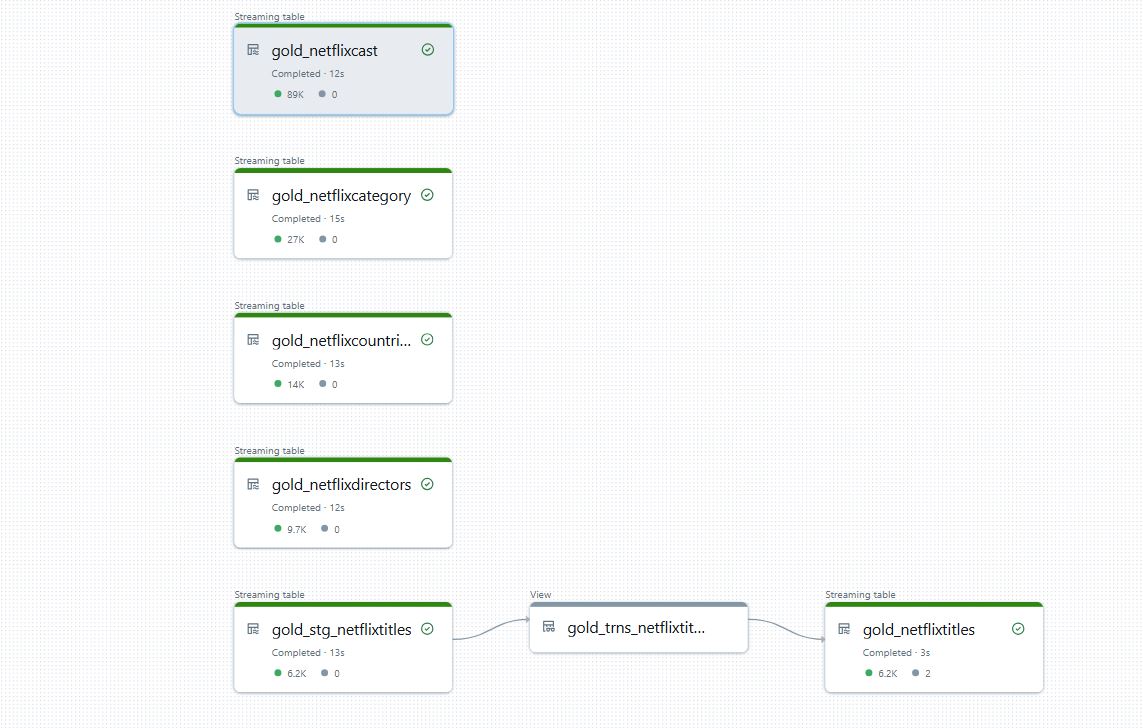
- The structured and processed data is stored in Unity Catalog to enable centralized governance, fine-grained access control, and optimized querying.
- The pipeline includes a notebook-based conditional scheduling mechanism.
- A Weekday Lookup Notebook checks if the current day is the 7th day of the week.
- If True, the SilverMasterData notebook executes.
- If False, an alternative notebook FalseNoteBook runs.
The data pipeline follows a structured Bronze-Silver-Gold architecture. The detailed data flow diagram can be viewed here:

- Secure Data Access
- Azure Databricks Access Connector ensures secure, RBAC-controlled access to ADLS Gen2.
- Incremental Data Processing
- AutoLoader efficiently loads real-time incremental data into the Bronze Layer.
- Optimized & Flexible Transformation
- Parameterized Notebooks allow dynamic data processing configurations.
- Delta Live Tables (DLT) automate transformations for scalability and efficiency.
- Automated Scheduling & Conditional Execution
- The pipeline dynamically determines whether to process Silver data or execute an alternative workflow based on the day of the week.
- Centralized Governance with Unity Catalog
- The Gold Layer is stored in Unity Catalog, ensuring fine-grained access control, schema governance, and Databricks SQL compatibility.
- Implement CI/CD with Azure DevOps for seamless deployment.
- Optimize querying performance by integrating Azure Synapse Analytics.
- Extend Unity Catalog policies for better governance and security.
- Integrate with Power BI for interactive reporting and dashboards.