


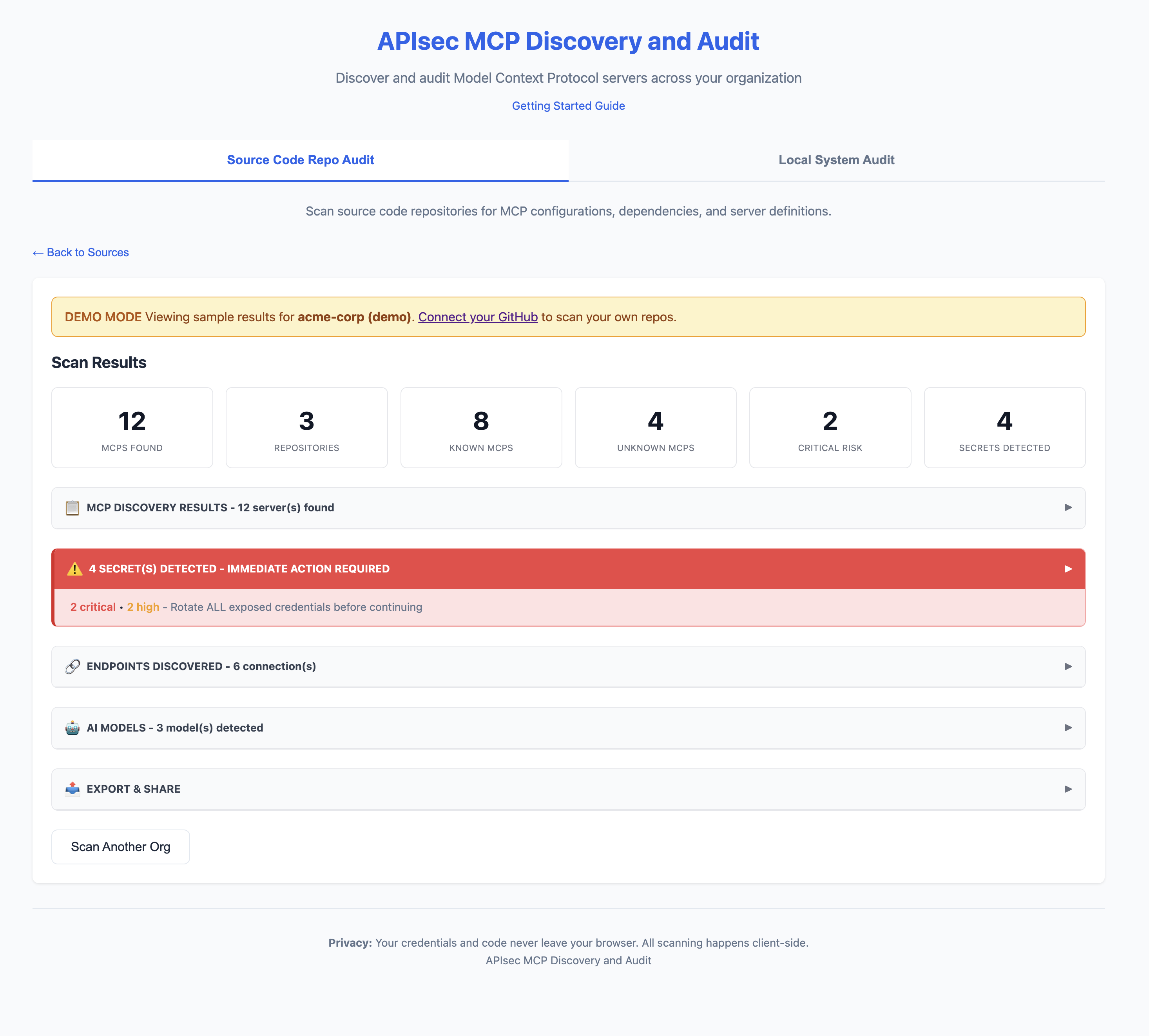
See what your AI agents can access - before they go live.
Web App
CLI
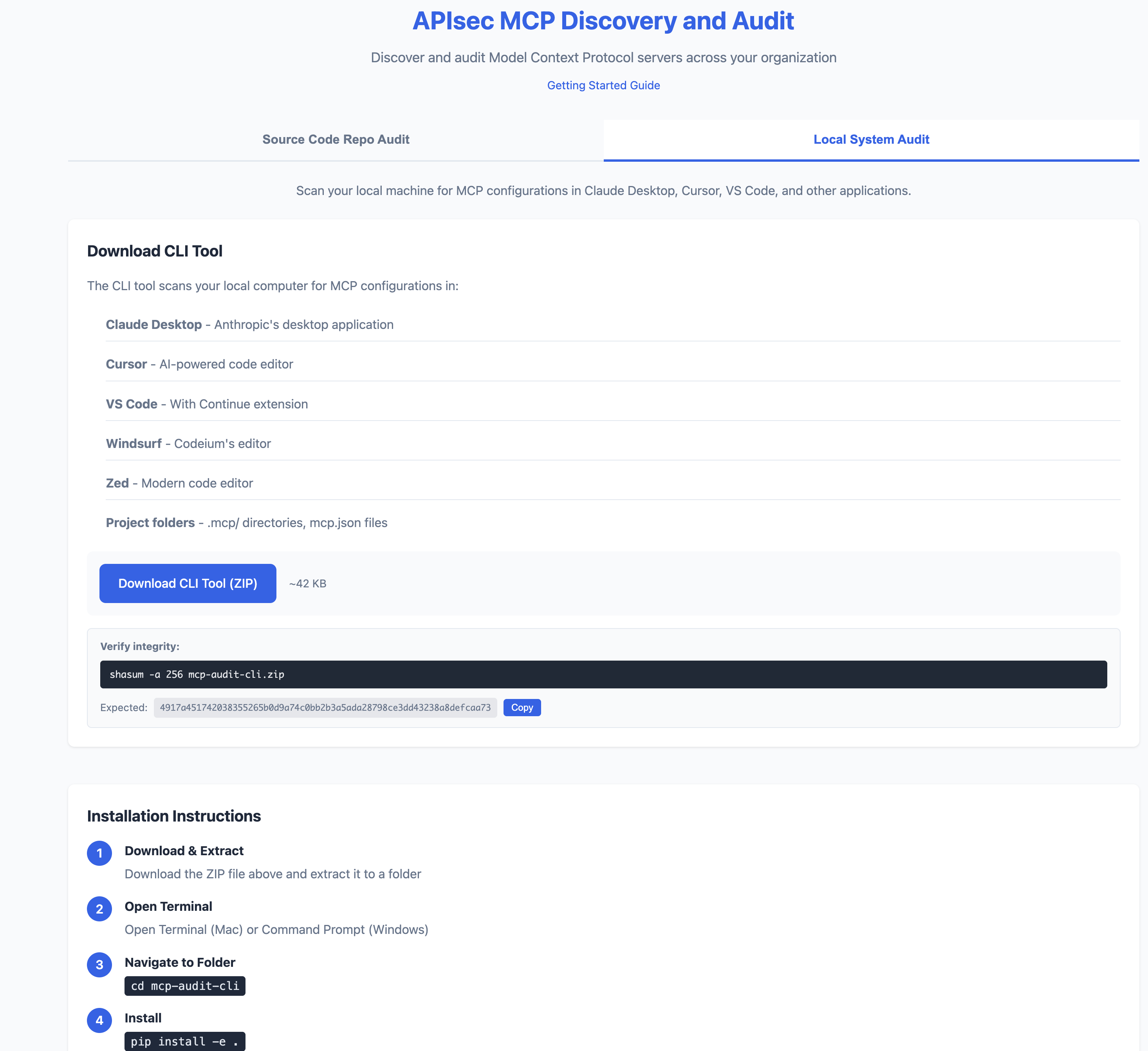


# Install
pip install -e .

# Scan your machine
mcp-audit scan

# Or try the web app (no install)
# https://apisec-inc.github.io/mcp-audit/?demo=trueMCP Audit scans your AI development tools (Claude Desktop, Cursor, VS Code) and reveals:
- Secrets - Exposed API keys, tokens, database passwords
- APIs - Every endpoint your AI agents connect to
- AI Models - Which LLMs are configured (GPT-4, Claude, Llama)
- Risk Flags - Shell access, filesystem access, unverified sources
⚠️  2 SECRET(S) DETECTED - IMMEDIATE ACTION REQUIRED

[CRITICAL] GitHub Personal Access Token
  Location: github-tools → env.GITHUB_TOKEN
  Remediation: https://github.com/settings/tokens → Delete → Recreate

[HIGH] Database Connection String
  Location: postgres-mcp → env.DATABASE_URL
  Remediation: Rotate credentials, use secrets manager
mcp-audit scan inventories MCP server configurations. The new mcp-audit source-scan command goes one level deeper — it reads the MCP server's own source code and flags code-level vulnerabilities the server author may have introduced.
Today it catches the "Prompt In, Shell Out" attack chain: an MCP server that pipes an LLM-controlled tool argument into a shell-spawning API (child_process.exec, util.promisify(exec), subprocess.run(shell=True), os.system, os.popen) without sanitization. An attacker controlling the LLM input can inject shell metacharacters and execute arbitrary code on the host running the MCP server.
$ mcp-audit source-scan ./packages/my-mcp-server

MCP source-scan: packages/my-mcp-server
1 critical · 0 high · 1 finding(s) total

  Severity  Conf  File:Line      API                                          Snippet
  CRITICAL  high  server.js:19   util.promisify(child_process.exec) ...       const { stdout } = await execAsync(
Outputs:
--format table(default, human-readable)--format json(CI integrations, jq pipelines)--format sarif(upload to GitHub code-scanning / GitLab / similar)
Gate merges on critical findings:
mcp-audit source-scan ./my-mcp --exit-codeThe scanner is intentionally narrow — it only opens files that look like MCP server source (imports an MCP SDK). It won't try to find shell-injection bugs in random Node / Python code; that's not the job.
After running mcp-audit scan, you'll see a nudge in the summary suggesting source-scan against any in-house or unverified servers it discovers.
| Scan Type | Finds |
|---|---|
| GitHub Scan | MCP configs committed to repositories (mcp.json, .mcp/, claude_desktop_config.json, etc.) |
| Local Scan | MCP configs on your machine (Claude Desktop, Cursor, VS Code, Windsurf, Zed) |
| Source Scan (v1.1) | Code-level vulnerabilities in MCP server source (JS/TS/Python): shell-injection sinks (child_process.exec, util.promisify(exec), subprocess.run(shell=True), os.system, os.popen) called with interpolated tool arguments |
| Blind Spot | Why |
|---|---|
| Secrets in environment variables at runtime | We scan config files, not running processes |
| Configs pulled from secrets managers | Vault, AWS Secrets Manager, etc. are not scanned |
| Dynamically generated configs | Configs created at runtime aren't in files |
| MCPs installed but not configured | No config file = nothing to scan |
| Private repos you don't have access to | GitHub scan is limited by your PAT scope |
| Encrypted or obfuscated secrets | Pattern matching won't catch encoded values |
| Non-standard config locations | Custom paths outside known locations |
A clean scan does not mean zero risk.
- Developers may have MCPs configured on machines you haven't scanned
- Configs may exist in repos outside your GitHub org
- Runtime behavior may differ from static configuration
MCP Audit provides visibility, not guarantees. Use alongside runtime monitoring and security reviews.
Fail builds on critical risks:
# .github/workflows/mcp-audit.yml
name: MCP Security Audit
on: [push, pull_request]

jobs:
  audit:
    runs-on: ubuntu-latest
    steps:
      - uses: actions/checkout@v4

      - name: Install MCP Audit
        run: pip install mcp-audit

      - name: Run Security Scan
        run: mcp-audit scan --path . --format json -o mcp-report.json

      - name: Fail on Critical
        run: |
          CRITICAL=$(jq '[.mcps[] | select(.risk == "critical")] | length' mcp-report.json)
          if [ "$CRITICAL" -gt 0 ]; then
            echo "❌ Found $CRITICAL critical-risk MCPs"
            exit 1
          fi

      - name: Upload AI-BOM
        uses: actions/upload-artifact@v4
        with:
          name: ai-bom
path: mcp-report.jsonIf you ship an in-house MCP server, gate merges on critical code-level findings:
# .github/workflows/mcp-source-scan.yml
name: MCP Source Scan
on: [pull_request]

jobs:
  source-scan:
    runs-on: ubuntu-latest
    steps:
      - uses: actions/checkout@v4
      - run: pip install mcp-audit

      # Fail the PR if any critical shell-injection findings are detected.
      - name: Source-scan in-house MCP server
        run: mcp-audit source-scan ./packages/my-mcp-server --exit-code

      # OR: upload findings to GitHub code-scanning instead of failing.
      - name: Source-scan -> SARIF
        run: mcp-audit source-scan ./packages/my-mcp-server --format sarif --output mcp.sarif
      - uses: github/codeql-action/upload-sarif@v3
        with:
sarif_file: mcp.sarif# JSON (for CI/CD)
mcp-audit scan --format json -o report.json
# AI-BOM (CycloneDX 1.6)
mcp-audit scan --format cyclonedx -o ai-bom.json
# SARIF (GitHub Security integration)
mcp-audit scan --format sarif -o results.sarif
# CSV / Markdown
mcp-audit scan --format csv -o report.csv
mcp-audit scan --format markdown -o report.md
# PDF Report via Email
mcp-audit scan --email security@company.com| Feature | Description |
|---|---|
| MCP Discovery | Find MCPs in Claude Desktop, Cursor, VS Code, Windsurf, Zed |
| Secrets Detection | 25+ secret patterns with provider-specific remediation |
| API Inventory | Database, REST, SSE, SaaS, Cloud endpoints |
| AI Model Detection | OpenAI, Anthropic, Google, Meta, Mistral, Ollama |
| OWASP LLM Top 10 | Maps findings to OWASP LLM Top 10 (2025) framework |
| AI-BOM Export | CycloneDX 1.6 for supply chain compliance |
| SARIF Output | GitHub Security integration with OWASP tags |
| Registry | 50+ known MCPs with risk classifications |
| Web App | CLI Tool | |
|---|---|---|
| Scans | GitHub repositories | Local machine |
| Install | None (browser) | Python 3.9+ |
| Best for | Org-wide visibility | Deep local analysis |
| Privacy | Token stays in browser | 100% local |
Web App: https://apisec-inc.github.io/mcp-audit/
mcp-audit scan                    # Full inventory scan
mcp-audit scan --secrets-only     # Only secrets
mcp-audit scan --apis-only        # Only API endpoints
mcp-audit scan --models-only      # Only AI models
mcp-audit scan --verbose          # Detailed output
mcp-audit scan --path ./project # Specific directorysource-scan is a separate command from scan. scan inventories MCP configurations; source-scan reads MCP server source code and flags code-level vulnerabilities. See docs/SOURCE_SCAN.md for the full guide.
mcp-audit source-scan ./my-mcp                         # Table output (default)
mcp-audit source-scan ./my-mcp --format json           # JSON for jq pipelines
mcp-audit source-scan ./my-mcp --format sarif          # SARIF for code-scanning
mcp-audit source-scan ./my-mcp --output mcp.sarif      # Write to file
mcp-audit source-scan ./my-mcp --exit-code             # CI gate (non-zero on critical)
mcp-audit source-scan ./my-mcp --explain # Inline remediation guidancemcp-audit scan --format json -o report.json # JSON output
mcp-audit scan --format csv -o report.csv # CSV output
mcp-audit scan --format markdown -o report.md # Markdown output
mcp-audit scan --format cyclonedx -o ai-bom.json # CycloneDX 1.6 AI-BOM
mcp-audit scan --format sarif -o results.sarif # SARIF for GitHub Security
mcp-audit scan --email security@company.com # PDF report via emailmcp-audit registry # List all known MCPs
mcp-audit registry --risk critical # Filter by risk
mcp-audit registry lookup "stripe" # Search registrymcp-audit explain shell-injection-in-source # Full remediation guidance
mcp-audit explain --list # All known risk flags| Level | Meaning | Examples |
|---|---|---|
| 🔴 CRITICAL | Full system access | Database admin, shell access, cloud IAM |
| 🟠 HIGH | Write access | Filesystem write, API mutations |
| 🟡 MEDIUM | Read + limited write | SaaS integrations, read-only DB |
| 🟢 LOW | Read-only | Public APIs, memory storage |
| Severity | Types |
|---|---|
| 🔴 Critical | AWS Keys, GitHub PATs, Stripe Live Keys, DB Credentials |
| 🟠 High | Slack Tokens, OpenAI Keys, Anthropic Keys, SendGrid |
| 🟡 Medium | Webhooks, Generic API Keys |
- Web App: GitHub token never leaves your browser
- CLI: Runs 100% locally, no telemetry
- PDF Reports: Only summary data sent (no secrets)
# Clone and install
git clone https://github.com/apisec-inc/mcp-audit.git
cd mcp-audit
pip install -e .

# Verify
mcp-audit --help
Requires Python 3.9+
# Build image
docker build -t mcp-audit .

# Scan current directory
docker run -v $(pwd):/scan mcp-audit scan

# Scan with JSON output
docker run -v $(pwd):/scan mcp-audit scan --format json -o /scan/report.jsonAll MCP Audit releases include SHA256 checksums.
# Download the checksum file
curl -O https://github.com/apisec-inc/mcp-audit/releases/latest/download/CHECKSUMS.txt

# Verify the zip file
shasum -a 256 -c CHECKSUMS.txt --ignore-missing
Expected output:
mcp-audit-cli.zip: OK
| File | SHA256 |
|---|---|
mcp-audit-cli.zip |
4917a451742038355265b0d9a74c0bb2b3a5ada28798ce3dd43238a8defcaa73 |
Full checksums: CHECKSUMS.txt
- Risk Scoring - How risk levels and flags are assigned
- Contributing - Guidelines for contributors
MIT - see LICENSE
Built by APIsec