



Harden your Rust with specifications.
The detailed reference is here: The Anodized Reference.
anodized is to specification what serde is to serialization: a common layer that connects your code to an ecosystem of tools.
Write preconditions, postconditions, loop invariants, and type refinements directly in standard Rust. Validate them with runtime checks, fuzzers, model checkers, or formal provers - without rewriting your specs when you switch or combine tools.
- highly expressive: Write specs in the Rust you already know - call functions, use macros, write
ifandmatchexpressions. - deeply integrated: Syntax-checked, type-checked, and understood by
rust-analyzerout of the box. No special toolchain components needed. - widely compatible: Validate the same specs with any combination of runtime checks, fuzzers, model checkers, or formal provers.
1. Add Anodized to your project.
[dependencies]
anodized = { version = "0.5.1" }
2. Extend your code with specs.
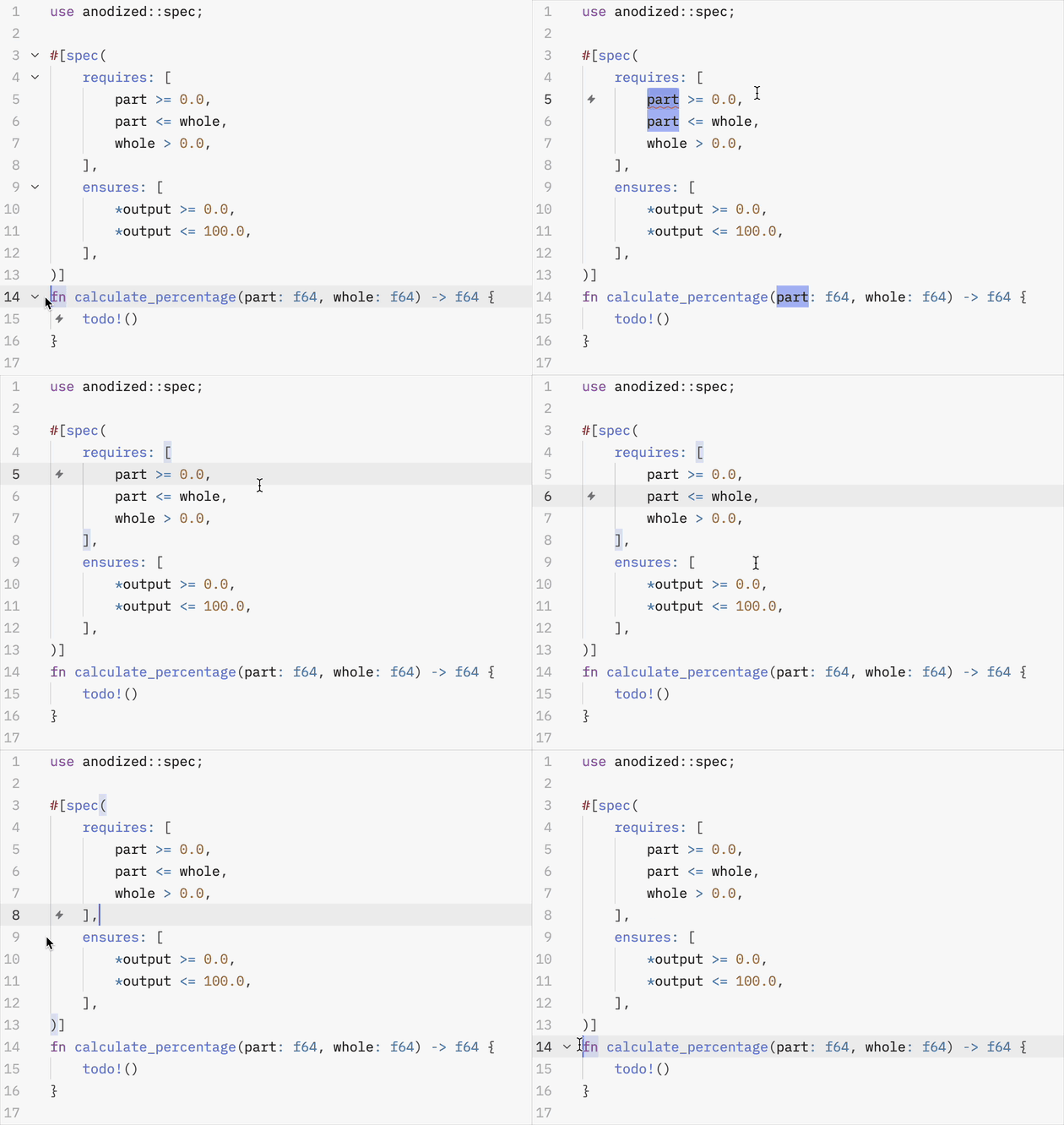
Use the #[spec] attribute to attach preconditions and postconditions to functions, invariants to loops, and refinements to data types. Each condition is a standard Rust expression that evaluates to bool.
use anodized::spec;

#[spec(
    requires: [
        part >= 0.0,
        part <= whole,
        whole > 0.0,
    ],
    ensures: [
        *output >= 0.0,
        *output <= 100.0,
    ],
)]
fn calculate_percentage(part: f64, whole: f64) -> f64 {
    100.0 * part / whole
}
3. Validate your code against the specs.
Use one or more enforcement tools.
The easiest is runtime checks, which Anodized provides out of the box. All you need is tests that make function calls.
#[test]
fn percentage_25_over_100() {
    // This call satisfies the spec and runs fine.
    println!("25 out of 100 = {}%", calculate_percentage(25.0, 100.0));
}

#[test]
fn percentage_10_over_0() {
    // This call violates the precondition and will panic.
    println!("10 out of 0 = {}%", calculate_percentage(10.0, 0.0));
}
Use the anodized_panic setting to instrument the code with runtime checks.
RUSTFLAGS="--cfg anodized_panic" cargo testA spec violation will cause a panic with a descriptive error message:
thread 'main' panicked at 'Precondition failed: part <= whole', src/main.rs:17:5
For more details and other approaches, see The Anodized Reference.
Rust has a growing ecosystem of excellent verification tools - Aeneas, Creusot, Flux, Hax, Kani, Prusti, Verus, and more. Each one brings unique strengths. Anodized provides a shared specification layer so that these tools, and the developers who use them, do not have to go it alone.
For developers writing specs:
- Write your specs once in standard Rust, using the language you already know.
- Validate them with runtime checks right away, without learning any new tools.
- When you are ready for deeper assurance, connect the same specs to a fuzzer, model checker, or formal verifier - without rewriting anything.
- Switch or combine tools freely. Your specs are yours, not locked to any single tool.
For developers building verification tools:
- Consume Anodized specs instead of building and maintaining a custom spec frontend.
- Focus your effort on the analysis that makes your tool unique.
- Reach developers who are already writing specs, lowering the barrier to trying your tool.
The Rust Team is building native contract support into the language. Anodized is a library-level experiment that lets developers start writing specs on stable Rust today. We hope to actively participate in the native contracts effort and contribute useful data points from practical experience with Anodized. When Rust-native contracts stabilize, we plan to offer a migration tool so that Anodized users can transition smoothly.
A core design principle of Anodized is that a spec uses standard Rust syntax. This is a deliberate choice that provides key benefits over using a custom language.
-
The Language You Already Know: No need to learn yet another language to write the specs. Write them in the one you already know: standard Rust. Call functions, use macros (like
matches!), or writeifandmatchexpressions, and so on. As long as it syntax- and type-checks, it is good to go. -
An Integral Part of Your Code: Specs are not special comments or strings; they are real Rust expressions, fully integrated with your code. The Rust compiler checks every spec for syntax and type errors, just like any other part of your code. If you misspell a variable, compare incompatible types, or make any other mistake, you will get a familiar compiler error pointing directly to the spec element that needs fixing.
The choice of "specification" (or "spec") over "contract" is deliberate. While Design by Contract has a rich history, the term "contract" is now strongly associated with blockchain. This is particularly true in Rust, which has become a leading language for smart contract development.
This naming collision hurts discoverability. Searching for "Rust contract" yields many blockchain results, not just correctness tools.
Using "specification" instead:
- Improves discoverability: Developers find correctness tools when searching for them.
- Reduces confusion: The distinction from blockchain is immediately clear.
- Maintains clarity: "Specification" accurately describes these formal behavior annotations.
The term "spec" is already familiar from test specs, API specs, and formal specifications. It conveys the same meaning as Design by Contract while avoiding modern ambiguity.
The idea of adding contracts to Rust is not new, and Anodized builds upon the great work and ideas from several other projects and discussions in the community. It is a fresh take with a strong focus on ergonomics and a forward-looking vision for an integrated ecosystem.
The contracts Crate
The most direct and popular predecessor is the contracts crate. It is a mature and feature-rich library that also provides #[requires], #[ensures], and #[invariant] attributes. It has been a major inspiration for Anodized.
Anodized differentiates itself with a few key design choices:
-
Unified Attribute: Anodized uses a single, comprehensive
#[spec]attribute, presenting each specification as one cohesive block. -
Ergonomic Focus: The design process has been heavily focused on refining the user-facing syntax (e.g. keyword choices, return value binding) to be as intuitive, approachable, and powerful as possible.
-
Ecosystem Vision: While
contractsis an excellent tool for runtime checking, Anodized is designed from the ground up to be a foundational layer for a wider ecosystem of diverse correctness tools.
Other Crates
Older crates like libhoare (a compiler plugin from before procedural macros were stabilized) and dbc explored similar ideas, proving the long-standing interest in Design by Contract within the Rust community. Anodized benefits from the modern procedural macro system, which allows for much better integration with the compiler and toolchain.
Inspiration from Other Languages
Anodized is also inspired by languages where contracts are a first-class feature, not just a library. Languages like Whiley, Eiffel, and Ada/SPARK demonstrate the power of deeply integrating formal specifications into the syntax, type system, and toolchain. The Anodized ecosystem begins with one library, but shares the great ambition of those languages: to bring a similar level of integration and ergonomic feel to Rust.
Anodized is distributed under the terms of the MIT License and the Apache License (Version 2.0). Users can choose either license, and contributors must license their changes under both.
See LICENSE-MIT and LICENSE-APACHE for details.
Contributions are welcome! Please feel free to open an issue or submit a pull request.
For detailed technical documentation including the formal specification grammar and runtime check implementation details, see the anodized-core documentation.