A developer knowledge operating system that compounds over time. Obsidian + Claude Code + Git — your second brain, built for engineers.



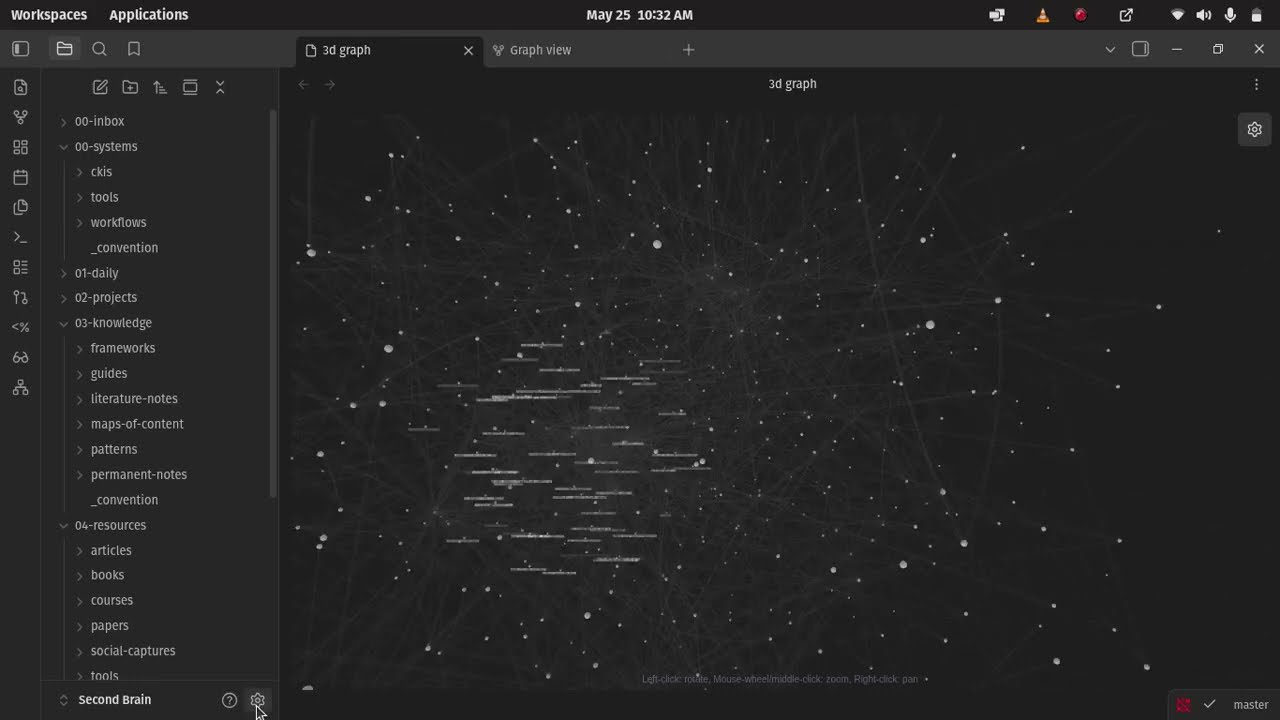
The 3D graph view — your vault as a living knowledge network.
The demo shows the vault's knowledge graph after active use:
- Cross-project connections — purple edges linking ideas across active projects
- Central nodes — your most-linked concepts surfaced automatically
- Plugin install — how to get the 3D graph view from Obsidian Community Plugins (Settings → Community plugins → Browse → "Open 3D Graph" by Alexander Weichart)
Every Claude Code session starts cold. You re-explain your projects. Decisions evaporate. Insights from last week are unreachable. Your AI assistant is brilliant in the moment but amnesiac across sessions.
Sound familiar? In 2026, a Notion vault with 822 files was audited — 90% were empty template shells. Two purchased templates stitched together, zero cross-system relations, six separate goal-tracking databases. Professionally organized, operationally unsustainable. The architecture looked good. The maintenance cost was crushing.
The failure mode is not the tool. It's the manual organization layer.
Andrej Karpathy identified the same bottleneck: in knowledge-heavy work, the constraint isn't retrieval — it's knowledge coherence. Connecting ideas across hundreds of documents, resolving contradictions, surfacing gaps. You don't need a better tool. You need a system that compiles knowledge the way a compiler builds code — incrementally, consistently, automatically.
CKIS is a structured Obsidian vault + Claude Code skill system that eliminates the manual organization layer:
- Injects full context automatically at every session start — project state, recent decisions, code architecture
- Compounds knowledge across sessions — every conversation builds on the last
- Bridges code ↔ knowledge — your codebases are queryable knowledge graphs, not just files
- Runs itself — 5 crons handle weekly reviews, memory consolidation, vault git sync, and more
You stop managing your second brain. It manages itself.
Princeton researchers showed that the same AI model performs 3× better when placed in the right environment — not a smarter model, but a better harness. OpenAI shipped 1M lines of code with 3 engineers not by switching models, but by building the linters, feedback loops, and observability tools that let agents operate at their ceiling. CKIS is that harness: three-layer memory, session context injection, and 5 automated crons that keep the environment alive without manual effort.
CKIS builds on and operationalizes ideas from across the AI and knowledge management space.
Karpathy's LLM Wiki pattern — Andrej Karpathy described a workflow where raw sources (papers, articles, repos) are compiled by an LLM into an incrementally-maintained .md wiki with summaries, cross-references, and automated lint passes — no RAG pipeline, no vector DB. At ~100 articles and ~400K words on a single topic, the wiki handles complex Q&A with no additional tooling. Every question asked improves the base. CKIS operationalizes this pattern: Obsidian is the wiki layer, Claude Code is the compiler, and 5 crons keep it self-healing.
Karpathy's four principles for AI coding agents — Karpathy identified why LLM coding assistants fail: silent assumptions, overcomplication, unwanted code changes. These observations were formalized into four principles (Think Before Coding, Simplicity First, Surgical Changes, Goal-Driven Execution) that went #1 on GitHub trending with 90k+ stars. These principles are embedded directly in CKIS's CLAUDE.md as the agent's operating rules.
Harness Engineering — Princeton research and OpenAI's internal practice show that the bottleneck in AI-assisted work isn't the model — it's the environment. Anthropic built a two-agent system where one agent sets up the environment before the other builds the product. CKIS applies this to knowledge work: the three-layer memory stack, session hooks, and automated crons are the harness that makes Claude effective across sessions, not just in them.
Context Engineering (Anthropic) — The evolution from prompt engineering to curating the optimal set of tokens at any given moment. CKIS treats every session start, skill trigger, and cron output as a context engineering decision: what is the minimal, highest-signal information the model needs right now?
PARA method (Tiago Forte) — Projects / Areas / Resources / Archive as the organizational skeleton for the vault (03-projects/, 07-areas/, 06-resources/, 11-archive/). CKIS extends PARA with additional layers: 01-systems/ for the operating system itself, 02-daily/ for temporal capture, 04-content/ for distribution, plus 08-goals/, 09-people/, and the full Dev Brain integration that PARA never anticipated.
Works on any OS. Three free tools do all the work:
| Prerequisite | What it is | Install |
|---|---|---|
| Obsidian | The markdown app that stores and visualizes your vault | obsidian.md (free) |
| Claude Code | Anthropic's AI coding agent — the intelligence layer that reads your vault and runs the skills | npm install -g @anthropic-ai/claude-code · docs |
| Git | Version control — tracks every change to your vault | git-scm.com (the gh CLI is also handy: cli.github.com) |
New to these? Obsidian is a free note-taking app where your vault is just a folder of .md files on disk. Claude Code is a terminal program (claude) you run inside that folder — it reads the included CLAUDE.md instructions and gains full context about how the system works. You drive it with plain English.
# 1. Clone this template (or click "Use this template" above)
gh repo create my-second-brain --template aedneth/ckis --private --clone
cd my-second-brain

# 2. Open the vault in Obsidian
# File → Open Vault → select this folder

# 3. Install community plugins (Settings → Community plugins → Browse)
# Essential: Obsidian Git, Templater, Dataview, Periodic Notes, Calendar

# 4. Install Claude Code (if you haven't already), then open it in this directory
npm install -g @anthropic-ai/claude-code   # one-time install
claude                                      # launch in the vault folder

# 5. Say "daily brief" — Claude now has full context and generates your first morning brief

# 6. (Optional, recommended) Install qmd for fast local vault search — replaces grep/Glob
bun install -g @tobilu/qmd   # or: npm install -g @tobilu/qmd  (needs Node >= 22)
qmd collection add . --name my-second-brain
That's it — clone and go. You don't need to read the architecture docs first. Claude reads your vault structure on launch, understands the system from the bundled CLAUDE.md, and starts compounding knowledge immediately. Every skill is triggered in plain English (see The Skill System below).
CKIS is a three-layer memory system:
┌─────────────────────────────────────────────────┐
│  Layer 3: CKIS Vault (Strategic Memory)         │
│  Obsidian + Claude Code + Git                   │
│  → Notes, decisions, goals, relationships       │
│  → Updated via 20+ skills + 5 crons             │
├─────────────────────────────────────────────────┤
│  Layer 2: Dev Brain (Engineering Memory)        │
│  ~/Documents/Dev Brain/ — auto-indexed          │
│  → Code knowledge graphs (graphify)             │
│  → Session history + wiki digest per project    │
├─────────────────────────────────────────────────┤
│  Layer 1: .brain/ (Session Memory)              │
│  Per-project, regenerated on every commit       │
│  → Working context for the current session      │
└─────────────────────────────────────────────────┘
Each layer is automatically populated. You never manually maintain the Dev Brain or .brain/ — git hooks and crons do it.
00-inbox/          # Everything enters here first (quick-capture, url-dumps, queues)
01-systems/        # CKIS architecture (22 docs) + workflows
02-daily/          # Daily notes + session logs
03-projects/       # Active projects (one folder each, with _overview.md)
04-content/        # Optional: distribution/content pipeline (empty by default, see CONVENTION.md)
05-knowledge/      # Processed knowledge (permanent-notes, MOCs, frameworks, guides, patterns)
06-resources/      # Source material (articles, books, youtube, social-captures, tools)
07-areas/          # Life areas (personal-brand, finance, health, learning, relationships)
08-goals/          # Unified goal system (annual → quarterly → monthly → weekly)
09-people/         # Relationship intelligence (clients, mentors, network)
10-templates/      # Note templates for every type
11-archive/        # Completed or inactive items
.claude/           # Claude Code config + 32 skills
CKIS ships with 32 Claude Code skills — natural language triggers that execute vault operations.
| Trigger | What it does |
|---|---|
daily brief |
Morning priorities + project pulse + inbox status |
braindump |
Capture raw thoughts → classified + filed automatically |
process inbox |
Route inbox items to correct folders with frontmatter |
project context [name] |
Full project brief in 60 seconds — status, blockers, recent sessions |
| Trigger | What it does |
|---|---|
process URL [url] |
Extract + summarize any web page → vault note |
process YouTube [url] |
Transcript → key points → literature note |
process social |
Social media captures → processed literature notes |
convert files |
Convert .docx, .pdf, images → clean markdown |
synthesize [topic] |
Find all vault notes on a topic → synthesized permanent note |
| Trigger | What it does |
|---|---|
weekly review |
Scan week → goal check → patterns → next week's focus |
knowledge consolidation |
Monthly pattern detection → update MOCs → intelligence report |
log decision [title] |
Structured decision log → routed to correct file |
| Trigger | What it does |
|---|---|
export context |
Package vault state for ChatGPT upload |
cross-model handoff |
Pass session context between Claude and ChatGPT |
ckis vault maintenance |
Health checks across all 22 architecture files |
ckis-context-handoff |
Extract full session state → paste-ready handoff doc for new tab |
claude-project-architect |
Generate vault-verified Claude.ai Project setup (name, instructions, knowledge files, first message) |
video-editor |
Cut, trim, and render brand-consistent videos with FFmpeg (demos, highlight reels) |
Full skill reference: 01-systems/ckis/20-ckis-skills-usage-guide.md
Install the 3D Graph community plugin (Open 3D Graph by Alexander Weichart) to see your vault as a navigable knowledge network.
Recommended settings: nodes sized by backlinks, colored by folder, force decay 0.4. The graph is a diagnostic — dispersed nodes mean unprocessed inbox; dense clusters mean compounding knowledge.
Full guide: 01-systems/ckis/21-obsidian-3d-graph-guide.md
The 5 habits that make the difference between a cold-start assistant and a compounding knowledge agent:
- Session start — always say
daily brieforproject context [name]before coding - Capture during — dump anything interesting to
00-inbox/quick-capture/ - Session end — log what was built and decided
- Weekly — run
weekly reviewevery Sunday (or let Cron 4 do it Friday at 17:00) - Monthly — run
knowledge consolidationto detect patterns
Full guide: 01-systems/ckis/19-agent-habits-guide.md
CKIS runs 5 crons that maintain the system without manual effort:
| Cron | Schedule | What it does |
|---|---|---|
| Cron 1: Vault git sync | Every 6h | git add . && git commit && push |
| Cron 2: CRM sort | Daily 07:30 | Sort and de-duplicate inbox items |
| Cron 3: Content discovery | Configurable | Surface new content to process |
| Cron 4: Weekly review | Fri 17:00 | Auto-runs ckis-weekly-review skill |
| Cron 5: Memory consolidation | 1st of month | Rewrites _MEMORY.md from vault state |
Setup guide: 01-systems/ckis/17-crons-architecture.md
A knowledge base with no backup is a liability. CKIS ships a self-hosting, declarative backup system — see backup-system/.
- 3-2-1: local + private GitHub remotes (off-site) + external-drive git bundles (off-device).
- Declarative: one
ckis-manifest.jsonclassifies every path (track/regenerable/secret/sensitive/snapshot). Adding a repo or tool is one entry. - Three rings of autonomy: push on session end, a daily
systemd --usersafety net (self-heals missing remotes, aggregates, runs physical), and a one-line health status in your session banner. - Plug-and-play restore:
ckis-restore.shrebuilds everything on a fresh machine/OS; only secrets are re-provisioned by hand (never in backup). - Zero heavy deps (
bash,git,jq,rsync,flock) and a pure-bash test suite (bash backup-system/tests/run.sh).
Start here: backup-system/README.md.
The same backup-system/ ships two optional, declarative autonomy layers — add one manifest block, no extra code:
- Search-index auto-refresh (
search_indexblock) — if you use qmd for local vault search, the backup reconcile re-indexes on every run (and a session-end hook does it instantly), soqmd searchstays fresh for edits made in Obsidian, mobile, or any agent. Best-effort: a stale index never fails a backup. - Reflux engine (
refluxblock +ckis-reflux-all) — keeps your canonical "heart docs" (_MEMORY/_ACTIVE-PROJECTS/_INTERESTS/_PROFILE) fresh from accumulated session activity via a headless model call (e.g.claude -p). Propose-only by default: it drafts an update + diff into a quarantine queue and never overwrites a live doc until you runckis-reflux-all --apply <queuefile>. Every proposal passes structural guards (frontmattercreatedimmutable, no section heading dropped, no shrink below a threshold, line cap, secret-scan) or it's rejected. Asystemd --usertimer runs it daily, cadence-throttled so it's never noisy; pending proposals surface in your session banner. This closes the gap where a vault grows for months while its canonical state files quietly go stale.
Both are off until you add the block; remove the block to disable. See backup-system/ckis-manifest.example.json.
CKIS v1.0 (April 2026) started as a simple answer to one question: how do you stop a second brain from becoming 822 empty files?
The answer was radical simplicity: Obsidian = storage layer, Claude Code = intelligence layer. One folder structure. One set of skills. One processing rule (everything enters 00-inbox/ first). No manual organization.
From that foundation, CKIS evolved through compounding insight:
- v1.0 — Vault structure + CLAUDE.md + 10 basic skills
- v2.0 — Per-project
.brain/layer + graphify code indexing + git hooks - v2.1 — Dev Brain autonomous pipeline (sessions/index.md, wiki digest, query-all.sh)
- v2.2 — 5 crons + multi-agent architecture (Opus orchestrator) + full skill audit
- v2.3 — Complete folder structure, 3D graph guide, Apache 2.0, agentmemory evaluation
The vision was always an Agentic OS: a system that manages itself while you focus on building. Each version moved further from "tool you maintain" toward "system that compounds autonomously."
Full architecture: 01-systems/ckis/00-ckis-master-context.md
| Plugin | Purpose |
|---|---|
| Obsidian Git | Auto-commit version control |
| Templater | Dynamic note templates |
| Dataview | Query your vault like a database |
| Calendar | Daily notes navigation |
| Periodic Notes | Auto weekly/monthly note creation |
| 3D Graph (Open 3D Graph) | Visualize knowledge connections |
| Plugin | Purpose |
|---|---|
| Copilot | Chat with your vault |
| Smart Connections | AI-powered note linking |
| Omnisearch | Full-text vault search |
| Excalidraw | Visual thinking and diagrams |
Tools CKIS integrates with, was built alongside, or evaluated against. Each solves a different layer of the problem.
graphify · @safishamsi · MIT · ✅ Active
The code knowledge graph engine powering Dev Brain (Layer 2). Indexes codebases — 31+ languages plus PDFs and markdown — into queryable knowledge graphs via tree-sitter AST parsing and LLM semantic extraction. Outputs: interactive HTML visualization, markdown architecture report, queryable JSON graph. Wired to CKIS via git post-commit hooks so every commit auto-updates the Dev Brain.
Strengths: MCP server for real-time Claude Code queries · confidence scoring (EXTRACTED / INFERRED / AMBIGUOUS) · relationship intelligence (god nodes, surprising cross-module connections) · zero manual curation
Limitations: Python 3.10+ required · full semantic extraction needs an API key (Claude / OpenAI / Gemini; Ollama fallback available)
Install: uv tool install graphifyy (double-y on PyPI)
qmd · MIT · ✅ Active
Local search engine for the vault — replaces grep/Glob for broad lookups so agents burn far fewer tokens finding things. Indexes all .md files into a SQLite FTS5 + vector store; qmd search (BM25 full-text) is instant and needs no embeddings. qmd vsearch/qmd query add semantic + hybrid + LLM-reranked search on top, fully local (no API keys, no network calls after the one-time model download).
Strengths: Zero-config full-text search, instant, no embeddings required · fully local/offline · MCP server (qmd mcp) for direct agent integration · hybrid BM25 + vector + rerank pipeline when semantic search is enabled
Limitations: Semantic search (qmd embed) runs a local inference model and is hardware-dependent — works well on a discrete GPU or modern CPU, but can be slow or crash on weak/integrated GPUs (Vulkan driver issues observed on older integrated graphics). BM25-only qmd search has no such limitation and covers most lookup needs on its own.
Install: bun install -g @tobilu/qmd (or npm install -g @tobilu/qmd with Node ≥22), then qmd collection add <vault-path> --name <vault-name> once. See .claude/CLAUDE.md → Search.
Obsidian · Obsidian · Proprietary (free personal use) · ✅ Required
The markdown storage and visualization layer. CKIS is a standard Obsidian vault — all files are plain .md and work without Obsidian, but you lose the 3D graph view, Dataview queries, and the plugin ecosystem.
GitNexus · @abhigyanpatwari · PolyForm Noncommercial
Code intelligence engine with 16 MCP tools. Runs entirely in-browser via WebAssembly (no install required), blast radius detection (pre-commit impact analysis), hybrid BM25 + semantic search, coordinated multi-file refactoring. Referenced in the Claude Code community as the dependency mapping tool behind zero-regression 100% AI-written code workflows.
Strengths: More MCP tools than Graphify · interactive browser UI, no install · git-diff impact analysis · coordinated rename across 50+ files
Limitations: PolyForm Noncommercial license restricts commercial use
Consider when: You want interactive code exploration UI or deeper MCP tool density in Cursor / Claude Code
MemPalace · @mempalace · MIT
Local-first semantic memory system with 29 MCP tools. Organizes memory by people / projects / topics (method of loci metaphor), achieves 96–98% retrieval recall via local vector embeddings, no cloud required, verbatim storage (no summarization loss), multi-agent memory isolation.
Strengths: No cloud dependency · verbatim recall · multi-agent memory sharing across specialist agents · temporal knowledge graphs
Limitations: Overlaps with CKIS Cron 5 (memory consolidation) + auto-memory at typical vault scale
Consider when: 2,000+ note vaults, multi-agent systems, or shared team memory
Evaluation: 01-systems/ckis/18-memory-architecture.md
claude-mem · @thedotmack · Apache 2.0
Session compression for Claude Code: 5 lifecycle hooks (SessionStart, UserPromptSubmit, PostToolUse, Stop, SessionEnd) capture observations → AI compresses → injects relevant context at next session start. Web viewer at localhost:37777, natural-language search via built-in skill.
Strengths: Lightweight · tight Claude Code lifecycle integration · token-cost visibility (progressive disclosure) · real-time web viewer
Limitations: Claude Code–specific; overlaps with CKIS auto-memory + session logs for full vault users
Consider when: Developers who want session persistence without building a full vault
Evaluation: 01-systems/ckis/18-memory-architecture.md
agentmemory · @rohitg00 · MIT
Reactive auto-capture from 12 lifecycle hooks → BM25 + vector + graph hybrid index → SessionStart injection. Neuroscience-inspired memory tiers (working / episodic / semantic / procedural) with automated decay and contradiction resolution. Claims 92% token reduction and 95% retrieval accuracy.
Strengths: Fully automatic (zero manual capture) · hybrid retrieval (BM25 + semantic + graph) · MCP integration
Limitations: Runtime vector/SQLite store — not human-readable markdown; operational complexity at <2,000 note scale
Consider when: 2,000+ notes, multi-user teams, or when the synthesize skill returns noisy/slow results
Evaluation: 01-systems/ckis/22-optional-agentmemory-integration.md
CKIS is an open template — adapting it to your workflow is the point. Contributions to the architecture, skills, and guides are welcome.
See CONTRIBUTING.md for guidelines. For bugs: open an issue. For architecture discussions: start a discussion.
Apache 2.0 — use freely, fork freely, build on it commercially. Attribution required. See LICENSE.
Built by the CKIS community. Original author: @aedneth.