



Automate Git, Jujutsu, and the GitHub / GitLab / Gitea forges from Rust.
vcs-toolkit drives the command-line tools you already have — git, jj, gh,
glab, tea — and hands you their output as typed Rust values. No libgit2, no
FFI, no reimplemented Git: you get the real tools' exact behavior, config, and
credentials, behind a clean async API. There's even a Model Context
Protocol (MCP) server, so an AI agent can drive
your repositories safely.
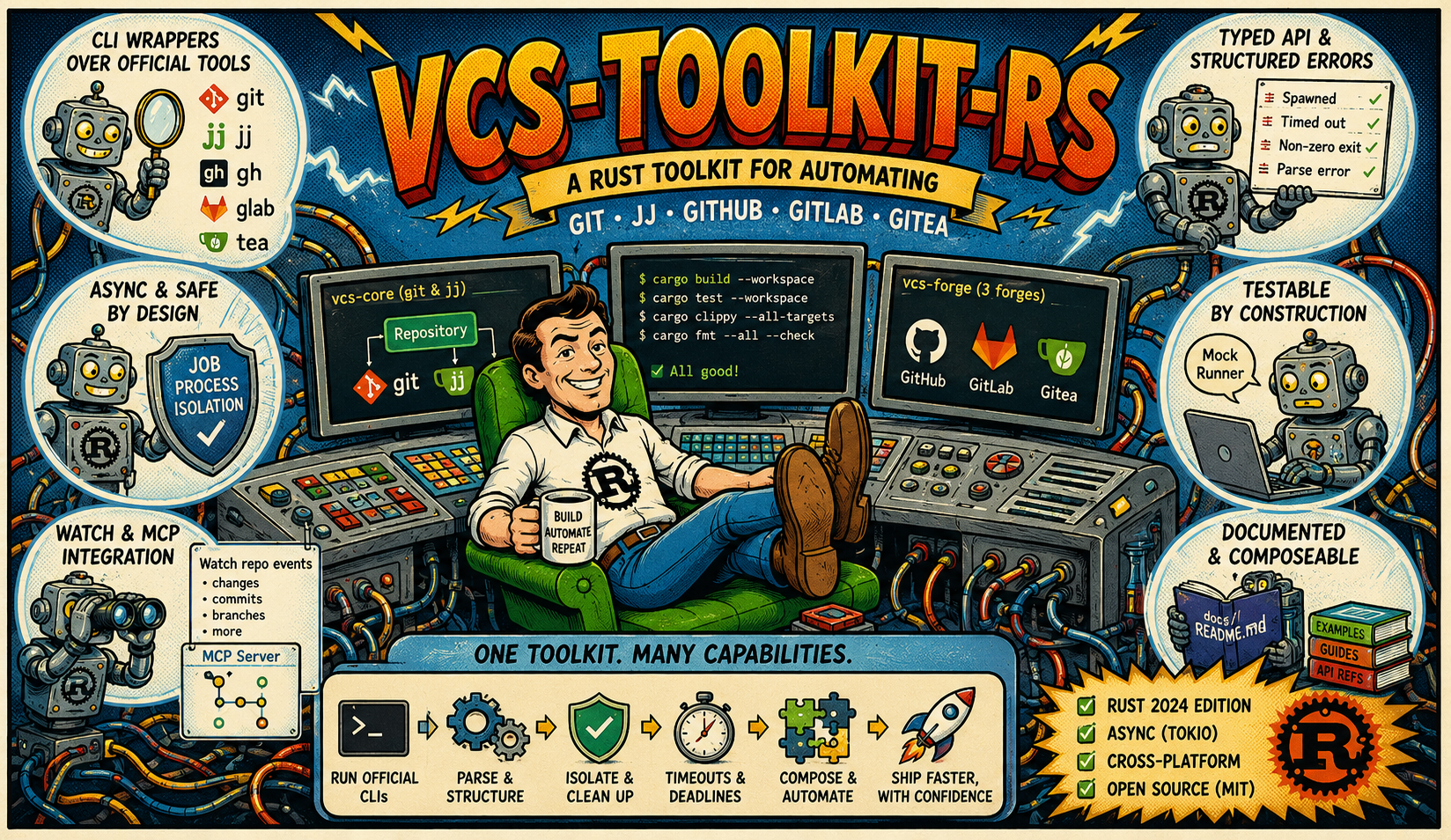
Every command is async (tokio) and runs inside an OS job (a Windows Job
Object or a Linux cgroup v2) so the whole process tree dies with the parent — no
orphaned subprocesses. That mechanism comes from the external
processkit crate, which also provides
timeouts, the structured Error, and the test seams these wrappers build on.
vcs-toolkit covers the everyday automation surface for git, Jujutsu, and the three forges — in plain terms:
- Drive git or Jujutsu directly — status, branches/bookmarks, commit, diff,
log, merge & rebase, worktrees, tags, blame, clone, and more, through one typed
async API per tool (
vcs-git,vcs-jj). - Treat "the repository" as one thing — a single
Repothat auto-detects whether a directory is git or jj and runs whatever both support, so your code doesn't have to care which it is (vcs-core). - Automate code forges — list, open, review, and merge pull/merge requests, and
manage issues and releases, on GitHub, GitLab, and Gitea — one API across all three
(
vcs-forge); read CI status on the forges that expose it (GitHub, GitLab). - React to repository changes — stream typed events (HEAD moved, branch
switched, a conflict appeared, the working copy changed…) as they happen
(
vcs-watch). - Supply credentials per operation — by default every backend uses the CLI's own
ambient auth; opt in to a
CredentialProvider(CI token, vault, per-account) and the secret is injected per call (GH_TOKEN/GITLAB_TOKENfor forges, an inline git credential helper for HTTPS) — kept out ofargvand never persisted. - Give an AI agent safe repo access — a ready-made MCP server exposes every
operation as an agent-callable tool, with writes gated off by default
(
vcs-mcp). - Test it all without the real tools — point your code at a mock or canned
command output; no installed binary, temp repo, or network needed
(
vcs-testkit).
Pick the crate that matches your task — each links to its guide:
- Control a repo, git or jj →
vcs-core(the unifiedRepo— the usual starting point). - Just one VCS →
vcs-gitorvcs-jj. - A code forge →
vcs-forgefor all three, orvcs-github/vcs-gitlab/vcs-giteadirectly. - Watch a repo for changes →
vcs-watch. - Serve operations to an AI agent →
vcs-mcp. - Write tests against a repo →
vcs-testkit.
- No reinvented protocols. You get exactly the behaviour of the
git/jj/gh/glab/teayou already have installed — same config, credentials, and version semantics. - No leaked subprocesses. A crashing, panicking, or
Ctrl-C'd parent never leaves agit gcor a hungghbehind: the OS job reaps the entire tree on close (see the platform table below). - Testable by construction. Consumers depend on an interface trait, not the concrete client, and swap in a mock or a scripted runner — no temp repos, no network, no installed binaries needed for unit tests.
- Structured failures. A non-zero exit, a spawn failure, a timeout, and a
parse error are distinct
processkit::Errorvariants carrying program, exit code, and stderr — not a stringly-typed blob. - Async with deadlines. Every call is a future; an optional per-client or per-call timeout kills the job (and the whole tree) when it elapses.
vcs-toolkit shells out to the installed CLIs, so you get the user's exact
git/jj/gh behavior, config, and credentials — plus Jujutsu and the forges,
which the in-process git libraries don't cover at all. The trade is a process
spawn per command. For high-throughput object-database work (blame over a huge
history, walking millions of commits), reach for an in-process library instead.
| vcs-toolkit | gitoxide |
git2 (libgit2) |
octocrab |
|
|---|---|---|---|---|
| Model | subprocess to the CLIs | in-process, pure Rust | in-process, C bindings | in-process HTTP client |
| Honors user config / credentials / hooks | yes — it is their binary | no | no | token only |
Covers Jujutsu (jj) |
yes | no | no | no |
| Covers GitHub / GitLab / Gitea | yes — one API | no | no | GitHub only |
| Per-operation cost | a process spawn | none — in-process | none — in-process | one HTTP call |
| Fidelity to the tool | exact CLI behavior | reimplementation | reimplementation | REST/GraphQL |
They compose: use an in-process library on the hot path (bulk object reads),
and vcs-toolkit for workflow automation and anything jj or a forge
touches. Full breakdown: the positioning guide.
This is a Cargo workspace, each crate versioned and published independently:
five CLI wrappers built on the external
processkit crate, two facades (over the
git/jj pair and over the three forges), a filesystem-watch crate emitting typed
repo events, an MCP server exposing the facades to agent harnesses, two
foundational crates the wrappers share, and a dependency-free test-fixture crate:
| Crate | Drives | crates.io name |
|---|---|---|
crates/git |
the git binary |
vcs-git |
crates/jj |
the jj (Jujutsu) binary |
vcs-jj |
crates/github |
the gh (GitHub CLI) binary |
vcs-github |
crates/gitlab |
the glab (GitLab CLI) binary |
vcs-gitlab |
crates/gitea |
the tea (Gitea CLI) binary |
vcs-gitea |
crates/forge |
— (facade over vcs-github/vcs-gitlab/vcs-gitea) |
vcs-forge |
crates/core |
— (facade over vcs-git/vcs-jj) |
vcs-core |
crates/watch |
— (filesystem-watch repo events, on vcs-core) |
vcs-watch |
crates/mcp |
— (MCP server over vcs-core/vcs-forge, on rmcp + tokio) |
vcs-mcp |
crates/diff |
— (shared std-only diff model + parser, Version) |
vcs-diff |
crates/cli-support |
— (shared argv guard, fetch policy, error classifiers) | vcs-cli-support |
crates/testkit |
— (test fixtures: git/jj sandboxes, bare remote) | vcs-testkit |
vcs-diff and vcs-cli-support are foundational: vcs-git/vcs-jj/vcs-github/
vcs-core depend on one or both and re-export their types (so vcs_git::FileDiff,
vcs_git::is_merge_conflict, … still resolve — vcs-github uses only
vcs-cli-support, as the gh wrapper does no diff parsing), since git diff and
jj diff --git are byte-identical for ASCII paths (they differ only in
non-ASCII filename rendering — git octal-C-quotes, jj writes raw UTF-8 — both of
which the shared parser decodes), so the wrappers share one parser/guard.
Each CLI wrapper exposes an interface trait (GitApi/JjApi/GitHubApi/
GitLabApi/GiteaApi) and a real client (Git/Jj/GitHub/GitLab/Gitea)
with typed, repo-scoped async commands that return parsed structs and fail with
the structured processkit::Error. They build on processkit (its CliClient
core, the cli_client! macro, the ProcessRunner seam) and depend on
async-trait; the forge wrappers add serde/serde_json to deserialize the
CLIs' --json output. Two facades unify a family behind one handle:
vcs-core over git/jj (a Repo), and vcs-forge over the three forges (a
Forge).
processkit launches every child inside an OS job so kill-on-close holds — the
mechanism is platform-specific and observable at runtime via its Mechanism:
| Platform | Mechanism | Kill-on-close |
|---|---|---|
| Windows | Job Object with JOB_OBJECT_LIMIT_KILL_ON_JOB_CLOSE |
✅ whole tree |
| Linux | cgroup v2 via cgroup.kill, with a POSIX process-group fallback when no writable cgroup is available |
✅ whole tree (cgroup) / ✅ process group (fallback) |
| macOS, BSD (and other Unix) | POSIX process group (killpg on drop) — the same backend Linux falls back to |
✅ whole tree (process group) |
v1 guarantees kill-on-close; resource limits are intentionally out of scope.
This README is the overview. For depth — every command grouped by theme, the
parsed result types, the builder and validating-newtype APIs, and worked
examples — see the guide set in docs/:
- Per-crate references: vcs-git · vcs-jj · vcs-github · vcs-gitlab · vcs-gitea · vcs-core (the git/jj facade) · vcs-forge (the forge facade) · vcs-watch (repo-event stream) · vcs-mcp (the MCP server) · vcs-testkit (fixtures).
- Cross-cutting topics: Conflict resolution · Testing & mocking · Security & hardening · Process model, errors & observability.
Add the wrapper(s) you need. Every method is async, so call them from a tokio
runtime:
use processkit::{Error, ErrorReason};
use std::path::Path;
use std::time::Duration;
use vcs_git::{Git, GitApi};

#[tokio::main]
async fn main() -> Result<(), Error> {
    // A real, job-backed client; give every command a 10s deadline.
    let git = Git::new().default_timeout(Duration::from_secs(10));
    let repo = Path::new(".");

    let branch = git.current_branch(repo).await?; // Option<String> (None if detached)
    let status = git.status(repo).await?; // Vec<StatusEntry>
    let log = git.log(repo, "HEAD", 5).await?; // Vec<Commit>, newest first

    println!(
        "on {branch}: {} change(s), HEAD = {}",
        status.len(),
        log[0].short_hash
    );

    // Distinguish failure modes structurally instead of matching on strings.
    // `Error` is an opaque wrapper; the variants live on `ErrorReason`.
    if let Err(err) = git.checkout(repo, "does-not-exist").await {
        match err.into_reason() {
            ErrorReason::Exit { code, stderr, .. } => {
                eprintln!("git exited {code}: {stderr}");
            }
            ErrorReason::Timeout { .. } => eprintln!("git timed out"),
            other => return Err(other.into()),
        }
    }
    Ok(())
}
vcs-jj and vcs-github follow the same shape:
use std::path::Path;
use vcs_github::{GitHub, GitHubApi};
use vcs_jj::{Jj, JjApi};

# async fn demo() -> Result<(), processkit::Error> {
    let jj = Jj::new();
    let head = jj.current_change(Path::new(".")).await?; // Change
    jj.describe(Path::new("."), "wip: refactor").await?;

    let gh = GitHub::new();
    if gh.auth_status().await? {
        // bool, never errors on exit code
        let prs = gh.pr_list(Path::new(".")).await?; // Vec<PullRequest>
        let _ = prs;
    }
# Ok(()) }Each client is a typed async API over its binary; its guide lists every method with the parsed return type. In brief:
vcs-git(GitApi) — status, branches, commit/checkout, diff & log, merge/rebase/reset, worktrees, tags, blame, clone, config, cherry-pick/revert, conflict parsing/resolution, and a hardened (hooks-off) mode for untrusted repos. → full referencevcs-jj(JjApi) — changes & descriptions, bookmarks, the operation log (restore/undo), workspaces, squash/split/absorb/duplicate/abandon, diff & template queries, git sync (fetch/push/clone/import), conflict parsing/resolution, and op-log-rollback transactions. → full referencevcs-github(GitHubApi) — auth, repo view, the full PR lifecycle (list/view/create/merge/ready/close, review/comment, checks, feedback), issues, releases, and GitHub Actions runs (list/view/watch). → full referencevcs-gitlab(GitLabApi) /vcs-gitea(GiteaApi) — the lean MR/PR lifecycle plus issues and releases, viaglab/tea. → gitlab · gitea
Every client also has a run(args) / run_raw(args) escape hatch — drop to a raw
command when something isn't modelled yet — plus version().
A few inline snippets below; the full collection — a prompt line in one call, open-a-PR-and-watch-CI, stash-safe switch, programmatic conflict resolution, backend dispatch — is in the Cookbook.
Stage everything changed and commit (git):
use std::path::{Path, PathBuf};
use vcs_git::{Git, GitApi};

# async fn demo(repo: &Path) -> Result<(), processkit::Error> {
    let git = Git::new();
    let paths: Vec<PathBuf> = git
        .status(repo)
        .await?
        .into_iter()
        .map(|e| PathBuf::from(e.path))
        .collect();
    if !paths.is_empty() {
        git.add(repo, &paths).await?;
        git.commit(repo, "chore: snapshot").await?;
    }
# Ok(()) }
Describe the working copy and push a bookmark (jj):
use std::path::Path;
use vcs_jj::{Jj, JjApi};

# async fn demo(repo: &Path) -> Result<(), processkit::Error> {
    let jj = Jj::new();
    jj.describe(repo, "feat: parser").await?;
    jj.git_fetch(repo).await?;
    jj.bookmark_set(repo, "main", "@").await?;
    jj.git_push(repo, Some("main".to_string())).await?;
# Ok(()) }
Open a PR only when authenticated (github):
use std::path::Path;
use vcs_github::{GitHub, GitHubApi, PrCreate};

# async fn demo(repo: &Path) -> Result<(), processkit::Error> {
    let gh = GitHub::new();
    if gh.auth_status().await? {
        // .head()/.base() optional: omitted = current branch / repo default.
        let url = gh.pr_create(repo, PrCreate::new("My change", "Body")).await?;
        println!("opened {url}");
    }
# Ok(()) }
Drop to a raw command (any client) when something isn't modelled yet:
# use vcs_git::{Git, GitApi};
# async fn demo(git: &Git) -> Result<(), processkit::Error> {
    // `run` returns trimmed stdout (errors on non-zero); `run_raw` returns the full
    // `processkit::ProcessResult<String>` without erroring on a non-zero exit.
    let sha = git.run(&["rev-parse".into(), "HEAD".into()]).await?;
    let res = git
        .run_raw(&["status".into(), "--porcelain".into()])
        .await?;
    println!("{sha} — exit {:?}", res.code()); // `code()` is `Option<i32>`
# Ok(()) }Consumers code against the trait and substitute a fake in their tests — two seams, neither of which needs the real binary, a temp repo, or the network:
use std::path::Path;
use vcs_git::{Git, GitApi};

// Production code depends on the interface, not the concrete client:
async fn current(git: &dyn GitApi) -> Result<Option<String>, processkit::Error> {
    git.current_branch(Path::new(".")).await // None on a detached HEAD
}

let git = Git::new(); // real, job-backed git
// current(&git).await ...-
Mock the interface — enable the
mockfeature;mockallgeneratesMockGitApifor stubbing whole methods (expect_current_branch().returning(…)). A consumer enables it only under[dev-dependencies], somockallnever lands in a release build. -
Inject a runner —
Git::with_runner(processkit::testing::ScriptedRunner::new()…)feeds canned binary output through the real argument-building and parsing, so a test exercises the actual command wiring without spawning anything. Wrap it in aprocesskit::testing::RecordingRunnerto assert the exact command that was built — full args, cwd, env, and even that a flag is absent:use processkit::testing::{Reply, ScriptedRunner}; use std::path::Path; use vcs_git::{Git, GitApi}; # async fn demo() { let git = Git::with_runner(ScriptedRunner::new().on(["git", "status"], Reply::ok(" M src/lib.rs\0"))); let entries = git.status(Path::new(".")).await.unwrap(); assert_eq!(entries[0].code, " M"); # }
For building integration-test scenarios, the vcs-testkit
crate (a dev-dependency) provides throwaway GitSandbox/JjSandbox repos, a
seeded BareRemote to clone/fetch against, and a self-cleaning TempDir — the
same fixtures this workspace's own ignored tests run on.
→ Full guide: Testing & mocking and the vcs-testkit fixtures.
Two layers, both on by default or one call away:
- Injection guards (automatic). Every exposed positional argument
(branch/tag/bookmark names, revisions, revsets, endpoints) refuses a
leading-
-or empty value before anything spawns — a caller-supplied string can't smuggle a flag into argv. For pre-validation at your input boundary, theRefName/RevSpec(vcs-git) andRevsetExpr(vcs-jj) newtypes validate eagerly; method signatures stay&str. Git::hardened(). Runninggitinside a repository you didn't create executes that repo's hooks and honours its config. The hardened profile disables hooks,core.fsmonitor, and a repo-localcore.sshCommand, scrubs repo-redirectingGIT_*variables and the env-based command hooks that make git spawn an arbitrary program (GIT_SSH_COMMAND/GIT_ASKPASS/GIT_EXTERNAL_DIFF/…), skips system config, and keeps prompts off — on every command the client runs. (It is hardening, not a sandbox: repo-localfilter/textconvkeys survive, so don't checkout/diff a fully untrusted repo without an OS sandbox — see the security guide.) jj needs no equivalent (no repo-local hooks); in a colocated repo, harden theGitclient you point at it.
A related opt-in is supplying a secret rather than guarding against one:
Git/GitHub/GitLab accept a CredentialProvider via with_credentials(...),
injecting a per-operation token (a git HTTPS credential.helper, or
GH_TOKEN/GITLAB_TOKEN) that is wrapped in a self-redacting Secret, kept out of
argv, and never persisted to a credential store. Off by default → ambient CLI
auth, unchanged.
Conflicted files parse into a typed model too: vcs_git::conflict /
vcs_jj::conflict turn marker soup into structured regions
(ours/base/theirs; jj's diff and snapshot styles) with a byte-exact
render and a resolve(side) writer — the primitive for programmatic
conflict resolution.
→ Full guides: Security & hardening and Conflict resolution.
Four seams, no extra configuration:
- Argv observation — wrap the real runner the same way tests wrap fakes:
RecordingRunner::new(JobRunner::new()), hand&rectowith_runner, and readrec.calls()(full argv, cwd, env per invocation). - Live output streaming — processkit 3.1's lifecycle stream is exposed by
GitApi::{fetch,push,clone_repo}_with_progress, the correspondingJjApi::git_*_with_progressmethods, and portableRepo::{fetch,push,clone}_with_progress. Their object-safe callback receivesProcessEvent::Started, stdout/stderr lines, then terminalExited; a non-zero exit still returns the ordinary structured error with both streams. Each call observes one process attempt (no hidden retry), so oneExitedalways closes one callback sequence and a UI never has to guess whether more events are coming. A panicking callback is disabled while the child continues to be drained and reaped. tracingfeature — each crate'stracingfeature makes processkit emit adebugevent per command run (program, args, exit) for any subscriber.- Dry-run harness —
ScriptedRunner::new().fallback(Reply::ok(""))executes nothing and answers everything, so a whole flow can be exercised without touching a repository; add.on(…)rules for the calls that need realistic replies.
→ Full guide: Process model, errors & observability.
Requires a Rust toolchain with the 2024 edition (Rust 1.88+; the wrappers use
let-chains). The real-binary tests additionally need git / jj / gh on PATH.
See the supported CLI version matrix for the five
runtime floors, their preflight behavior, and exact/best-effort CI coverage.
cargo build                         # build all crates
cargo test                          # unit + integration tests (whole workspace)
cargo test -p vcs-git               # one crate
cargo test --workspace --features mock      # exercise the mockall mocks + ScriptedRunner
cargo test -- --ignored             # tests that require the real binaries installed
cargo clippy --all-targets -- -D warnings
cargo fmt --all --check
Tests that shell out to the real git / jj / gh binaries are marked
#[ignore] so CI stays hermetic; run them locally with --ignored. The pure
parsers (status/diff/blame, the operation and conflict models) are additionally
property-tested with proptest for panic-freedom on arbitrary input and a
byte-exact render(parse(x)) == x conflict roundtrip — these run in the normal
cargo test gate. CI (.github/workflows/ci.yml) runs fmt, clippy (with and
without mock), the test suite on Linux/Windows/macOS, cargo-deny, a
cargo package gate, and an integration job that installs several jj
versions (oldest supported … latest) plus an older-git runner image and runs
the --ignored suites against each, so CLI/template drift in the parsers is
caught before users hit it. A separate weekly, non-gating
scheduled drift lane re-runs the
--ignored suites against the actual latest jj/glab/tea, and stands up a
one-shot live Gitea to exercise the real create → merge PR lifecycle (plus
issues/releases) end-to-end through vcs-forge/vcs-gitea — the forge coverage
hermetic fixtures can't give — reporting any drift as a tracking issue rather
than failing a PR.
Releases go through the Release GitHub Action (workflow_dispatch) — you
never type a version. Click Run workflow and pick:
- Crate —
vcs-diff,vcs-cli-support,vcs-git,vcs-jj,vcs-github,vcs-gitlab,vcs-gitea,vcs-forge,vcs-testkit,vcs-core,vcs-watch,vcs-mcp, orall(release every crate in one run). - Bump —
patch/minor/major.
For each selected crate it reads the current version from that crate's
Cargo.toml, computes the next one (a crate's first release — no
<crate>-v* tag yet — ships the current version as-is, ignoring the bump),
promotes its CHANGELOG.md, publishes to crates.io before tagging
<crate>-v<version>, and opens a GitHub Release from the curated notes. all
does them in a single commit + atomic push.
The dependency layers drive the publish order. The two foundational crates
(vcs-diff — std-only — and vcs-cli-support, which depends only on the
already-published processkit) publish
first; the CLI wrappers depend on them (plus processkit), so they publish
next; the facades come after — vcs-forge (depends on the github/gitlab/gitea
wrappers) and vcs-core (depends on vcs-git/vcs-jj) — then vcs-watch (on
vcs-core) and vcs-mcp (on both vcs-core and vcs-forge) last.
vcs-testkit depends on nothing and can go anywhere. So all releases in that
order, and each ^MAJOR.MINOR requirement on an in-workspace dependency must stay
in range when that dependency crosses a minor/major boundary.
See CONTRIBUTING.md for building, testing, the dependency policy (every dependency gets a "why" comment), the per-crate changelog process, and the release workflow.
Licensed under the MIT License.