This is a fork of alasdairtran/fourierflow maintained by students for a course project. It is not affiliated with the original authors of the F-FNO paper.
What we added: a self-contained
mini_project/folder containing a from-scratch PyTorch re-implementation of FNO and F-FNO, a scaled-down replication of the paper's main claims on 2D Navier-Stokes, a training-trick ablation study, and a small methodological extension exploring anisotropic per-axis mode allocation. Everything runs end-to-end on a single Colab GPU in about 1.5 hours. It is intended as a pedagogical companion to the original paper, not a substitute for the full codebase.If you want the original project: everything below this notice is unchanged from the upstream repo. Follow those instructions to reproduce the paper's main results at full scale.
If you're a course reviewer or curious student: start with
mini_project/README.md, which documents our setup, key findings, and how to reproduce every figure in our report.— Ryan Michael Chekkouri & Yijun Gu, UC Berkeley Spring 2026
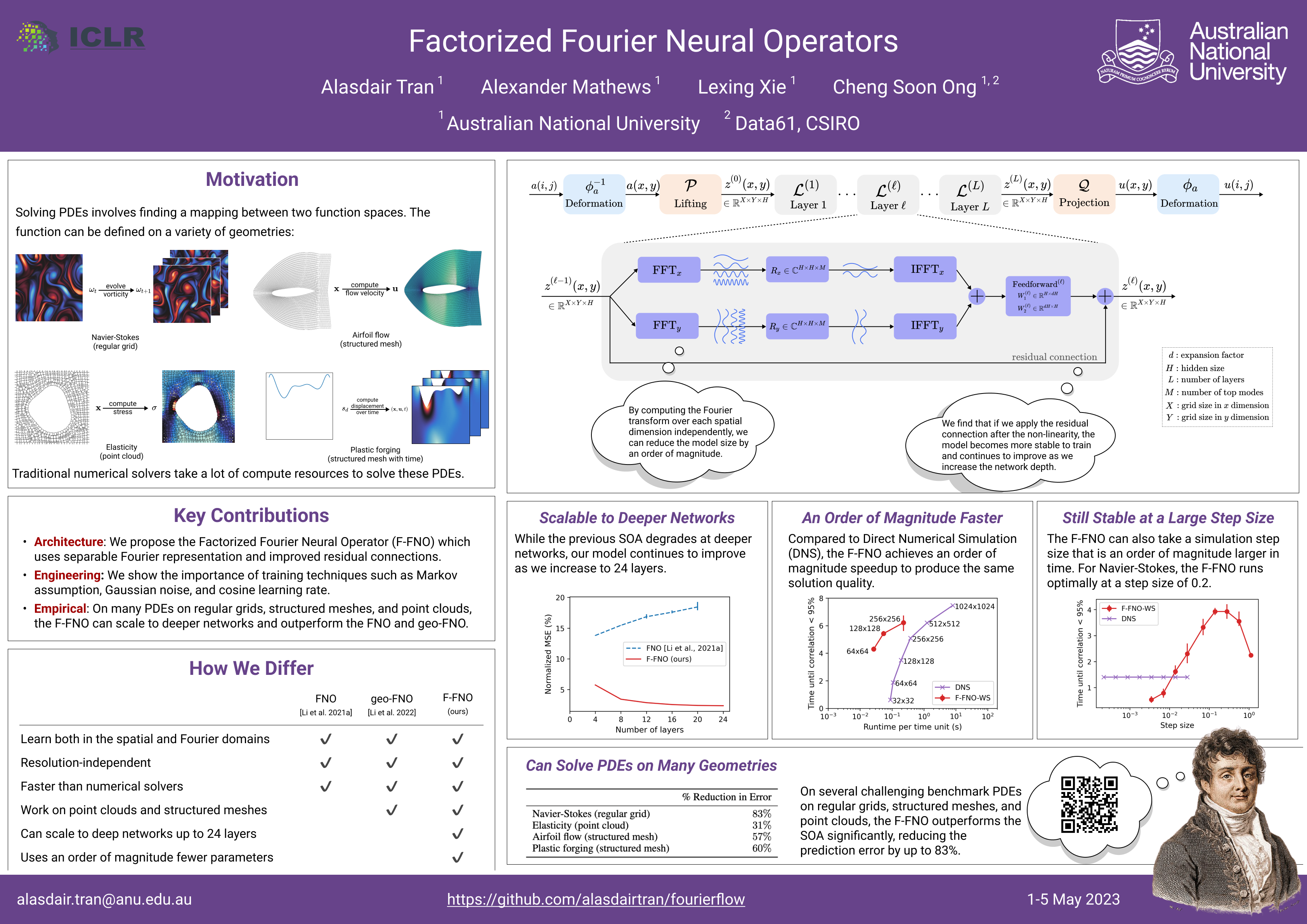
This repository contains the code to reproduce the results in our ICLR 2023 paper, Factorized Fourier Neural Operators.
We propose the Factorized Fourier Neural Operator (F-FNO), a learning-based approach for simulating partial differential equations (PDEs). Starting from a recently proposed Fourier representation of flow fields, the F-FNO bridges the performance gap between pure machine learning approaches to that of the best numerical or hybrid solvers. This is achieved with new representations – separable spectral layers and improved residual connections – and a combination of training strategies such as the Markov assumption, Gaussian noise, and cosine learning rate decay. On several challenging benchmark PDEs on regular grids, structured meshes, and point clouds, the F-FNO can scale to deeper networks and outperform both the FNO and the geo-FNO, reducing the error by 83% on the Navier-Stokes problem, 31% on the elasticity problem, 57% on the airfoil flow problem, and 60% on the plastic forging problem. Compared to the state-of-the-art pseudo-spectral method, the F-FNO can take a step size that is an order of magnitude larger in time and achieve an order of magnitude speedup to produce the same solution quality.
Please cite with the following BibTeX:
@inproceedings{tran2023factorized,
  title     = {Factorized Fourier Neural Operators},
  author    = {Alasdair Tran and Alexander Mathews and Lexing Xie and Cheng Soon Ong},
  booktitle = {The Eleventh International Conference on Learning Representations},
  year      = {2023},
  url       = {https://openreview.net/forum?id=tmIiMPl4IPa}
}
# If you'd like to reproduce the exact numbers in our ML4PS workshop paper,
# checkout v0.2.0 to use the same seeds and package versions.
git checkout v0.2.0

# Otherwise we can use latest Python and Pytorch versions.
# Set up pyenv and pin python version to 3.9.9
curl https://pyenv.run | bash
# Configure our shell's environment for pyenv
pyenv install 3.10.7
pyenv local 3.10.7
curl -sSL https://install.python-poetry.org | python3 - --version 1.2.0b3

# Install all python dependencies
poetry install
source .venv/bin/activate # or: poetry shell
# If we need to use Jupyter notebooks
python -m ipykernel install --user --name fourierflow --display-name "fourierflow"

# set default paths
cp example.env .env
# The environment variables in .env will be loaded automatically when running
# fourierflow train, but we can also load them manually in our terminal
export $(cat .env | xargs)

# Alternatively, you can pass the paths to the system using env vars, e.g.
DATA_ROOT=/My/Data/Location fourierflow train ...You can download all of our datasets and pretrained model as follows:
# Datasets (209GB)
wget --continue https://object-store.rc.nectar.org.au/v1/AUTH_c0e4d64401cf433fb0260d211c3f23f8/fourierflow/data-2021-12-24.tar.gz
tar -zxvf data-2021-12-24.tar.gz

# Pretrained models and results (30GB)
wget --continue https://object-store.rc.nectar.org.au/v1/AUTH_c0e4d64401cf433fb0260d211c3f23f8/fourierflow/experiments-2021-12-24.tar.gz
tar -zxvf experiments-2021-12-24.tar.gz
Alternatively, you can also generate the datasets from scratch:
# Download Navier Stokes datasets
fourierflow download fno

# Generate Navier Stokes on toruses with a different forcing function and
# viscosity for each sample. Takes 14 hours.
fourierflow generate navier-stokes --force random --cycles 2 --mu-min 1e-5 \
    --mu-max 1e-4 --steps 200 --delta 1e-4 \
    data/torus/torus_vis.h5

# Generate Navier Stokes on toruses with a different time-varying forcing
# function and a different viscosity for each sample. Takes 21 hours.
fourierflow generate navier-stokes --force random --cycles 2 --mu-min 1e-5 \
    --mu-max 1e-4 --steps 200 --delta 1e-4 --varying-force \
    data/torus/torus_vis_force.h5

# If we decrease delta from 1e-4 to 1e-5, generating the same dataset would now
# take 10 times as long, while the difference between the solutions in step 20
# is only 0.04%.

# Generate initial conditions for 2D Kolmogorov flows (Kochkov et al, 2021).
fourierflow generate kolmogorov data/kolmogorov/re_1000/initial_conditions/train.yaml # 22 GPU hours
fourierflow generate kolmogorov data/kolmogorov/re_1000/initial_conditions/valid.yaml # 3 GPU hours
fourierflow generate kolmogorov data/kolmogorov/re_1000/initial_conditions/test.yaml # 22 GPU hours

# Run baseline simulations with the numerical solver (no ML).
fourierflow generate kolmogorov data/kolmogorov/re_1000/baseline/32.yaml # 1 GPU min
fourierflow generate kolmogorov data/kolmogorov/re_1000/baseline/64.yaml # 2 GPU mins
fourierflow generate kolmogorov data/kolmogorov/re_1000/baseline/128.yaml # 3 GPU mins
fourierflow generate kolmogorov data/kolmogorov/re_1000/baseline/256.yaml # 6 GPU mins
fourierflow generate kolmogorov data/kolmogorov/re_1000/baseline/512.yaml # 20 GPU mins
fourierflow generate kolmogorov data/kolmogorov/re_1000/baseline/1024.yaml # 2 GPU hours

# Generating training data for ML models.
fourierflow generate kolmogorov data/kolmogorov/re_1000/trajectories/train.yaml # 19 GPU hours
fourierflow generate kolmogorov data/kolmogorov/re_1000/trajectories/valid.yaml # 2 GPU hours
fourierflow generate kolmogorov data/kolmogorov/re_1000/trajectories/test.yaml # 19 GPU hours
Training and test commands:
# Reproducing SOA model on Navier Stokes from Li et al (2021).
fourierflow train --trial 0 experiments/torus_li/zongyi/4_layers/config.yaml

# Train with our best model
fourierflow train --trial 0 experiments/torus_li/markov/24_layers/config.yaml

# Get inference time on test set
fourierflow predict --trial 0 experiments/torus_li/markov/24_layers/config.yaml
Visualization commands:
# Some example commands to create plots and tables for paper
fourierflow plot torus-li-performance
fourierflow plot complexity
fourierflow plot table-torus-li
fourierflow plot table-airfoil
fourierflow plot table-elasticity
fourierflow plot table-plasticity

# Create the flow animation for presentation
fourierflow plot flow

# Create plots for the poster
fourierflow plot poster

# Create plots related to comparison with 2D Kolmogorov flows (Kochkov et al, 2021).
fourierflow plot correlation# Download jax-cfd datasets
gsutil -m cp -r gs://gresearch/jax-cfd data/# Plot effect of coordinates and velocity as input channels (Figure 5b)
fourierflow plot coordinates-velocity-ablation# Download the Geo-FNO datasets
fourierflow download geo-fno
# Reproducing SOA model from Li et al (2022).
fourierflow train --trial 0 experiments/airfoil/geo-fno/4_layers/config.yaml
fourierflow train --trial 0 experiments/plasticity/geo-fno/4_layers/config.yaml
fourierflow train --trial 0 experiments/elasticity/geo-fno/4_layers/config.yaml
# Train with our best model
fourierflow train --trial 0 experiments/airfoil/ffno/24_layers/config.yaml
fourierflow train --trial 0 experiments/plasticity/ffno/24_layers/config.yaml
fourierflow train --trial 0 experiments/elasticity/ffno/24_layers/config.yaml
# Plot samples
fourierflow sample experiments/elasticity/geo-fno/4_layers/config.yaml
fourierflow sample experiments/elasticity/ffno/24_layers/config.yaml
fourierflow sample experiments/elasticity/ffno/24_layers/config.yamlOur model is based on the code of the original author of the Fourier Neural Operators paper:
JAX-based models are adapted from JAX-CFD: https://github.com/google/jax-cfd
Mesh-based simulations are based on meshgraphnets: https://github.com/deepmind/deepmind-research/tree/master/meshgraphnets