









Installation Guide | readthedocs | Introduction on Colab | HowToLens
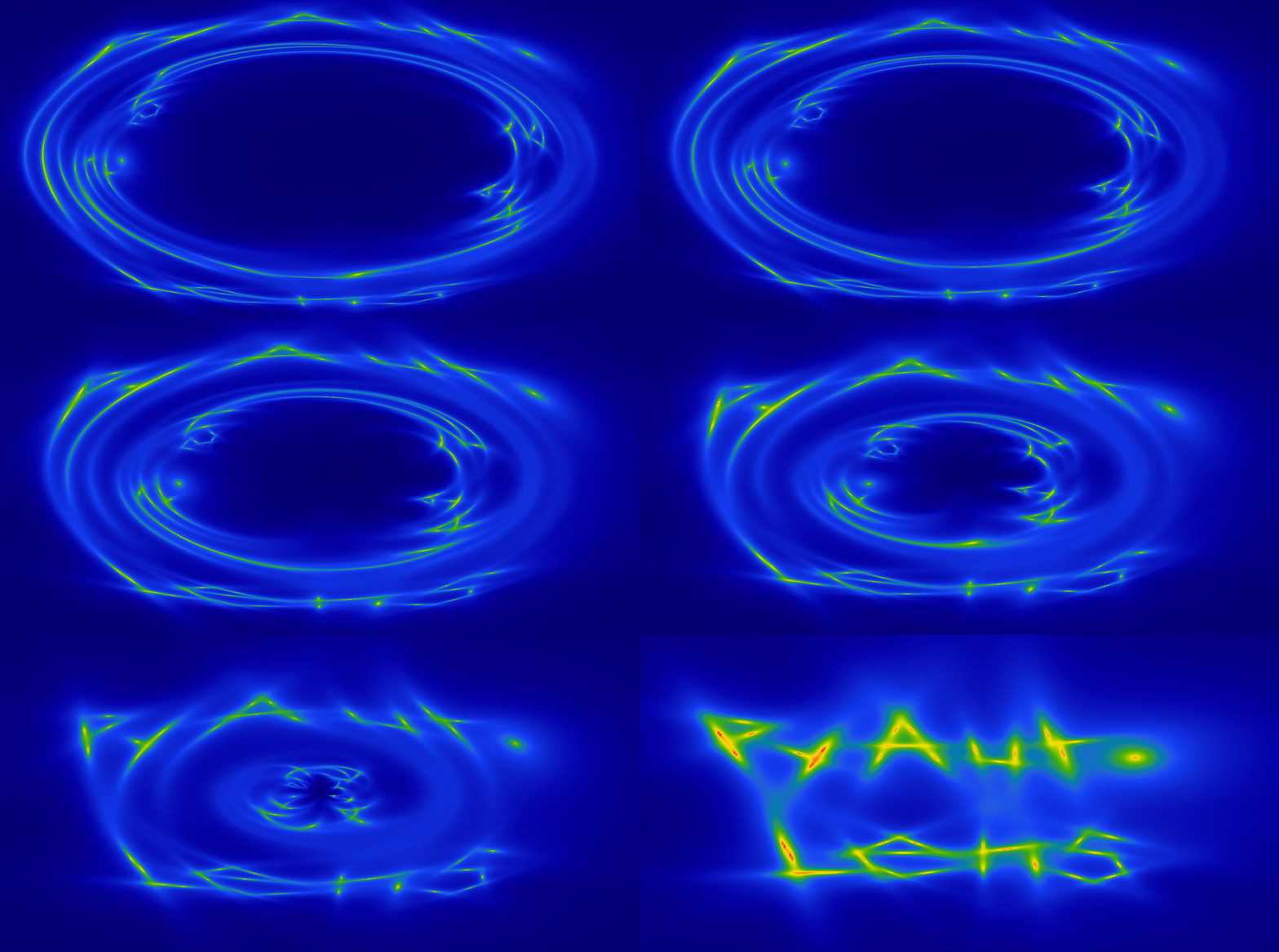
When two or more galaxies are aligned perfectly down our line-of-sight, the background galaxy appears multiple times.
This is called strong gravitational lensing and PyAutoLens makes it simple to model strong gravitational lenses, using JAX to accelerate lens modeling on GPUs.
🤖 AI-assisted use: you can also learn and drive PyAutoLens with AI — either a browser chat assistant (ChatGPT, Claude) pointed at autolens_assistant, or a fully agentic coding tool (Claude Code, Codex) that runs lens modeling end-to-end on your machine. See the Three Ways to Learn PyAutoLens section below.
The following links are useful for new starters:
- The PyAutoLens readthedocs: which includes an overview of PyAutoLens's core features, a new user starting guide and an installation guide.
- The introduction Jupyter Notebook on Google Colab: try PyAutoLens in a web browser (without installation).
- The autolens_workspace GitHub repository: example scripts covering every PyAutoLens use case.
- The HowToLens GitHub repository: a Jupyter notebook lecture series teaching strong lensing and lens modeling from the ground up.
There are three ways to learn how to use PyAutoLens, which you can freely mix and match:
- Manual navigation — read the workspace guides yourself, starting from the new user guide and the
start_herenotebooks, which are organised by lens scale and dataset type. - AI chat assistant — ask questions to a conversational AI assistant such as ChatGPT or Claude in the browser. Point it at the autolens_assistant repository and ask a question like "How do I model a galaxy-scale strong lens observed with Hubble imaging?".
- Fully agentic AI — drive PyAutoLens end-to-end with an agentic coding tool such as Claude Code or Codex together with autolens_assistant. These can inspect your data, write and run scripts, and manage a lens-modeling project directly on your machine.
See autolens_assistant for more on the AI-assisted options (2 and 3).
Support for PyAutoLens is available via our Slack workspace, where the community shares updates, discusses gravitational lensing analysis, and helps troubleshoot problems.
Slack is invitation-only. If you'd like to join, please send an email requesting an invite.
For installation issues, bug reports, or feature requests, please raise an issue on the GitHub issues page.
For users less familiar with gravitational lensing, Bayesian inference and scientific analysis you may wish to read through the HowToLens lectures. These teach you the basic principles of gravitational lensing and Bayesian inference, with the content pitched at undergraduate level and above.
A complete overview of the lectures is provided on the HowToLens readthedocs page, and the notebooks themselves live in the PyAutoLabs/HowToLens repository.
Information on how to cite PyAutoLens in publications can be found on the citations page.
Information on how to contribute to PyAutoLens can be found on the contributing page.
Hands on support for contributions is available via our Slack workspace, again please email to request an invite.