




QR codes in your terminal — the way Claude Code CLI draws its remote-connection codes: Unicode half-blocks, low error correction so the code stays small, a proper quiet zone. Plus a Rich renderable and helpers for crypto-wallet URIs.
█▀▀▀▀▀█ ▄▀ ▄▀ █▀▀▀▀▀█
█ ███ █ ▄▀ ▄  █ ███ █
█ ▀▀▀ █ ▄▄█▀█ █ ▀▀▀ █
▀▀▀▀▀▀▀ ▀ █▄█ ▀▀▀▀▀▀▀
█▀█▀▀▄▀▀▀▀  █▀ █ █▄█▄
 ▄▄▄▄▄▀▄▀▀█▀ ▀ ▄█▀  ▀
 ▀▀  ▀▀ ██▀█▄█▄ ▀▄▀▄▄
█▀▀▀▀▀█ ▀▄█▄█▄█▀ ▄▀ █
█ ███ █ █ ▄ █  █  █
█ ▀▀▀ █ █ ▄▀ ▀ ▄█ █ ▄
▀▀▀▀▀▀▀ ▀  ▀ ▀  ▀ ▀
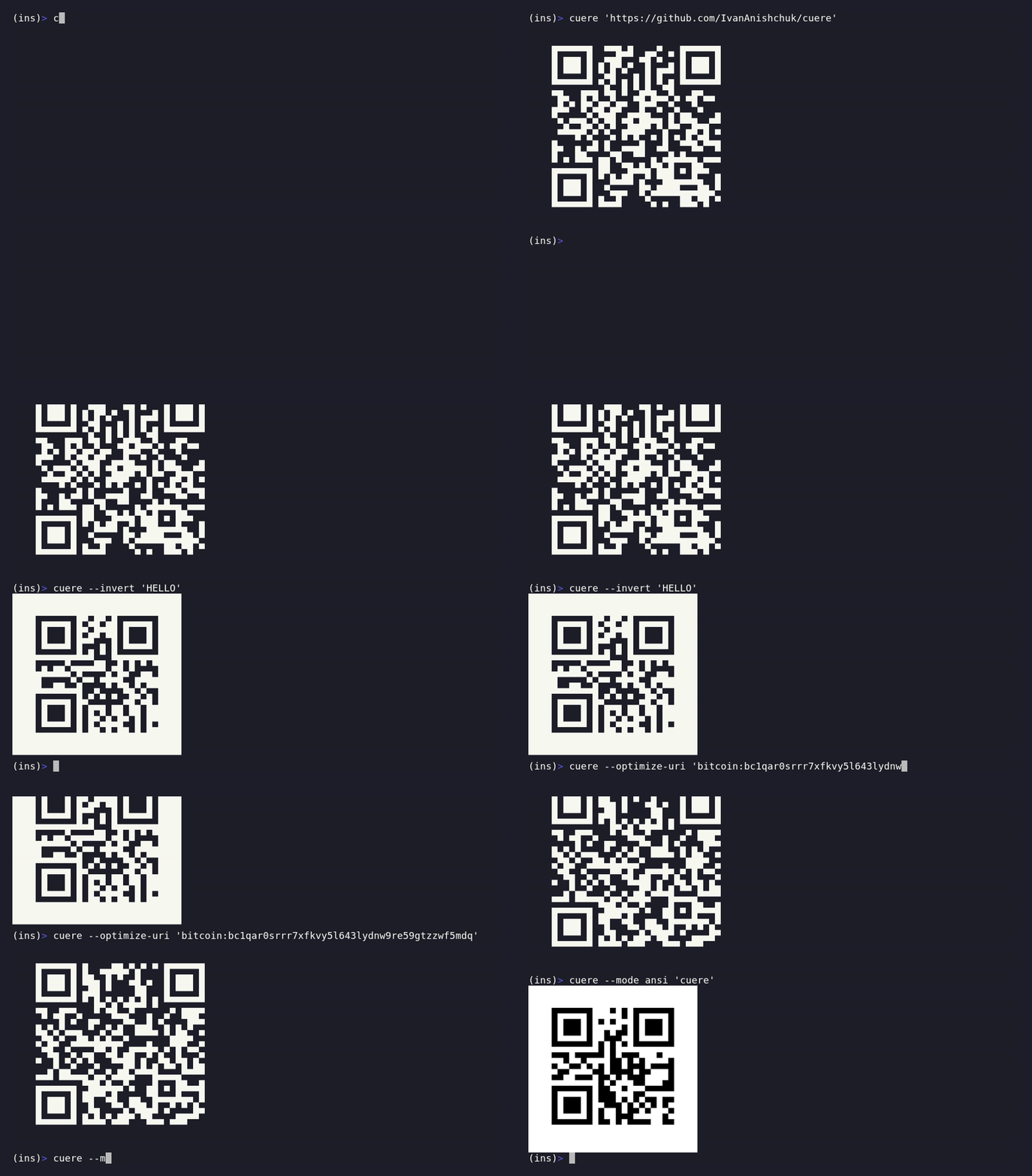
Recorded with vhs from
examples/demo.tape — regenerate with
uv run python scripts/render_demo.py (needs vhs, ttyd, and ffmpeg):
cuere "https://github.com/IvanAnishchuk/cuere"   # a first code
cuere --invert "HELLO"                            # light-on-dark
cuere --optimize-uri "bitcoin:bc1q..."            # smaller wallet code
cuere --mode ansi "cuere"                         # theme-proof colors
📖 Full documentation: ivananishchuk.github.io/cuere
uv add cuere          # or: pip install cuere
uv add 'cuere[image]' # optional: adds PNG export (pulls in Pillow)from cuere import render, show, fits
payload = "wc:7f6e504b...@2?relay-protocol=irn&symKey=587d..."
show(payload) # prints to stdout
text = render("HELLO", mode="block", invert=True) # returns a str
if not fits(payload): # does it fit the terminal?
...With Rich (centering, panels, layouts):
from rich.console import Console
from rich.panel import Panel
from cuere.rich import QRCode

Console().print(Panel(QRCode("bitcoin:BC1Q..."), title="scan to pay"), justify="center")
Wallet URIs — bitcoin_uri() builds a validated BIP-21
bitcoin: payment request, lightning_uri() wraps a bech32 Lightning payload
(BOLT11 invoice / LNURL / BOLT12 offer) in a lightning: URI, and
optimize_uri() uppercases a fully lowercase bitcoin: or lightning: URI
(bech32 is case-insensitive per BIP-173) so it encodes in QR alphanumeric mode,
yielding a smaller code. scheme_case() exposes the typed SchemeCase that
decides this: case-significant schemes (ethereum: EIP-55 checksums, wc:
WalletConnect), mixed-case URIs, and URIs with non-alphanumeric query parts are
returned unchanged:
from decimal import Decimal
from cuere import bitcoin_uri, lightning_uri, optimize_uri, show

show(optimize_uri(bitcoin_uri("bc1q...")))                  # smaller, scannable code
bitcoin_uri("bc1q...", amount=Decimal("0.01"), label="Tip") # -> "bitcoin:bc1q...?amount=0.01&label=Tip"
optimize_uri("bitcoin:bc1q...")                             # -> "BITCOIN:BC1Q..."
optimize_uri(lightning_uri("lnbc1..."))                     # -> "LIGHTNING:LNBC1..."
For Ethereum, ethereum_uri() and erc20_transfer_uri() build
EIP-681 ethereum: requests — a
native payment (value in wei) or an ERC-20 transfer. Their EIP-55 checksums
are case-significant, so these URIs are never passed through optimize_uri:
from cuere import erc20_transfer_uri, ethereum_uri

ethereum_uri("0xfb69...d359", value=10**16, chain_id=1)         # -> "ethereum:0xfb69...d359@1?value=10000000000000000"
erc20_transfer_uri("0xA0b8...eB48", to="0x8e23...d052", amount=1_000_000)  # -> "ethereum:0xA0b8...eB48/transfer?address=0x8e23...d052&uint256=1000000"
See the wallet cookbook for the full
payment-request recipes, and
the BIP-21 / Lightning /
EIP-681 summaries for the formats and the optimize_uri
scheme model.
Need the raw module grid (to render it yourself or inspect it)? Encode to a
QRMatrix:
from cuere import QRMatrix

m = QRMatrix.encode("HELLO", error="L", border=4)
m.modules   # tuple[tuple[bool, ...], ...] — True is a dark module
m.size      # side length, quiet zone included
Export to a file or bytes — save() writes the chosen format (inferred from the
path suffix when not given), render_bytes() returns the raw bytes:
from cuere import save, render_bytes

save("HELLO", "code.svg")                       # vector SVG, format from suffix
save("bitcoin:BC1Q...", "pay.png", scale=8)     # raster PNG (needs cuere[image])
png_bytes = render_bytes("HELLO", format="png") # -> bytes, no file
The formats are text (the terminal rendering), svg, and png (needs the
cuere[image] extra). See the exporting recipe and
output formats for the full model.
CLI:
cuere "wc:...your walletconnect uri..."
echo "some payload" | cuere
cuere --input payload.txt              # read the payload from a file
cuere 12345 --micro                    # compact Micro QR for a tiny payload
cuere HELLO --mode ansi --invert --border 2 --error M
cuere HELLO --mode ansi --dark "#1a1a1a" --light "#fafafa"   # custom ANSI colors
cuere HELLO --output svg:code.svg      # write SVG to a file (default stays terminal)
cuere HELLO -o png:- --scale 8 > code.png # PNG to stdout (needs cuere[image])| mode | one module is | width of a v2 code | notes |
|---|---|---|---|
half (default) |
½ character (▀▄█) |
33 cols | survives copy-paste; inherits terminal colors |
ansi |
½ character, colored (black-on-white default) | 33 cols | theme-proof; customizable colors; show() downgrades it to half when piped or NO_COLOR is set |
block |
2 characters (██) |
66 cols | most font-robust, twice as wide |
The block-drawing glyphs (█▀▄) are East-Asian Ambiguous width: a terminal
configured to render those double-width will widen the output, so the column
counts above assume standard single-width rendering.
ansi mode's colors are customizable: pass dark / light to render / show
(and cuere.rich.QRCode, and the CLI --dark / --light flags) to set the
dark-module and light-ground colors — a name, a 256-palette index, or a truecolor
hex / (r, g, b) value. They default to spec-correct black-on-white. Colors are
ansi-only (passing them to half / block raises ColorError). See
terminal colors for the forms and the scanner-contrast caveats.
- On dark terminals the default mode shows an inverted code (light modules
on dark). Modern phone cameras handle this; for a stubborn scanner pass
invert=True/--invert, or usemode="ansi"for spec-correct polarity. - Error correction defaults to
L: screens don't get dirty or torn, and lower correction means a smaller code that fits your terminal. - The quiet zone (4 modules) is part of the output on purpose — don't strip the "blank" margins.
uv sync                  # editable install via meson-python
uv run pytest            # 100% branch coverage enforced
uv run ruff check && uv run mypy src/ tests/ && uv run ty check && uv run basedpyright
uv run pre-commit install --install-hooks
Build-system notes (meson-python):
- Every shipped file must be listed in
src/cuere/meson.build— meson does not glob.tests/test_packaging.pyfails if the list drifts. - The version lives only in the root
meson.build. - sdists are produced from committed files (
meson dist); commit beforeuv build.
CC0-1.0 — public domain.