


I develop advanced AI methods for engineering simulation, material modeling, and digital twins.
My work combines finite element methods, nonlinear continuum mechanics, physics-informed neural networks, neural operators, computer vision, and data science to solve complex engineering and scientific problems.


- Physics-Informed Neural Networks, VPINNs and Neural Operators
- Nonlinear Solid Mechanics, Hyperelasticity and Finite-Strain Formulations
- Finite Element Methods, Constitutive Modeling, Damage and Fracture Mechanics
- Thermodynamically Consistent Deep Learning for Material Modeling
- Geometry-Conditioned Simulation and Scientific Machine Learning
- Computer Vision for Crack, Defect and Material Field Analysis
- Agentic AI, Digital Twins and AI Systems for Engineering Applications
| Project | Area | Key Contribution |
|---|---|---|
| PI-GINOT DogBone | Neural Operators / Mechanics | Data-free geometry-conditioned simulation for finite-strain hyperelastic specimens |
| Thermodynamic DL Material Model | Constitutive Modeling | Physics-informed material model enforcing thermodynamic consistency |
| Hybrid ML-FEM Damage Model | FEM / ML | LSTM-assisted finite element framework for viscoelastic-viscoplastic nanocomposites |
| PINN Solid Mechanics DogBone | PINNs / Hyperelasticity | Mesh-free solution of nonlinear equilibrium equations for a dogbone specimen |
| VPINN 2D Elasticity | Weak-Form PINNs | Variational physics-informed formulation for plane-stress elasticity |
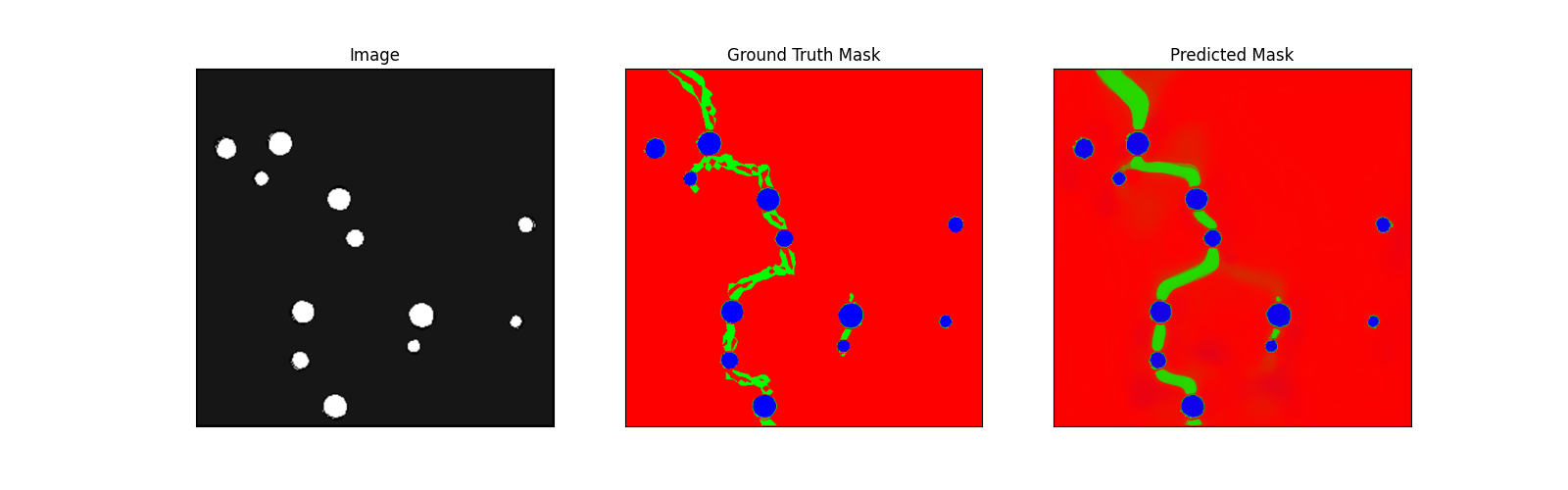
| U-Net Crack Detection | Computer Vision | Semantic segmentation of cracks and defects in electromechanical materials |
| GNN Force Field | Molecular Simulation | Graph neural network surrogate for coarse-grained molecular dynamics |
graph TD
    A[Physics-Informed AI] --> B[Computational Mechanics]
    A --> C[Material Modeling]
    A --> D[Neural Operators]
    A --> E[Digital Twins]

    B --> F[FEM]
    B --> G[PINNs / VPINNs]
    B --> H[Nonlinear Solid Mechanics]

    C --> I[Constitutive Models]
    C --> J[Thermodynamic Consistency]
    C --> K[Damage and Fracture]

    D --> L[Geometry-Conditioned Simulation]
    D --> M[Fast Engineering Surrogates]

    E --> N[Agentic AI]
    E --> O[Engineering Decision Support]


-
A multiphysics deep energy method for fourth-order phase-field fracture with piezoresistive self-sensing
Aamir Dean, Betim Bahtiri
arXiv preprint, 2026
arXiv -
A hybrid electromechanical phase-field and deep learning framework for predicting fracture in dielectric nanocomposites
Aamir Dean, Jaykumar Mavani, Betim Bahtiri, Behrouz Arash, Raimund Rolfes
Engineering Fracture Mechanics, 335, 111906, 2026
DOI · ScienceDirect · arXiv
-
Physics-Informed Deep Learning Constitutive Model for Anisotropic and Pressure-Dependent Behavior of Short Fiber-Reinforced Polymers
Aamir Dean, Vinayak Bhaskar Naik, Betim Bahtiri, Emad Mahdi, P. K. Asur Vijaya Kumar
International Journal for Numerical Methods in Engineering, 126(19), e70144, 2025
DOI -
Phase-field modeling of fracture in viscoelastic–viscoplastic thermoset nanocomposites under cyclic and monolithic loading
Behrouz Arash, Shadab Zakavati, Betim Bahtiri, Maximilian Jux, Raimund Rolfes
Engineering with Computers, 41, 681–701, 2025
DOI · Springer · arXiv
-
A thermodynamically consistent physics-informed deep learning material model for short fiber/polymer nanocomposites
Betim Bahtiri, Behrouz Arash, Sven Scheffler, Maximilian Jux, Raimund Rolfes
Computer Methods in Applied Mechanics and Engineering, 427, 117038, 2024
DOI · ScienceDirect · arXiv -
Deep learning informed multiphysics material modeling of fiber reinforced polymer nanocomposites
Betim Bahtiri
Doctoral thesis, Leibniz University Hannover, 2024
DOI · Leibniz University Repository
- A machine learning-based viscoelastic–viscoplastic model for epoxy nanocomposites with moisture content
Betim Bahtiri, Behrouz Arash, Sven Scheffler, Maximilian Jux, Raimund Rolfes
Computer Methods in Applied Mechanics and Engineering, 415, 116293, 2023
DOI · ScienceDirect · arXiv
- Elucidating atomistic mechanisms underlying water diffusion in amorphous polymers: An autonomous basin climbing-based simulation method
Betim Bahtiri, Behrouz Arash, Raimund Rolfes
Computational Materials Science, 212, 111565, 2022
DOI · ScienceDirect
| Theme | Publications |
|---|---|
| Physics-informed material modeling | Thermodynamic PIDL model, anisotropic SFRP constitutive model |
| Hybrid ML-FEM simulation | LSTM-assisted viscoelastic-viscoplastic FEM model |
| Fracture and phase-field modeling | Electromechanical phase-field + deep learning, thermoset fracture modeling, deep energy fracture method |
| Multiphysics and molecular simulation | Water diffusion in amorphous polymers, multiphysics thesis work |
| AI for engineering simulation | Neural constitutive models, surrogate modeling, computer vision for field prediction |














Objective:
Developed a data-free neural operator for finite-strain hyperelasticity on parametric dogbone tensile specimens.
Core Idea:
The model learns displacement and stress fields over a family of geometries using physics residuals instead of FEM-generated training labels.
Physics Core:
- Compressible Neo-Hookean hyperelasticity
- First Piola-Kirchhoff stress formulation
- Strong-form equilibrium in the reference configuration
- Traction-free boundary residuals
- Determinant barrier to preserve physical invertibility
- Section-force consistency across the specimen
Architecture:
- Geometry encoder based on boundary point clouds and geometry parameters
- Transformer-style decoder for displacement and stress field prediction
- Physics-informed loss formulation for data-free training
- Geometry-conditioned inference for rapid simulation and optimization
Impact:
Enables millisecond-scale simulation and design-space exploration for parametric tensile specimens.
Repository:
PI-GINOT-DogBone
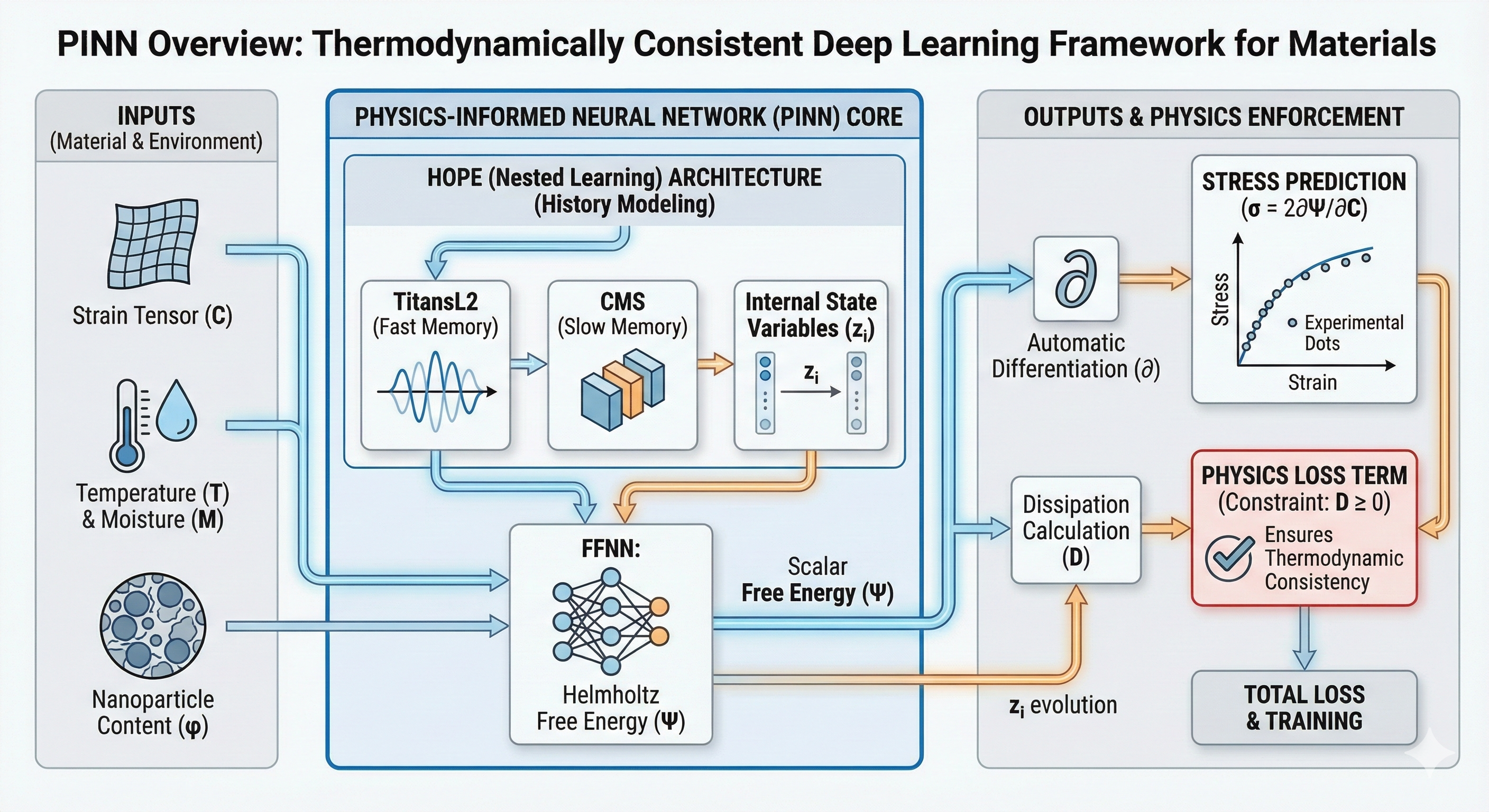
2. Nested Learning-Based Physics-Informed Deep Learning for Material Modeling
Objective:
Extended a physics-informed deep learning framework by replacing classical recurrent components with a HOPE-style nested learning architecture.
Core Idea:
The model introduces multi-timescale memory systems inspired by associative memory and brain oscillation concepts to improve temporal dependency modeling in material behavior prediction.
Technical Contributions:
- Implemented a TitansL2-style memory module with Delta Rule updates
- Developed a continuum memory system with chunk-based multi-frequency processing
- Designed a FullHOPEBlock combining high-frequency and low-frequency memory updates
- Integrated the architecture into a physics-informed material modeling workflow
Tech Stack:
Python, TensorFlow/Keras, automatic differentiation, physics-informed neural networks, memory-augmented neural architectures.
Repository:
Physics-Informed Deep Learning with HOPE Layers
3. Hybrid ML-FEM Viscoelastic-Viscoplastic Damage Model — Published in CMAE
Objective:
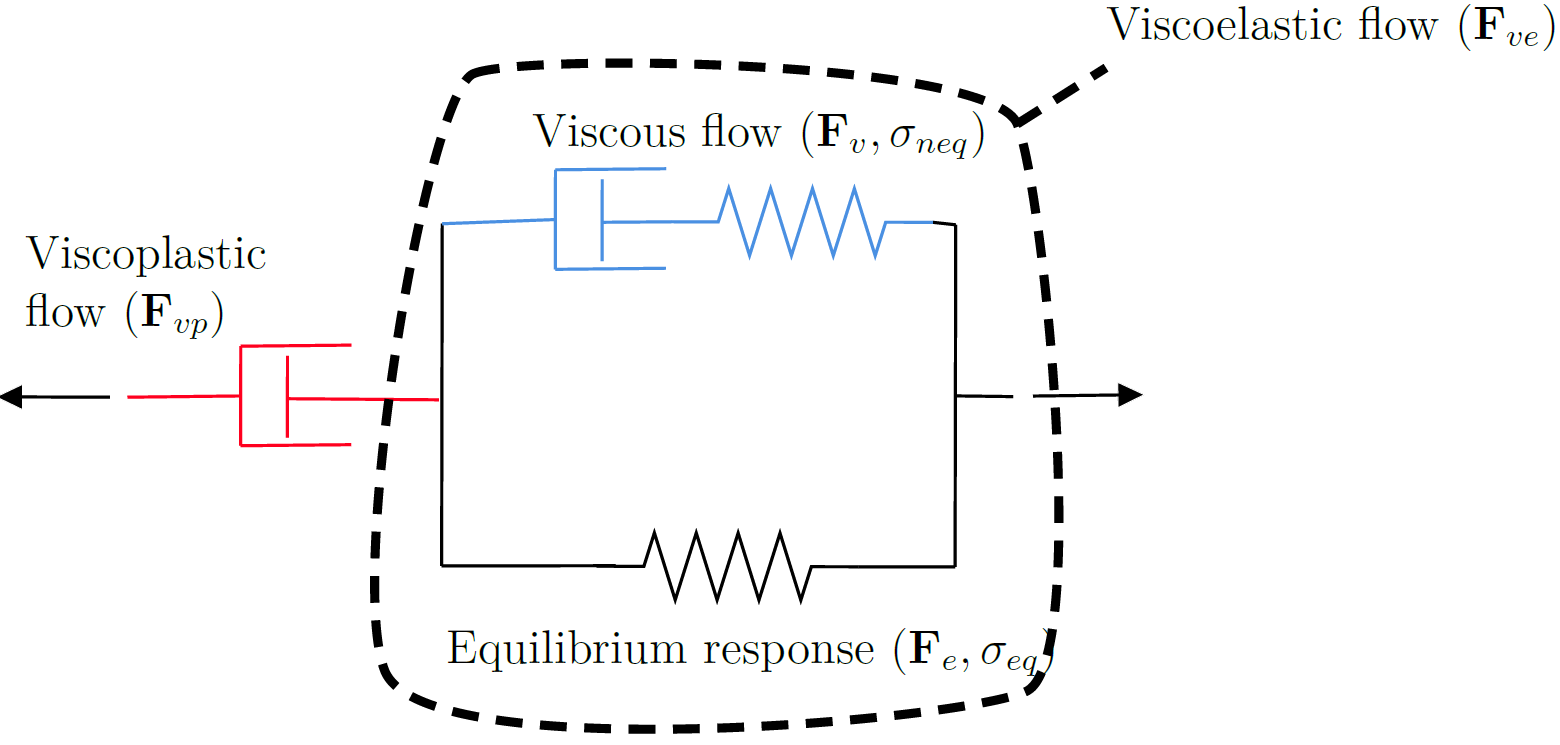
Implemented a hybrid finite element and machine learning framework to simulate complex material behavior in epoxy nanocomposites under cyclic loading, including moisture and nanoparticle effects.
Method:
Combined classical constitutive modeling with LSTM-based machine learning components for computational acceleration and history-dependent material response prediction.
Technical Contributions:
- Developed a large-deformation solid mechanics framework
- Integrated LSTM models into a finite element simulation workflow
- Modeled multi-network viscoelastic-viscoplasticity with damage
- Incorporated environmental effects such as moisture content
- Implemented the model using C++, deal.II, Python, MPI and CMake
Impact:
Published in Computer Methods in Applied Mechanics and Engineering.
DOI:
10.1016/j.cma.2023.116293
Repository:
LSTM-Assisted Viscoelastic-Viscoplastic Model FEM
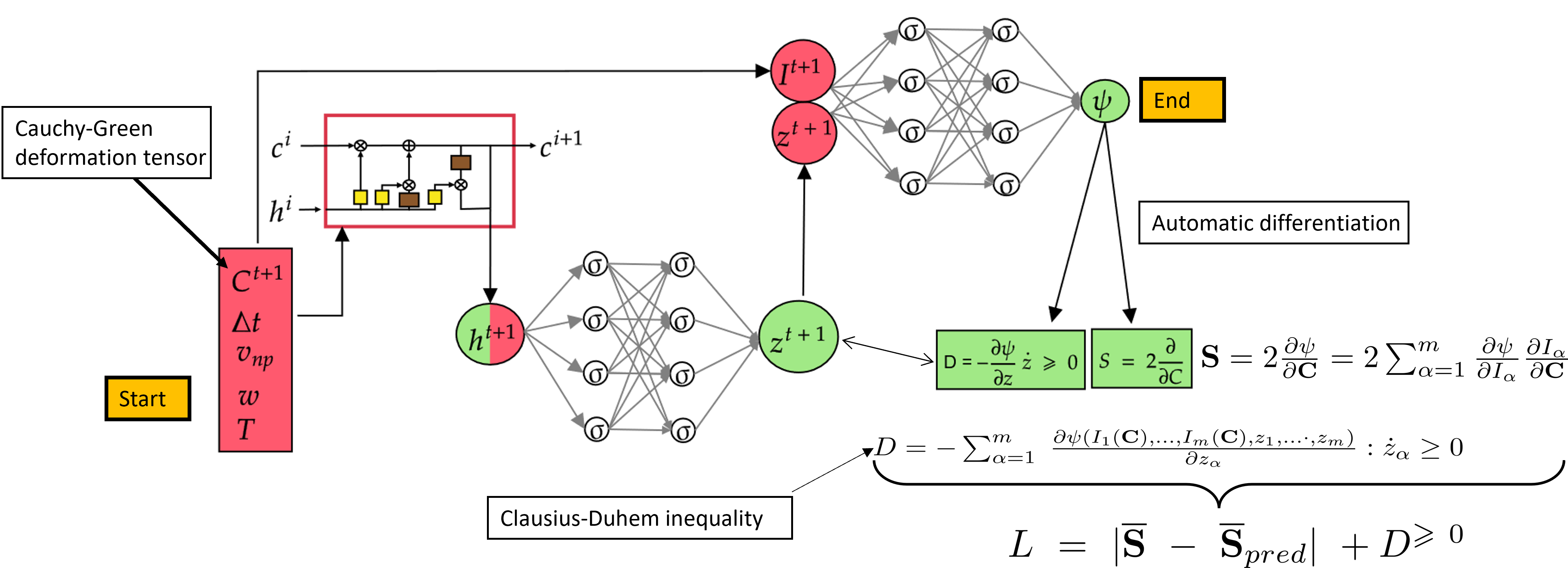
4. Thermodynamically Consistent Deep Learning Material Model — Published in CMAE
Objective:
Developed a physics-informed deep learning constitutive model for epoxy composites under varying ambient conditions, including temperature, moisture and nanoparticle volume fraction.
Method:
The framework combines LSTM and feed-forward neural networks to predict internal variables and free-energy functions while enforcing thermodynamic consistency.
Technical Contributions:
- Developed a deep learning model for nonlinear material response prediction
- Integrated thermodynamic constraints into the model architecture
- Trained the model using experimental material data
- Captured temperature-dependent, moisture-dependent and nanoparticle-dependent behavior
- Formulated a data-driven constitutive model consistent with physical laws
Impact:
Published in Computer Methods in Applied Mechanics and Engineering.
DOI:
10.1016/j.cma.2024.117038
Repository:
Deep Learning Constitutive Model
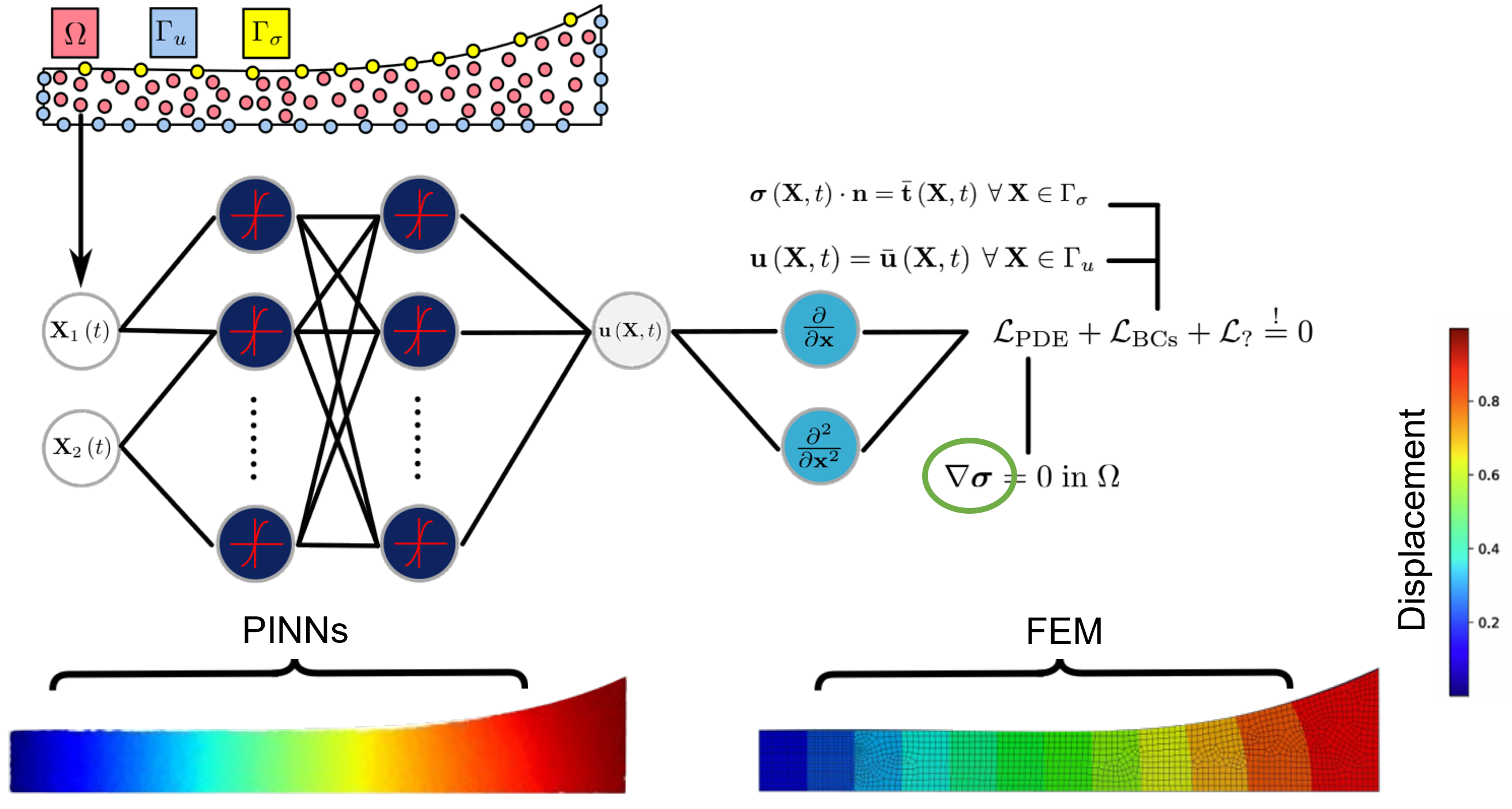
5. Physics-Informed Neural Network for Hyperelastic Solid Mechanics
Objective:
Simulated a quasi-static tensile test on a hyperelastic dogbone specimen using a mesh-free physics-informed neural network.
Method:
The PDE problem is transformed into an optimization problem. A neural network approximates the displacement field, while the loss function penalizes violations of equilibrium equations and boundary conditions.
Physics Core:
- Nonlinear hyperelastic solid mechanics
- Strong-form static equilibrium
- Dogbone specimen under tensile loading
- Automatic differentiation for PDE residual computation
- Verification against finite element simulations
Impact:
Developed a PINN model for nonlinear mechanical equilibrium and compared the solution against FEM reference simulations.
Repository:
PINN Solid Mechanics DogBone Specimen
6. Variational Physics-Informed Neural Network for 2D Elasticity
Objective:
Solved a 2D linear elasticity problem in plane stress using a variational physics-informed neural network.
Method:
The model solves the weak form of the equilibrium equation by minimizing the energy functional instead of directly enforcing the strong-form PDE residual.
Technical Contributions:
- Implemented a VPINN based on the variational formulation of elasticity
- Used Legendre polynomials as test functions
- Applied Gauss-Legendre quadrature for numerical integration
- Enforced Dirichlet boundary conditions analytically through an augmented deep formulation
- Verified displacement, stress and strain fields against an analytical solution
Tech Stack:
Python, PyTorch, NumPy, SciPy, Matplotlib.
Repository:
Variational Physics-Informed Neural Network Linear Elasticity
7. GNN Force Field for Coarse-Grained Molecular Dynamics
Objective:
Developed a graph neural network model for predicting atomic forces in coarse-grained molecular dynamics simulations.
Core Idea:
The model acts as a fast surrogate for traditional force fields while preserving physically meaningful force-direction behavior.
Technical Contributions:
- Implemented a GNN-inspired force field architecture
- Developed a rotationally covariant force prediction module
- Learned scalar force magnitudes and projected them onto direction vectors
- Built a complete training pipeline with outlier filtering and Z-score normalization
- Designed the workflow for noisy molecular simulation data
Impact:
Created an end-to-end GNN force-field pipeline that can accelerate coarse-grained molecular dynamics simulations of polymer systems.
Repository:
gnn-cg-peo-forcefield

8. Crack Detection in Electromechanical Materials using U-Net
Objective:
Applied deep learning for semantic segmentation of crack propagation in materials under electromechanical loading.
Method:
Implemented U-Net-based computer vision models with ResNet backbones to detect crack and defect patterns from phase-field and electrical-potential simulation data.
Technical Contributions:
- Developed a multi-class semantic segmentation workflow
- Used transfer learning for crack and defect detection
- Compared phase-field and electrical-potential representations
- Automated model tuning and performance evaluation
- Achieved high segmentation precision in crack detection tasks
Tech Stack:
Python, TensorFlow, Keras, OpenCV, Abaqus-based simulation data.
Reference:
arXiv:2508.07469
Repository:
Computer Vision Crack Detection
- Physics-informed geometric neural operators for nonlinear solid mechanics
- Data-free simulation methods driven by physical residuals
- Agentic AI systems for engineering simulation and design optimization
- Digital twins for engineering and healthcare technology systems
- Graph-based retrieval and knowledge systems for technical domains
- Scientific foundation models for computational mechanics
- Email:
betimbahtiri@outlook.de - LinkedIn: Dr.-Ing. Betim Bahtiri
- Google Scholar: Betim Bahtiri
- GitHub: BBahtiri
Feel free to reach out for discussions around physics-informed AI, computational mechanics, material modeling, scientific machine learning, digital twins or engineering simulation.
All repositories are personal research and engineering projects and are not affiliated with my current or previous employers.