Given a string containing digits from
2-9inclusive, return all possible letter combinations that the number could represent.A mapping of digit to letters (just like on the telephone buttons) is given below. Note that 1 does not map to any letters.
Example:
Input: "23"
Output: ["ad", "ae", "af", "bd", "be", "bf", "cd", "ce", "cf"].

代码:
- Java
class Solution {
	public List<String> res = new ArrayList<>();
    public String[] keys = new String[10];
    public List<String> letterCombinations(String digits) {
        if (digits == null || digits.length() == 0)
            return res;
        keys[0] = "";
        keys[1] = "";
        keys[2] = "abc";
        keys[3] = "def";
        keys[4] = "ghi";
        keys[5] = "jkl";
        keys[6] = "mno";
        keys[7] = "pqrs";
        keys[8] = "tuv";
        keys[9] = "wxyz";
        StringBuilder temp = new StringBuilder();
        dfs(digits, 0, temp);
        return res;
    }
    public void dfs(String digits, int idx, StringBuilder temp) {
    	if (temp.length() == digits.length()) {
    		res.add(temp.toString());
    		return;
    	}
    	int pos = digits.charAt(idx) - '0';
        String cur = keys[pos];
        for (int j = 0; j < cur.length(); j++) {
            temp.append(cur.charAt(j));
            dfs(digits, idx + 1, temp);
            temp.deleteCharAt(temp.length() - 1);
        }
    }
}
class Solution(object):
def letterCombinations(self, digits):
"""
:type digits: str
:rtype: List[str]
"""
letterMap = [" ","","abc","def","ghi","jkl","mno","pqrs","tuv","wxyz"]
res = []
def findCombination(digits, index, s):
if index == len(digits):
res.append(s)
return
ch = digits[index]
ch_letters = letterMap[ord(ch)-ord('0')]
for i in range(len(ch_letters)):
findCombination(digits, index+1, s+ch_letters[i])
return
if digits == "":
return []
findCombination(digits, 0, "")
return resGiven n pairs of parentheses, write a function to generate all combinations of well-formed parentheses.
For example, given n = 3, a solution set is:
[
 "((()))",
 "(()())",
 "(())()",
 "()(())",
 "()()()"
]
思路:
- 要么加左括号,要么加右括号
- 递归终止:右括号个数已经等于n,证明n对括号已经匹配组合完成,把
cur_str添加到res中,直接return. - 加左括号的条件:当左括号个数小于n。
- 加右括号的条件:当右括号的个数小于左括号。
class Solution(object):
    def generateParenthesis(self, n):
        """
        :type n: int
        :rtype: List[str]
        """
        res = []

        def dfs(cur_str, res, n, lp, rp):#lp: 左括号个数, rp: 右括号个数
            if rp == n:
                res.append(cur_str)
                return
            if lp < n:
                # add '('
                dfs(cur_str+"(", res, n, lp+1, rp)
            if rp < lp:
                # only the num of ')'< '(', we can add ')'
                dfs(cur_str+")", res, n, lp, rp+1)

        dfs("",res,n,0,0)
return resThe n-queens puzzle is the problem of placing n queens on an n×n chessboard such that no two queens attack each other.
Given an integer n, return all distinct solutions to the n-queens puzzle.
Each solution contains a distinct board configuration of the n-queens' placement, where
'Q'and'.'both indicate a queen and an empty space respectively.
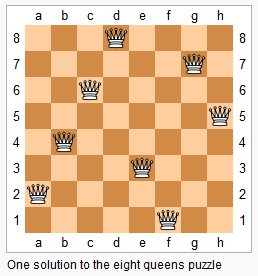
参考:回溯算法详解
code:
class Solution {
public:
    vector<vector<string>> res;
    vector<vector<string>> solveNQueens(int n) {
        vector<string> board(n, string(n,'.'));
        backtrack(board, 0);
        return res;
    }

    void backtrack(vector<string>& board, int row){
        // 触发结束条件
        if (row == board.size()){
            res.push_back(board);
            return;
        }
        int n = board[row].size();
        for (int col = 0; col < n; col++){
            if (!isValid(board, row, col))
                continue;
            board[row][col] = 'Q';
            backtrack(board, row+1);
            board[row][col] = '.';
        }
    }

    // check if conflict
    bool isValid(vector<string>& board, int row, int col){
        int N = board.size();
        // check column first
        for (int i = 0; i < N; i++) {
            if (board[i][col] == 'Q')
                return false;
        }
        // check 右上方
        for (int i = row - 1, j = col + 1; i>=0 && j<N; i--, j++) {
            if (board[i][j] == 'Q')
                return false;
        }
        // check 左上方
        for (int i = row - 1, j = col - 1; i>=0 && j>=0; i--, j--){
            if (board[i][j] == 'Q')
                return false;
        }
        return true;
    }
};给定一个Distinct的数组求全排列
Given a collection of distinct integers, return all possible permutations.
Example:
Input: [1,2,3]
Output:
[
  [1,2,3],
  [1,3,2],
  [2,1,3],
  [2,3,1],
  [3,1,2],
  [3,2,1]
]
class Solution {
    private List<List<Integer>> res = new LinkedList<>();

    public List<List<Integer>> permute(int[] nums) {
        LinkedList<Integer> route = new LinkedList<>();
        backtrack(nums, route);
        return res;
    }

    public void backtrack(int[] nums, LinkedList<Integer> route) {
        if (route.size() == nums.length) {
            res.add(new LinkedList(route));
            return;
        }

        for (int i = 0; i < nums.length; i++) {
            if (route.contains(nums[i]))
                continue;
            route.add(nums[i]);
            backtrack(nums, route);
            route.removeLast();
        }
    }
}给定一个有重复的数组求全排列
Given a collection of numbers that might contain duplicates, return all possible unique permutations.
Example:
Input: [1,1,2]
Output:
[
  [1,1,2],
  [1,2,1],
  [2,1,1]
]
- 先要对数组排序,目的是为了处理duplicate number
- 设置 visited[] 记录访问情况
- 回溯中的if条件有二:
- visited[i] == true
- 当前数字不是数组(排序后)中第一位,且前一个数字未被访问(因为回溯会在每次循环时,对 visited[i] 先 true 后 false,如果当前数字与它前一个相同,且未被访问,例如 [1, 1, 2],当第一次进行循环时,先对第一个1进行遍历,包括它在内的三个数字会被依次访问且添加到路径中,此时第一个1的循环结束时,来到 res.add() 的操作,return 后再对第二个1重复跟第一个1一样的操作,但需要注意的是,每次回溯都会进到for循环的 i = 0 的地方,也就是每次回溯都会经过第一个1,如何保证不会重复添加?这里体现了 visited 的作用,最外层的循环只有三个数,1,1,2,第一个1走完所有的分支后,它的visited就从 true 变成了 false,所以第二个1开始走,发现前一个1的 visited 是 false 的时候,就说明前一个是重复的数,不需要添加。可以画递归树来理解!
class Solution {

    private List<List<Integer>> res = new LinkedList<>();

    public List<List<Integer>> permuteUnique(int[] nums) {

        Arrays.sort(nums);  // first sort nums;
        LinkedList<Integer> route = new LinkedList<>();
        boolean[] visited = new boolean[nums.length];
        backtrack(nums, visited, route);
        return res;
    }

    private void backtrack(int[] nums, boolean[] visited, LinkedList<Integer> route) {
        if (route.size() == nums.length) {
            res.add(new LinkedList<>(route));
            return;
        }
        for (int i = 0; i < nums.length; i++) {
            if (visited[i] == true)
                continue;
            if (i > 0 && visited[i - 1] == false && nums[i] == nums[i - 1]) {
                // meet duplicate number
                continue;
            }

            visited[i] = true;
            route.add(nums[i]);
            backtrack(nums, visited, route);
            visited[i] = false;
            route.removeLast();
        }
    }
}https://leetcode.com/problems/iterator-for-combination/
Design an Iterator class, which has:
- A constructor that takes a string
charactersof sorted distinct lowercase English letters and a numbercombinationLengthas arguments.- A function next() that returns the next combination of length
combinationLengthin lexicographical order.- A function hasNext() that returns
Trueif and only if there exists a next combination.Example:
CombinationIterator iterator = new CombinationIterator("abc", 2); // creates the iterator.

iterator.next(); // returns "ab"
iterator.hasNext(); // returns true
iterator.next(); // returns "ac"
iterator.hasNext(); // returns true
iterator.next(); // returns "bc"
iterator.hasNext(); // returns false
class CombinationIterator:

    def __init__(self, characters: str, combinationLength: int):
        self.combinations = []

        def backtrack(combination, i):
            if len(combination) == combinationLength:
                self.combinations.append(combination)
            elif len(combination) < combinationLength:
                for j in range(i + 1, len(characters)):
                    backtrack(combination + characters[j], j)

        for i in range(len(characters)):
            backtrack(characters[i], i)

    def next(self) -> str:
        return self.combinations.pop(0)

    def hasNext(self) -> bool:
        if self.combinations:
            return True
return Falsehttps://leetcode.com/problems/increasing-subsequences/
Given an integer array, your task is to find all the different possible increasing subsequences of the given array, and the length of an increasing subsequence should be at least 2.
Example:
Input: [4, 6, 7, 7]
Output: [[4, 6], [4, 7], [4, 6, 7], [4, 6, 7, 7], [6, 7], [6, 7, 7], [7,7], [4,7,7]]
Constraints:
- The length of the given array will not exceed 15.
- The range of integer in the given array is [-100,100].
- The given array may contain duplicates, and two equal integers should also be considered as a special case of increasing sequence.
class Solution {
    public List<List<Integer>> findSubsequences(int[] nums) {
        Set<List<Integer>> res = new HashSet<>();
        LinkedList<Integer> temp = new LinkedList<>();
        backtrack(0, nums, temp, res);
        return new ArrayList<>(res);
    }
    private void backtrack(int index, int[] nums, LinkedList<Integer> temp, Set<List<Integer>> res) {
        if (temp.size() >= 2)
            res.add(new ArrayList<>(temp));
        for (int i = index; i < nums.length; i++) {
            if (temp.isEmpty() || temp.getLast() <= nums[i]) {
                temp.add(nums[i]);
                backtrack(i+1, nums, temp, res);
                temp.removeLast();
            }
        }
    }
}