Hey Julian,
Thank you for your great work!
Cars:
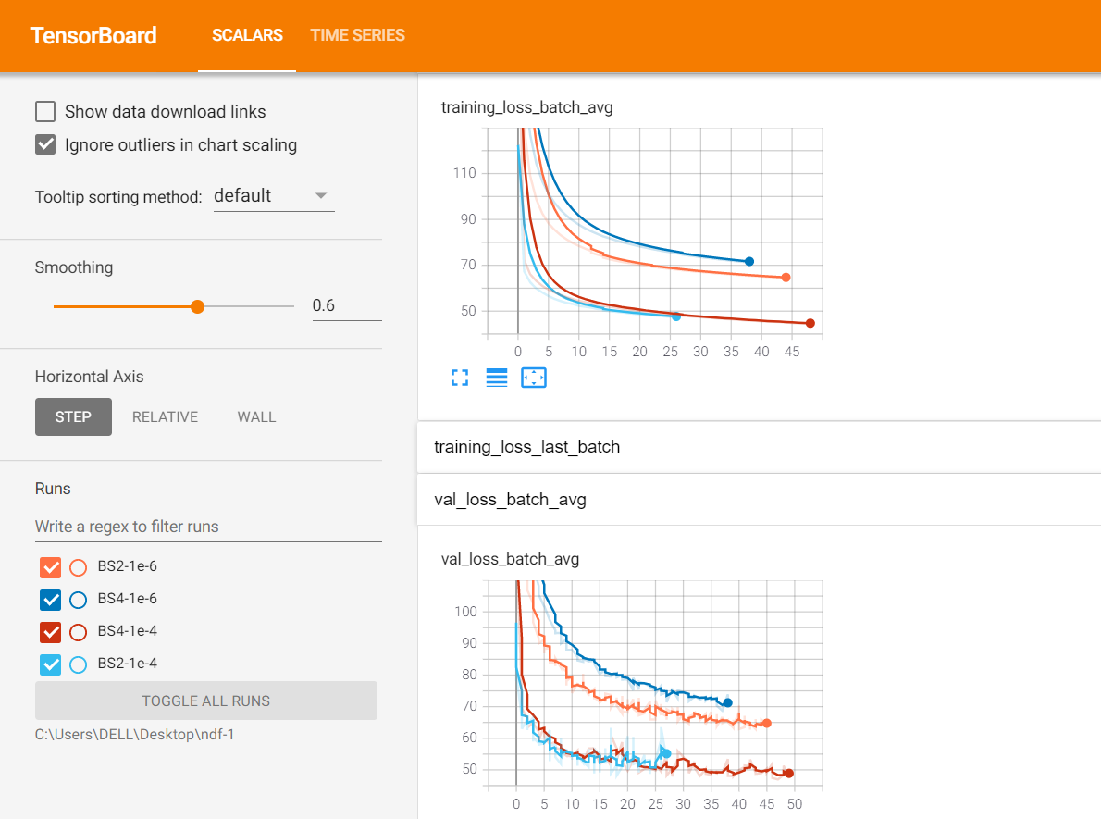
Previously, I have trained NDF on ShapeNet cars. And I found that the learning rate is 1e-6 in your code. In this case the convergence would be affected. It's too slow and the performance is not good. So I alter the learning rate to 1e-4, and that worked out as well as the pre-trained model.
Also the batch_size and the initialization will not affect the performance. Here are the loss value for different BS and lr:
Scenes:
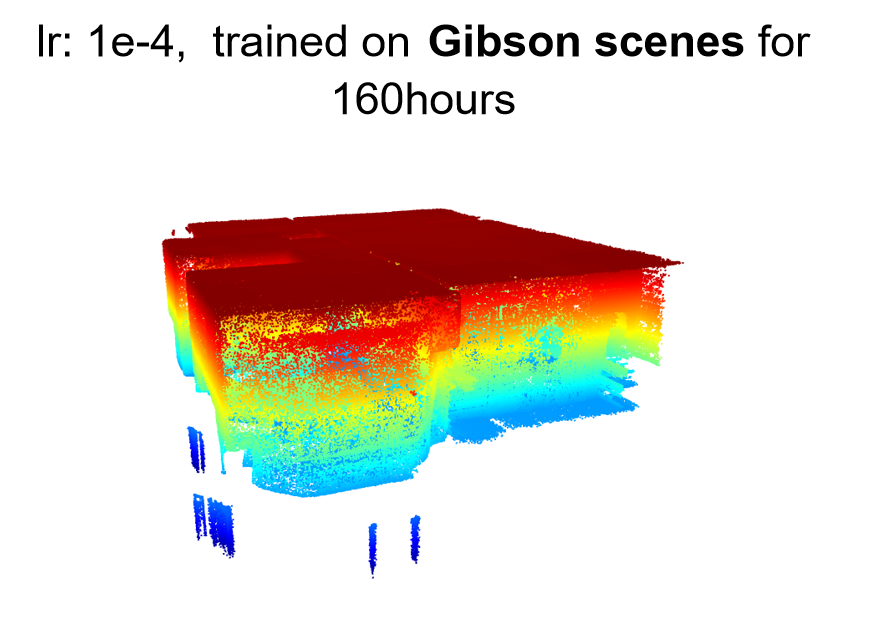
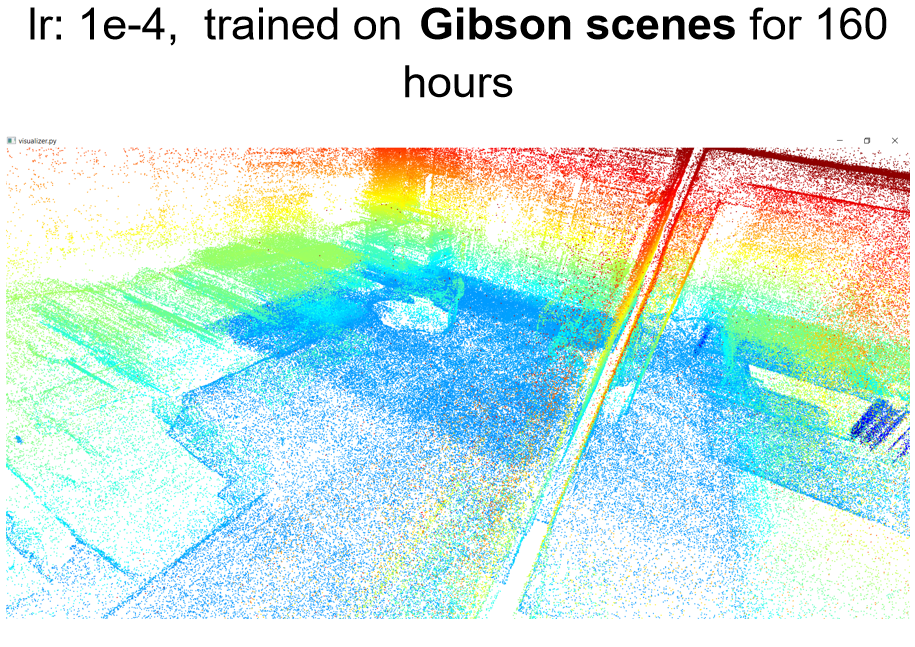
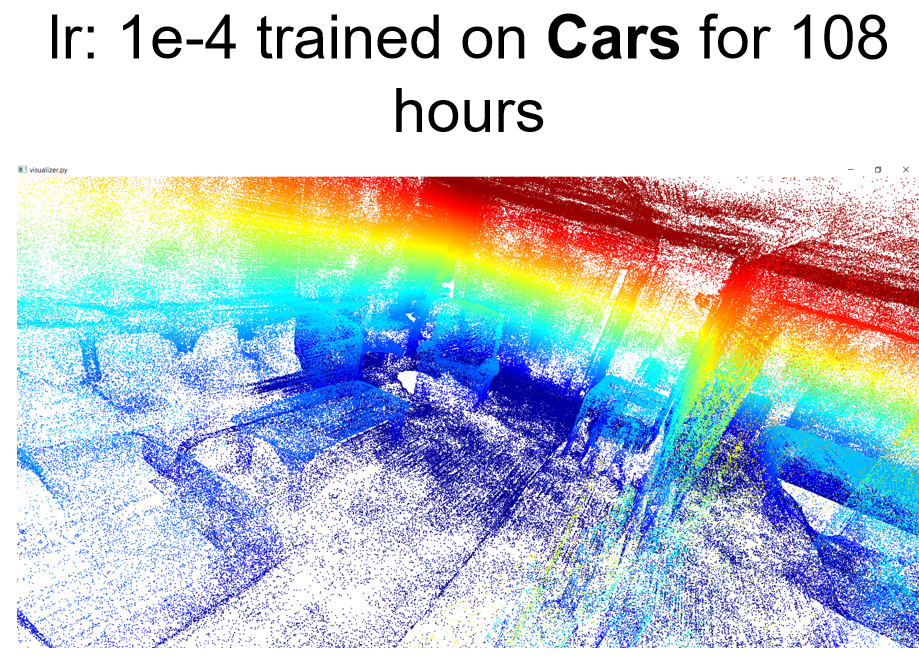
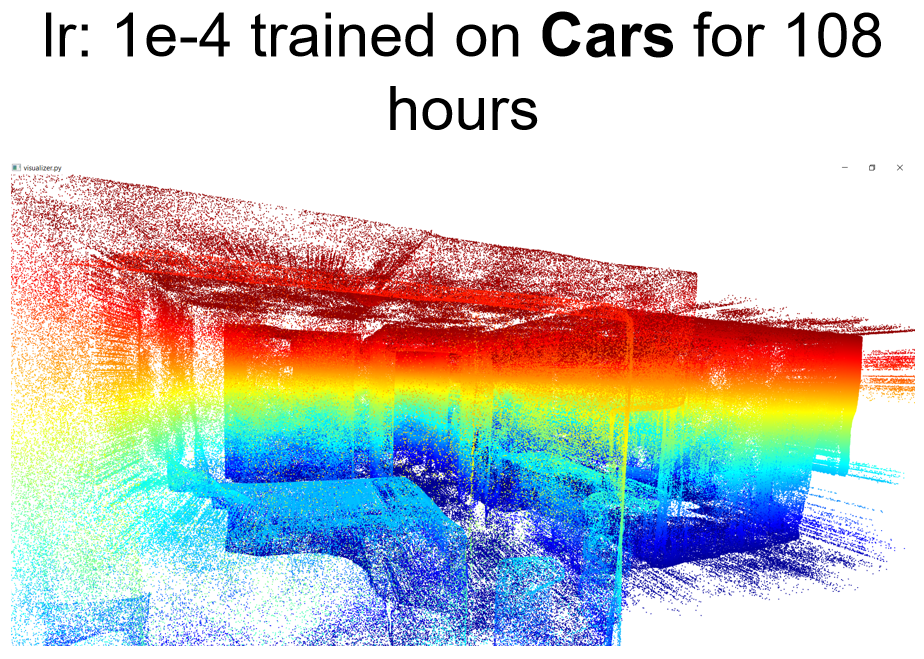
I also tried to use this learning rate 1e-4 for scenes. Looking at the loss value. It's also much better than before. However, the loss value is simply 3~4 times bigger than the loss of cars. I also tried to use your model pre-trained on cars to directly apply to scenes to generalize and it's even better than training on scenes. Please look at the example below:
Loss:
My training settings: Trained for 160 hours, batchsize1 (I think we can only use 1 because the point number in each cube is different), lr 1e-4. Other arguments remaining the same as cars(e.g. threshold). For preprocessing I was just using the script you released in NDF-1 repo and got many cubes for each scene. During training I just adapt the dataloader from Cars, and feed the split cubes into the network one by one (batchsize1), so the steps number in each epoch is the total cubes' number. For cars, the boundary sampled points number fed into the network is 50000, which is a half of the boundary sampled points(100000 sampled from mesh). So I also use 2 strategies to train on scenes, one is using all points in the cube as boundary points input(decoder input), the other one is using a half of them, but both of them did not work well:

Qualitative results:
Questions:
Q1. Do you remember how long it would take to train on scenes? Could you provide a pre-trained model if possible?
Q2. When do you plan to release the code for scenes? Or could you give us a brief introduction or guide line of how to train and test on scenes?
Q3. Have you changed arguments (e.g. thresholds) for training and testing on scenes (e.g. filter_val)? How do you train on scenes? Do you use a batch size 1 using the pre-processed data? Is there any other difference between the training on cars and scenes? (e.g. sample number?)
Q4. In Supplementary, What does this sentence in section 1 Hyperparameters - Network training part: 'To speed up training we initialized all networks with parameters gained by training on the full ShapeNet' means?
- I didn't see any code related to this. Instead, you just train from scratch. I also tried loading your pre-trained model on cars to continue train on scenes but the loss is bigger than the ones trained on scenes (0.02 and 0.003), which is really weird. Because obviously the generation result using cars' model is much better than the one trained on scenes but somehow the loss is much bigger. In the mean time, the performance would degenerate if I load the pre-trained model and continue to train on scenes. The best performing one now for me is still the model pre-trained on cars.
(updates: I found that during generation of each cubes' dense point cloud, the gradients produced by the model trained on scenes is not as precise as the one trained on cars. Though, for scenes' model, the df is generally smaller (more points with df < 0.03) at the beginning, after 7 refinement steps, only a small amount of them would have smaller df than before resulting in less points with df<0.009, so the generation will take much more steps and time, which I think is due to the inaccurate gradients because after we move the points along the gradients, the df should be smaller. On the other hand, the cars' model have less points with df<0.03 to begin with, but after 7 refinement steps, almost all of them can be correctly moved closer to the surface, resulting in more points with df<0.009.). I think something's gone wrong during training, it doesn't make sense. The loss is smaller, but the gradient is somehow more inaccurate. It seems like the ground truth might be incorrect, but the only adaption I made is switch pymesh to igl to compute gt_df. That's all.
Q5. Do you use different dense pc generation strategies for cars and scenes? Do you use the same script for both of them?
-
My method: I generate the scenes by first generating each cube using the same generation script(only decrease sample_num for each cube to ~50000) as cars and then based on the cube corner to stack them together.
-
However, The iteration for generating the dense point cloud sometimes will be infinite, because after each iteration no new points would fall within the 'filter_val' threshold (you keep those points with df < filter_val after each iteration) So I tried to increase the sample_num for the iteration to 200000 to increase the possibility of selecting correct points, but it did not improve the performance but only to some extent avoid the infinite loop described.
-
I think there might be 2 reasons:
- Some arguments for generation has changed for scenes (e.g. filter_val, sample_num..). But I think it's not the key, because I also tried use your model pre-trained on cars to directly perform on scenes with exactly the same generation settings , it looks even better than the model I trained on scenes.
- You might have a different training strategy or arguments I don't know.
Hope you can help me, thanks for your time!
Best,
Zhengdi
Hey Julian,
Thank you for your great work!
Cars:
Previously, I have trained NDF on ShapeNet cars. And I found that the learning rate is 1e-6 in your code. In this case the convergence would be affected. It's too slow and the performance is not good. So I alter the learning rate to 1e-4, and that worked out as well as the pre-trained model.
Also the batch_size and the initialization will not affect the performance. Here are the loss value for different BS and lr:

Scenes:
I also tried to use this learning rate 1e-4 for scenes. Looking at the loss value. It's also much better than before. However, the loss value is simply 3~4 times bigger than the loss of cars. I also tried to use your model pre-trained on cars to directly apply to scenes to generalize and it's even better than training on scenes. Please look at the example below:
Loss:
My training settings: Trained for 160 hours, batchsize1 (I think we can only use 1 because the point number in each cube is different), lr 1e-4. Other arguments remaining the same as cars(e.g. threshold). For preprocessing I was just using the script you released in NDF-1 repo and got many cubes for each scene. During training I just adapt the dataloader from Cars, and feed the split cubes into the network one by one (batchsize1), so the steps number in each epoch is the total cubes' number. For cars, the boundary sampled points number fed into the network is 50000, which is a half of the boundary sampled points(100000 sampled from mesh). So I also use 2 strategies to train on scenes, one is using all points in the cube as boundary points input(decoder input), the other one is using a half of them, but both of them did not work well:
Qualitative results:




Questions:
Q1. Do you remember how long it would take to train on scenes? Could you provide a pre-trained model if possible?
Q2. When do you plan to release the code for scenes? Or could you give us a brief introduction or guide line of how to train and test on scenes?
Q3. Have you changed arguments (e.g. thresholds) for training and testing on scenes (e.g. filter_val)? How do you train on scenes? Do you use a batch size 1 using the pre-processed data? Is there any other difference between the training on cars and scenes? (e.g. sample number?)
Q4. In Supplementary, What does this sentence in section 1 Hyperparameters - Network training part: 'To speed up training we initialized all networks with parameters gained by training on the full ShapeNet' means?
(updates: I found that during generation of each cubes' dense point cloud, the gradients produced by the model trained on scenes is not as precise as the one trained on cars. Though, for scenes' model, the df is generally smaller (more points with df < 0.03) at the beginning, after 7 refinement steps, only a small amount of them would have smaller df than before resulting in less points with df<0.009, so the generation will take much more steps and time, which I think is due to the inaccurate gradients because after we move the points along the gradients, the df should be smaller. On the other hand, the cars' model have less points with df<0.03 to begin with, but after 7 refinement steps, almost all of them can be correctly moved closer to the surface, resulting in more points with df<0.009.). I think something's gone wrong during training, it doesn't make sense. The loss is smaller, but the gradient is somehow more inaccurate. It seems like the ground truth might be incorrect, but the only adaption I made is switch pymesh to igl to compute gt_df. That's all.
Q5. Do you use different dense pc generation strategies for cars and scenes? Do you use the same script for both of them?
My method: I generate the scenes by first generating each cube using the same generation script(only decrease sample_num for each cube to ~50000) as cars and then based on the cube corner to stack them together.
However, The iteration for generating the dense point cloud sometimes will be infinite, because after each iteration no new points would fall within the 'filter_val' threshold (you keep those points with df < filter_val after each iteration) So I tried to increase the sample_num for the iteration to 200000 to increase the possibility of selecting correct points, but it did not improve the performance but only to some extent avoid the infinite loop described.
I think there might be 2 reasons:
Hope you can help me, thanks for your time!
Best,
Zhengdi