Given two lists of closed intervals, each list of intervals is pairwise disjoint and in sorted order.
Return the intersection of these two interval lists.
(Formally, a closed interval [a, b] (with a <= b) denotes the set of real numbers x with a <= x <= b. The intersection of two closed intervals is a set of real numbers that is either empty, or can be represented as a closed interval. For example, the intersection of [1, 3] and [2, 4] is [2, 3].)
Example 1:
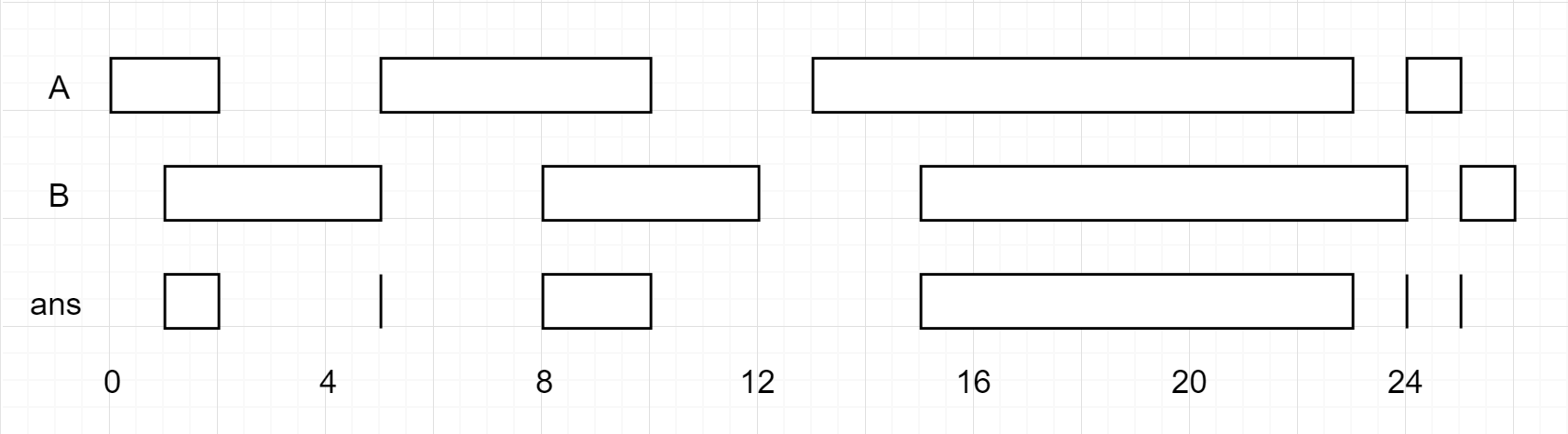
Input: A = [[0,2],[5,10],[13,23],[24,25]], B = [[1,5],[8,12],[15,24],[25,26]]
Output: [[1,2],[5,5],[8,10],[15,23],[24,24],[25,25]]
Reminder: The inputs and the desired output are lists of Interval objects, and not arrays or lists.
Note:
0 <= A.length < 10000 <= B.length < 10000 <= A[i].start, A[i].end, B[i].start, B[i].end < 10^9
Companies:
Uber, Facebook, DoorDash
Related Topics:
Two Pointers
Similar Questions:
// OJ: https://leetcode.com/problems/interval-list-intersections/
// Author: github.com/lzl124631x
// Time: O(M+N)
// Space: O(1)
class Solution {
public:
    vector<vector<int>> intervalIntersection(vector<vector<int>>& A, vector<vector<int>>& B) {
        int M = A.size(), N = B.size();
        vector<vector<int>> ans;
        for (int i = 0, j = 0; i < M && j < N; ) {
            int s = max(A[i][0], B[j][0]), e = min(A[i][1], B[j][1]);
            if (s <= e) ans.push_back({ s, e });
            if (A[i][1] < B[j][1]) ++i;
            else ++j;
        }
        return ans;
    }
};